
Vondran Legal® AI Legal Insights: Understanding the Copyright Risks for Businesses Deploying Artificial Intelligence
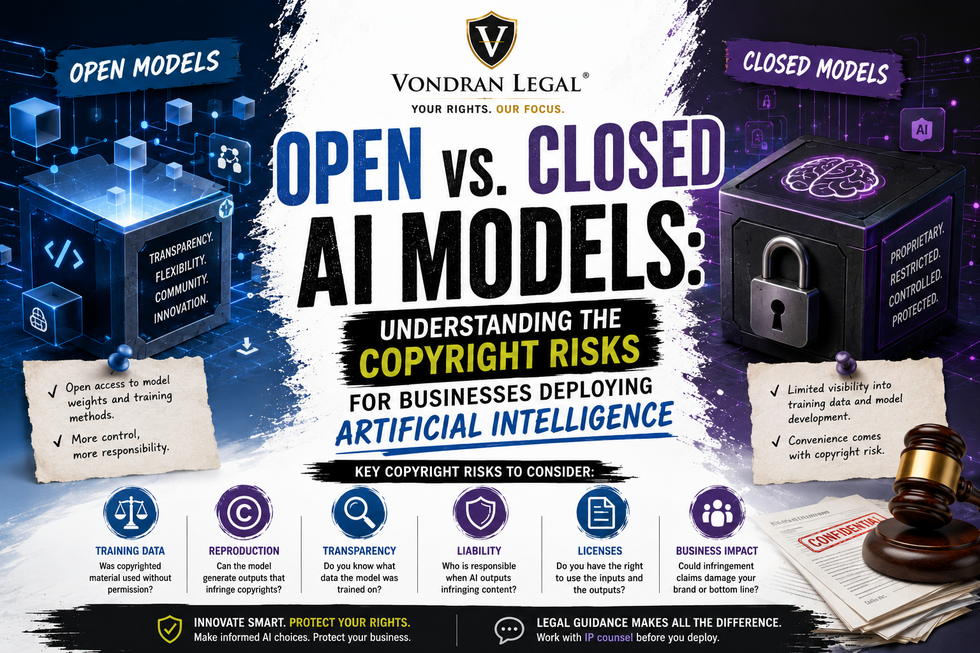
By Vondran Legal® – Nationwide Intellectual Property and AI Law Attorneys
Artificial intelligence has rapidly become an indispensable business tool. Companies are integrating AI into customer service, software development, legal research, marketing, engineering, healthcare, education, and nearly every other industry.
As organizations evaluate AI solutions, discussions often revolve around performance, cost, security, speed, and privacy.
Yet one important legal issue frequently receives far less attention:
What are the copyright risks associated with deploying AI, and who bears those risks?
That question has become increasingly important as businesses choose between proprietary ("closed") AI models offered by companies such as OpenAI, Anthropic, Google, and Microsoft, and the growing number of open-weight models released by organizations such as Meta, Mistral, DeepSeek, Moonshot AI, and others.
While no AI deployment is legally risk-free, understanding how copyright liability may differ between these approaches can help businesses make better-informed decisions.
What Is the Difference Between Open and Closed AI Models?
Although the terminology can be confusing, the distinction is relatively straightforward.
Closed (Proprietary) Models
Closed AI models remain under the control of the developer.
Users interact with the model through:
- a web interface,
- cloud platform,
- API,
- enterprise deployment, or
- software integration.
The customer never receives the actual trained model.
Instead, the provider controls:
- the model weights,
- infrastructure,
- updates,
- security patches,
- moderation systems,
- and content filters.
Examples include:
- OpenAI GPT models
- Anthropic Claude
- Google Gemini
- Microsoft Copilot
Open-Weight Models
Open-weight models operate differently.
Instead of simply providing API access, the developer releases the trained neural network weights that power the AI model.
Organizations may then:
- download the model,
- host it internally,
- customize it,
- fine-tune it,
- retrain portions of it,
- integrate proprietary data,
- or build entirely new commercial products.
Examples include:
- Llama
- Mistral
- DeepSeek
- Gemma
- Kimi K-series
- Qwen
For many organizations, this flexibility is extremely attractive.
However, greater control often comes with greater responsibility.
Why Copyright Matters More Than Ever
Artificial intelligence has triggered one of the largest waves of copyright litigation in modern history.
Authors, publishers, software developers, photographers, artists, musicians, news organizations, and media companies have filed dozens of lawsuits challenging how AI developers obtained training data and how AI systems generate outputs.
Although many of these lawsuits target AI developers rather than end users, businesses deploying AI should not assume they are insulated from intellectual property claims.
Instead, companies should understand several distinct categories of copyright risk.
Copyright Issue #1: AI Training Data
The first major legal question concerns how an AI model was trained.
Large language models require enormous amounts of information.
Training datasets may include:
- books
- newspapers
- academic journals
- source code
- photographs
- artwork
- websites
- music
- videos
Many copyright owners argue these works were copied without permission.
AI developers respond that model training constitutes fair use because the models learn statistical relationships rather than reproducing the underlying works.
Federal courts have begun issuing significant decisions, but the law remains unsettled. Recent cases involving Anthropic, Meta, OpenAI, and others have explored whether AI training on copyrighted works is sufficiently "transformative" under Section 107 of the Copyright Act. Courts have reached differing conclusions depending on the facts, particularly where allegedly pirated copies of works were involved.
For businesses deploying AI, an important practical question is whether the model developer has addressed these issues through licensing, litigation strategy, or contractual commitments.
Copyright Issue #2: AI Outputs
Another concern involves the content generated by AI.
Examples include:
- software code
- marketing materials
- legal documents
- product descriptions
- photographs
- artwork
- music
- educational materials
If an AI system reproduces protected expression that is substantially similar to copyrighted material, infringement claims may arise against the party publishing or commercially exploiting that output.
Most AI systems are designed to reduce verbatim copying.
However, no system is perfect.
Companies should implement human review procedures before publishing AI-generated materials.
Copyright Issue #3: Fine-Tuning Creates New Questions
Many businesses fine-tune open-weight models using their own proprietary datasets.
That process can dramatically improve performance.
It may also create additional legal questions.
For example:
- Did the organization possess rights to all fine-tuning materials?
- Were third-party licenses respected?
- Did contractual restrictions prohibit machine learning?
- Were confidential materials inadvertently incorporated?
These issues extend beyond copyright into trade secret law, software licensing, privacy law, and contract law.
Copyright Issue #4: AI Guardrails and Content Filters
One often-overlooked distinction between open and closed AI systems involves content moderation.
Closed AI providers continuously maintain:
- copyright filters,
- safety systems,
- abuse detection,
- output restrictions,
- monitoring,
- and security updates.
Open-weight deployments generally place those responsibilities on the organization operating the model.
If safeguards are removed, weakened, or improperly configured, businesses may increase their exposure to infringement claims or other legal risks.
Copyright Issue #5: Contractual Indemnification
Perhaps the most significant practical difference between many enterprise AI offerings is contractual risk allocation.
Many proprietary AI providers offer enterprise customers some level of intellectual property indemnification.
Although these provisions vary considerably—and often contain important exclusions—they may provide contractual protection if certain copyright claims arise from authorized use of the provider's services.
By contrast, many open-weight licenses, including MIT-style and Apache 2.0 licenses, broadly disclaim warranties and liability.
This does not necessarily mean an open-weight model creates more copyright infringement.
It does mean the organization deploying the model is often assuming much more of the legal risk itself.
Recent AI Copyright Cases Every Business Should Know
Although AI copyright law continues to evolve, several cases have become particularly significant.
New York Times v. OpenAI and Microsoft
One of the most closely watched cases involves allegations that copyrighted news articles were used to train AI systems and that AI outputs may compete with original journalism.
The litigation remains ongoing and may significantly influence future AI licensing practices.
Getty Images v. Stability AI
Getty alleges that millions of copyrighted photographs were copied to train image-generation models without authorization.
The case raises important questions regarding image datasets, licensing, and derivative outputs.
Andersen v. Stability AI
Artists allege unauthorized use of copyrighted artwork to train image generation systems.
The litigation addresses how visual art may be incorporated into generative AI models and whether resulting outputs infringe artist rights.
Bartz v. Anthropic
The Anthropic litigation has produced some of the first substantive judicial analysis of AI training under the fair use doctrine. The dispute also highlighted the distinction between training on lawfully acquired works and allegations involving unauthorized or pirated copies. The matter ultimately resulted in a landmark settlement while leaving broader legal questions for future courts.
Open AI vs. Closed AI: Which Is Safer?
There is no universal answer.
Instead, businesses should evaluate multiple factors, including:
- intellectual property risk
- privacy requirements
- cybersecurity
- cost
- customization
- vendor support
- contractual protections
- regulatory compliance
- governance policies
For some organizations, an enterprise hosted model with contractual protections may be the better choice.
For others, an internally deployed open-weight model may provide greater flexibility while requiring stronger internal legal and technical governance.
Best Practices Before Deploying AI
Organizations should consider conducting an AI legal risk assessment before enterprise deployment.
Questions worth asking include:
- What license governs the model?
- Does the provider offer indemnification?
- What limitations appear in the Terms of Service?
- What copyrighted materials were used for fine-tuning?
- How are outputs reviewed?
- Are employees trained regarding AI use?
- Does the company have an AI governance policy?
- Are confidential materials protected?
- Are third-party software licenses compatible with AI training?
- Are there contractual restrictions on machine learning?
These issues often intersect with copyright law, contract law, trade secret protection, software licensing, and privacy compliance.
How Vondran Legal Can Help
Artificial intelligence is rapidly changing intellectual property law.
At Vondran Legal®, we advise businesses, software developers, startups, content creators, technology companies, and enterprise clients on the evolving legal issues surrounding generative AI.
Our firm assists clients with:
- AI copyright counseling
- AI governance policies
- AI deployment risk assessments
- software licensing reviews
- open-source and open-weight license analysis
- copyright infringement defense
- fair use opinions
- DMCA compliance
- AI vendor contract review
- enterprise indemnification analysis
- software audit defense
- API and SDK licensing issues
- intellectual property strategy for AI-enabled products
- copyright registration and enforcement
- trade secret protection
- AI-related commercial litigation
Whether your organization is deploying a proprietary AI platform, hosting an open-weight model internally, or developing its own AI-powered products, proactive legal planning can substantially reduce future litigation risk.
Contact an AI Copyright Attorney
Artificial intelligence is transforming virtually every industry, but the law is still catching up. Businesses that take a proactive approach to AI governance, intellectual property compliance, and contract review will be better positioned to capitalize on AI while minimizing legal exposure.
If your company is evaluating AI technologies, developing AI-enabled products, or responding to copyright concerns involving artificial intelligence, Vondran Legal can help you understand the legal landscape and develop practical strategies for managing risk.
Schedule a confidential consultation today to discuss your AI, copyright, software licensing, or intellectual property questions.

