
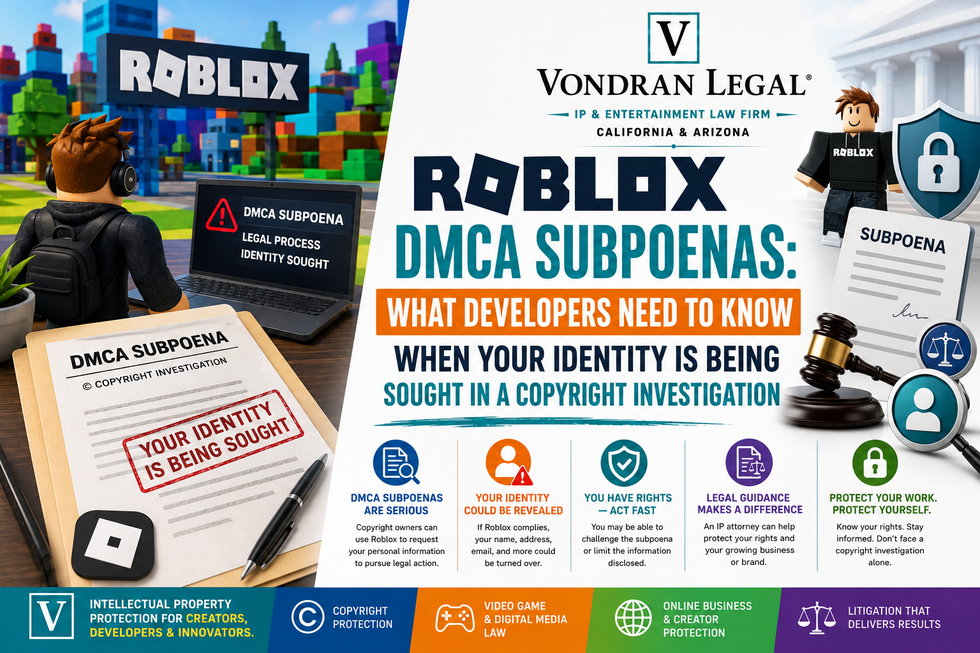
Roblox DMCA Subpoenas: What Developers Need to Know When Your Identity Is Being Sought in a Copyright Investigation
Keywords: Roblox DMCA subpoena lawyer, Roblox copyright attorney, DMCA subpoena Roblox, 17 U.S.C. § 512(h), Roblox copyright infringement, Roblox game copied, video game copyright lawyer, game developer legal defense, subpoena to identify Roblox developer, DMCA defense attorney
Introduction
Imagine waking up to an email from Roblox informing you that a copyright owner has obtained—or is attempting to obtain—a DMCA subpoena seeking your identity.
You have not been sued.
You have not received a demand letter.
But someone is asking a federal court to compel Roblox to disclose your name, email address, and mailing address because they believe your game infringes their copyrighted work.
This situation is becoming increasingly common as Roblox, Unreal Engine, Steam, Epic Games, and other platforms continue to grow into billion-dollar ecosystems. Independent developers, small studios, and hobbyists now compete in a marketplace where allegations of copying, cloning, or "reskinning" another game can quickly escalate into legal proceedings.
At Vondran Legal®, we represent creators, developers, software companies, and online businesses in copyright disputes nationwide. If you have received notice of a DMCA subpoena or a copyright complaint involving your game, early legal advice can make a significant difference.
What Is a DMCA Subpoena?
A DMCA subpoena is authorized by 17 U.S.C. § 512(h).
Unlike a traditional lawsuit, a copyright owner can ask a federal court clerk to issue a subpoena directing an online service provider to identify an alleged infringer.
Rather than filing suit against "John Doe," the copyright owner first seeks identifying information from the platform hosting the content.
This information may include:
- Name
- Email address
- Mailing address
- Account information
- Other identifying records maintained by the service provider
Once that information is obtained, the copyright owner may decide whether to:
- Send a settlement demand
- Open negotiations
- File a federal copyright lawsuit
- Decide not to pursue the matter
A Recent Example: Roblox Copyright Dispute
A recent federal filing illustrates how this process works.
A game developer alleged that another Roblox game copied numerous creative elements of its popular game.
According to the filing, the allegedly infringing game copied numerous expressive elements including:
- artwork
- maps
- user interface
- menus
- game assets
- layouts
- level designs
- aesthetics
- colors
- various visual elements
The copyright owner argued that the accused developer merely "re-skinned" the original game in an attempt to disguise copying while preserving the underlying creative expression.
The filing included numerous side-by-side screenshots comparing:
- game environments
- streets
- buildings
- menus
- inventory systems
- collectible items
- interface layouts
- icons
- weapons
- reward systems
The stated purpose of the subpoena was not to obtain damages—it was simply to identify the developer behind the allegedly infringing Roblox experience so the copyright owner could pursue its legal rights.
Why Would Roblox Notify Me?
Many online service providers notify account holders when legal process seeks disclosure of their information.
This gives developers an opportunity to:
- consult counsel
- preserve evidence
- evaluate defenses
- prepare for possible litigation
While the subpoena is directed to Roblox—not necessarily to you—it is often your first indication that a copyright owner intends to pursue the matter further.
Does Receiving a DMCA Subpoena Mean I Have Lost?
Absolutely not.
A DMCA subpoena is not a finding of infringement.
It simply allows the copyright owner to identify the person or company operating the account.
The copyright owner must still prove infringement if litigation is later filed.
What Must the Copyright Owner Ultimately Prove?
Copyright law protects original expression.
It does not protect:
- ideas
- concepts
- methods of operation
- systems
- game mechanics
- rules
- general themes
Instead, courts focus on whether the defendant copied protected expression.
In video game cases, courts generally ask:
- Does the plaintiff own a valid copyright?
- Did the defendant copy protected expression?
- Are the protectable elements substantially similar?
Simply creating another city game, fighting game, survival game, or role-playing game does not automatically create copyright liability.
What Parts of a Video Game Are Potentially Protectable?
Depending on the facts, copyright protection may extend to:
Artwork
- character artwork
- textures
- illustrations
- icons
- background art
Audio
- music
- sound effects
- voice recordings
Story Elements
- dialogue
- original narratives
- scripted events
Original Characters
Certain highly distinctive characters may receive copyright protection.
Examples outside the Roblox context include:
- Mario
- Sonic
- Lara Croft
- Master Chief
- Pac-Man
Not every game character qualifies. Courts generally look at whether the character is sufficiently distinctive and consistently delineated.
Original 3D Models
Custom models created by artists may receive copyright protection.
Original Animations
Unique movement sequences, cut scenes, and animated works may also be protected.
What Is Generally Not Protected?
Many important aspects of games remain free for everyone to use.
These include:
Ideas
No one owns the idea of:
- racing
- collecting coins
- building cities
- fighting zombies
- role-playing
- fashion competitions
Game Mechanics
Mechanics are generally not protected by copyright.
Examples include:
- leveling systems
- health bars
- experience points
- inventory systems
- crafting
- combat mechanics
Patent law—not copyright—may protect certain innovative gameplay mechanics.
Standard User Interface Features
Many interface elements are functional rather than expressive.
Examples include:
- health meters
- mini maps
- inventory slots
- settings menus
- chat windows
Scenes à Faire
Courts exclude standard or indispensable features associated with a genre.
For example, a modern city game will naturally include:
- roads
- sidewalks
- buildings
- traffic lights
- parks
- hospitals
- police stations
These commonplace elements generally cannot be monopolized.
The Idea/Expression Dichotomy
One of the most important principles in copyright law is the idea/expression dichotomy.
You may borrow an idea.
You may not copy someone else's original expression of that idea.
For example:
Idea:
A multiplayer city where players complete quests.
Expression:
Specific artwork, textures, character models, custom icons, dialogue, animations, and unique artistic presentation.
That distinction often becomes the centerpiece of video game litigation.
Common Defenses in Video Game Copyright Cases
Every case is different, but common defenses may include:
Independent Creation
Perhaps the strongest defense.
If your team independently developed the game without copying the plaintiff's protected expression, there is no infringement even if similarities exist.
Lack of Substantial Similarity
The plaintiff must prove unlawful similarity of protected expression—not merely overall resemblance.
Scenes à Faire
Standard genre conventions cannot ordinarily be monopolized.
Functional Elements
Many interface components are dictated by function rather than artistic creativity.
Licensed Third-Party Assets
Many developers purchase:
- Roblox Marketplace assets
- Unity Asset Store content
- Unreal Marketplace assets
- TurboSquid models
- Adobe Stock graphics
Proper licensing may defeat portions of an infringement claim.
Public Domain Material
Some materials may not be protected at all.
Fair Use
Although less common in competing commercial games, fair use may arise in:
- parody
- commentary
- criticism
- education
What Should You Do Immediately After Receiving a DMCA Subpoena?
Do not panic.
Instead:
Preserve Everything
Do not delete:
- source code
- Git repositories
- Roblox Studio files
- Blender projects
- Photoshop files
- Discord development chats
- emails
- invoices
- Marketplace receipts
Evidence preservation is critical.
Document Development History
Identify:
- who developed the game
- when development began
- which assets were created internally
- which assets were licensed
- contractors involved
- design changes over time
Avoid Admissions
Do not send emotional emails to the complaining party.
Do not admit copying.
Do not speculate.
Consult Experienced Counsel
Early legal advice often prevents costly mistakes.
Can You Stop the Subpoena?
Sometimes developers ask whether they should file a motion to quash.
The answer depends on the circumstances.
Because the subpoena is typically directed to the online service provider—not the developer—motions to quash often face significant procedural and standing hurdles. While there may be cases in which challenging the subpoena is appropriate, many disputes are better addressed by preparing for the next phase of the matter rather than spending substantial resources trying to prevent disclosure.
Every case should be evaluated individually.
Our Pre-Litigation DMCA Defense Services
At Vondran Legal®, we offer proactive representation designed to put developers in the strongest possible position before a demand letter or lawsuit arrives.
Our services may include:
- Review of the DMCA subpoena and supporting materials
- Legal assessment of copyright exposure
- Comparison of the competing games
- Analysis of potentially protectable versus unprotectable elements
- Review of development history
- Source material review
- Evidence preservation guidance
- Independent creation analysis
- Review of Marketplace asset licenses
- Communication with opposing counsel
- Written legal risk assessment
- Litigation readiness planning
Rather than simply waiting for the next letter, we help clients prepare an informed strategy based on the specific facts of their case.
Which Companies Use DMCA Subpoenas?
There is no comprehensive public database of all § 512(h) subpoenas, but companies in content-heavy industries have used them over the years to identify anonymous online users. Examples include:
- major motion picture studios
- record labels
- television networks
- software companies
- video game publishers
- photography agencies
- media companies
- independent game developers
- publishers protecting digital assets
Technology platforms that frequently receive copyright-related subpoenas or legal process include:
- Roblox
- YouTube
- GitHub
- Discord
- Dropbox
- Meta (Facebook and Instagram)
- X (formerly Twitter)
- Etsy
- Shopify
- Steam (Valve)
- Epic Games
- Amazon Web Services
Whether a particular company can or will disclose information depends on the applicable law, the nature of the request, the platform's policies, and any available legal objections.
Frequently Asked Questions
Am I being sued?
Not necessarily. A DMCA subpoena is often the first step in identifying an alleged infringer before a lawsuit is filed.
Should I delete my game?
Generally, no. Deleting evidence after receiving notice of a potential dispute may create additional legal issues. Speak with counsel before making significant changes.
What if I purchased all of my assets?
Asset licenses may be an important defense, but they do not automatically resolve every infringement claim. A careful review is necessary.
Can similarities alone prove infringement?
No. Copyright law protects original expression, not general ideas, genres, or common game mechanics. Courts analyze whether the allegedly copied elements are actually protected and whether those protected elements are substantially similar.
Contact an Experienced Roblox Copyright Lawyer
If you have received a DMCA subpoena, copyright notice, or pre-litigation demand involving Roblox or another gaming platform, obtaining legal advice early may significantly improve your position.
At Vondran Legal®, we represent creators, software companies, developers, and online businesses in complex copyright disputes throughout the United States. Whether you are accused of copying a game, using third-party assets, or infringing another developer's work, we can help you evaluate the claims, preserve critical evidence, assess available defenses, and prepare a thoughtful strategy before litigation begins.
Contact Vondran Legal® today to schedule a confidential consultation and learn how we can help protect your creative work and your business.

