
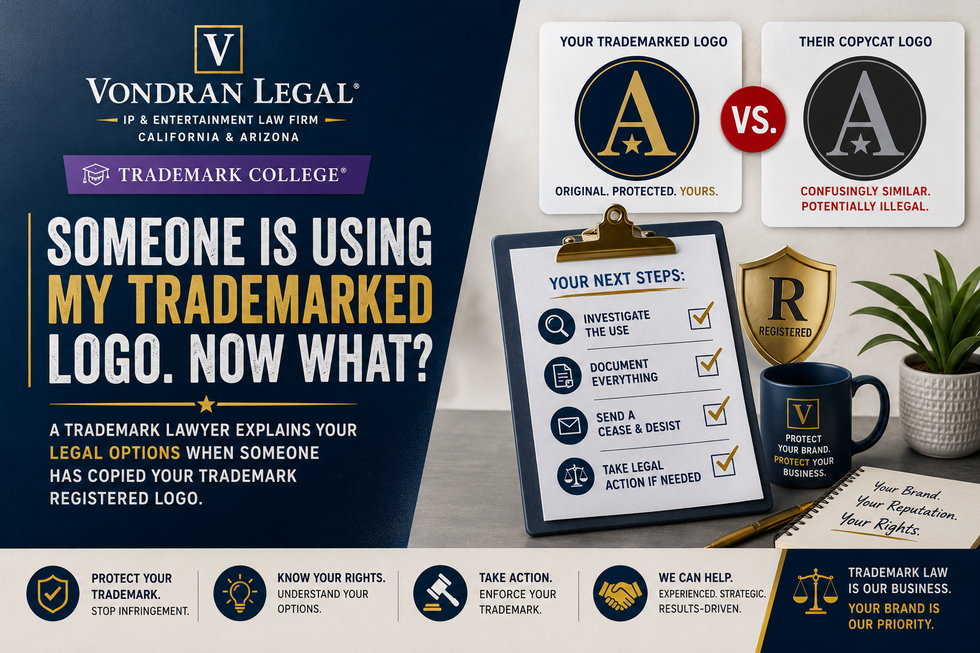
Vondran Legal® Trademark College® A Trademark Lawyer Explains Your Legal Options when someone has copied your trademark registered logo.
Keywords: trademark infringement lawyer, someone copied my logo, trademark infringement lawsuit, registered trademark rights, Lanham Act, likelihood of confusion, trademark attorney fees, cease and desist letter, logo infringement attorney, federal trademark lawyer
Introduction
You spent years building your brand. You invested in a professionally designed logo, obtained a federal trademark registration from the United States Patent and Trademark Office (USPTO), and built goodwill with your customers.
Then one day you discover another company using a logo that looks remarkably similar to yours.
What can you do?
Do you immediately file a lawsuit?
Send a cease-and-desist letter?
Demand they stop using it?
Or is it possible that both companies can legally coexist?
The answer depends on many factors. Trademark infringement cases are highly fact-specific, and two logos that appear similar at first glance may not necessarily constitute infringement under the Lanham Act.
This article explains what trademark owners need to know, how courts analyze infringement claims, what defenses commonly arise, and when attorney's fees may be available.
What Does a Trademark Protect?
Unlike copyright law, which protects creative expression, trademark law protects consumers from confusion regarding the source of goods or services.
A trademark identifies:
- the source of products
- the source of services
- brand identity
- reputation
- goodwill
Examples include:
- company names
- logos
- slogans
- product packaging
- colors (in limited situations)
- sounds
- trade dress
A registered logo can become one of a company's most valuable business assets.
Does Federal Registration Matter?
Absolutely.
Federal registration on the Principal Register provides significant legal advantages.
Among other things, registration creates presumptions that:
- the mark is valid;
- the registrant owns the mark; and
- the registrant has the exclusive right to use the registered mark nationwide for the goods or services identified in the registration, subject to certain defenses and prior rights.
Registration also provides:
- nationwide constructive notice of your claim;
- the ability to sue in federal court;
- access to additional remedies in appropriate cases;
- the potential to record your registration with U.S. Customs to help combat counterfeit imports.
While registration is not always required to sue for infringement, it substantially strengthens a trademark owner's position.
I Found Someone Using My Logo. What Should I Do First?
Many business owners immediately threaten litigation.
That is not always the best first step.
Instead, consider working through the following checklist.
1. Preserve Evidence
Capture:
- screenshots
- webpages
- advertisements
- social media posts
- business cards
- brochures
- product packaging
- dates of discovery
Evidence can disappear quickly.
2. Determine When They Started Using the Logo
This is critical.
Trademark rights generally arise from use, not registration.
A business that began using a logo before you—even if it never registered the mark—may possess superior common-law rights in certain geographic areas.
Priority is often one of the first issues examined during trademark litigation.
3. Compare the Goods or Services
A similar logo does not automatically create infringement.
Ask:
- Are they selling similar products?
- Are they offering similar services?
- Do customers overlap?
- Are both companies competing for the same consumers?
The closer the marketplace relationship, the greater the likelihood of confusion.
4. Compare the Logos as Consumers See Them
Courts do not compare logos under a microscope.
Instead, they ask how ordinary consumers encounter the marks in the marketplace.
Relevant considerations include:
- overall appearance
- colors
- fonts
- design
- commercial impression
- surrounding branding
- accompanying company names
The focus is the overall impression—not isolated details.
What Is "Likelihood of Confusion"?
The central issue in most trademark infringement cases is whether consumers are likely to become confused regarding:
- source
- sponsorship
- affiliation
- endorsement
Actual confusion is helpful evidence, but it is not required.
The question is whether confusion is likely, not whether it has already occurred.
The Sleekcraft Factors
In the Ninth Circuit (covering California and several western states), courts commonly analyze likelihood of confusion using the Sleekcraft factors from AMF Inc. v. Sleekcraft Boats, 599 F.2d 341 (9th Cir. 1979).
These factors include:
1. Strength of the Plaintiff's Mark
Courts examine:
- inherent distinctiveness
- marketplace recognition
- advertising
- reputation
- consumer recognition
Strong marks receive broader protection.
Weak marks receive narrower protection.
2. Similarity of the Marks
Courts compare:
- appearance
- sound
- meaning
- commercial impression
The comparison considers the marks as consumers actually encounter them.
3. Similarity of Goods or Services
Are both companies:
- law firms?
- software companies?
- restaurants?
- clothing brands?
Greater similarity generally increases confusion.
4. Marketing Channels Used
Do both companies advertise through:
- trade shows
- Amazon
- Etsy
- YouTube
- television
Shared marketing channels may increase confusion.
5. Degree of Consumer Care
Consumers purchasing:
- luxury products
- legal services
- medical services
- enterprise software
often exercise greater care than impulse buyers.
Sophisticated purchasers may be less likely to become confused.
6. Defendant's Intent
Did the defendant intentionally attempt to:
- imitate the logo?
- capitalize on goodwill?
- create association?
- divert customers?
Intentional copying can significantly strengthen an infringement case.
7. Evidence of Actual Confusion
Examples include:
- mistaken phone calls
- mistaken emails
- customer complaints
- misdirected payments
- online reviews intended for the wrong company
Although not required, actual confusion can be compelling evidence.
8. Likelihood of Expansion
Will either company likely expand into the other's market?
Future competition can influence the analysis.
Other Circuits Use Different Tests
Not every federal circuit applies the Sleekcraft factors.
For example:
- Second Circuit: Polaroid factors
- Sixth Circuit: Frisch's factors
- Federal Circuit: various trademark precedents
- Eleventh Circuit: similar multifactor analysis
Although the wording varies, courts generally evaluate the same core considerations:
- similarity
- strength
- marketplace overlap
- consumer perception
- evidence of confusion
Common Defenses to Trademark Infringement
Not every infringement claim succeeds.
Common defenses include:
Prior Use
A defendant may have started using its mark before the plaintiff.
Priority often determines ownership rights.
No Likelihood of Confusion
The defendant may argue:
- different consumers
- different industries
- different branding
- different marketplace impressions
Weak Mark
Some trademarks receive relatively narrow protection because they are:
- descriptive
- highly diluted
- composed of common initials
- widely used by third parties
Fair Use
Certain descriptive uses may qualify as classic fair use.
Nominative Fair Use
Businesses may use another's trademark when accurately referring to the trademark owner's products or services under limited circumstances.
Laches
Waiting many years before asserting trademark rights may limit available remedies in appropriate cases.
Acquiescence or Consent
Prior permission or coexistence agreements can affect enforcement.
Should You Send a Cease-and-Desist Letter?
Often, yes.
A well-drafted cease-and-desist letter may:
- stop infringement quickly;
- preserve business relationships;
- avoid litigation expenses;
- demonstrate good-faith efforts to resolve the dispute.
However, poorly drafted demand letters sometimes provoke declaratory judgment lawsuits or escalate the conflict unnecessarily.
An experienced trademark attorney can help evaluate the strategic risks before sending a demand.
When Is Litigation Appropriate?
Trademark litigation may become necessary when:
- negotiations fail;
- infringement is ongoing;
- significant customer confusion exists;
- substantial damages are occurring;
- counterfeit goods are involved;
- goodwill is being harmed.
Federal courts can issue injunctions ordering an infringer to stop using a confusingly similar mark.
What Remedies Are Available?
Successful trademark plaintiffs may seek:
- preliminary injunctions;
- permanent injunctions;
- destruction of infringing materials;
- defendant's profits (in appropriate cases);
- actual damages;
- corrective advertising damages where supported;
- costs of suit;
- in exceptional cases, attorney's fees.
Can You Recover Attorney's Fees?
Yes—but not automatically.
Section 35(a) of the Lanham Act, 15 U.S.C. § 1117(a), provides that:
"The court in exceptional cases may award reasonable attorney fees to the prevailing party."
The key phrase is "exceptional cases."
Following the U.S. Supreme Court's decision in Octane Fitness, LLC v. ICON Health & Fitness, Inc., 572 U.S. 545 (2014), many federal courts have applied a flexible, totality-of-the-circumstances approach in determining whether a trademark case is "exceptional."
Factors may include:
- willful infringement;
- bad-faith litigation conduct;
- objectively unreasonable legal positions;
- frivolous claims or defenses;
- abusive litigation tactics;
- repeated misconduct.
Prevailing defendants, as well as prevailing plaintiffs, may seek attorney's fees in appropriate circumstances.
Does Someone Have to Copy Your Logo Exactly?
No.
Trademark law protects against confusingly similar uses.
Small changes involving:
- color
- font
- spacing
- borders
- geometric design
may not eliminate infringement if the overall commercial impression remains confusingly similar.
Conversely, even logos sharing common elements—such as a single letter or geometric shape—may coexist lawfully if the overall marketplace impression is sufficiently different.
Practical Tips for Trademark Owners
If you believe someone copied your logo:
- Gather evidence before contacting the other party.
- Confirm your registration status.
- Investigate the other party's first use.
- Assess marketplace overlap.
- Evaluate actual customer confusion.
- Consider whether coexistence is possible.
- Consult an experienced trademark attorney before initiating litigation.
Why Experienced Trademark Counsel Matters
Trademark disputes often involve much more than comparing two logos side by side.
A skilled attorney can evaluate:
- priority of use;
- common-law rights;
- federal registrations;
- marketplace evidence;
- likelihood-of-confusion factors;
- defenses;
- litigation risk;
- settlement opportunities;
- coexistence agreements.
Many disputes can be resolved through careful negotiation, while others require aggressive federal litigation to protect valuable brand assets.
Contact Vondran Legal®
If another company is using a logo or trademark that you believe infringes your rights—or if you have been accused of trademark infringement—Vondran Legal® can help evaluate your options.
Our firm represents businesses, entrepreneurs, content creators, software companies, and professionals in trademark enforcement, trademark defense, federal litigation, cease-and-desist matters, licensing, and brand protection.
A prompt legal evaluation can help you understand your rights, assess litigation risk, and develop a strategy tailored to your business objectives.
Contact Vondran Legal® to schedule a confidential consultation and protect the goodwill you have worked hard to build.

