
Trademark Law in the Gaming Industry: Vondran Legal® Trademark College
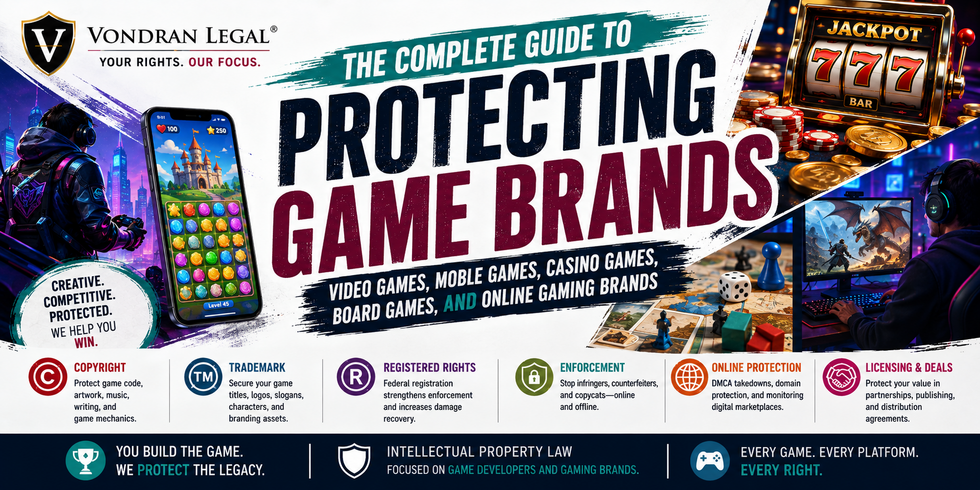
By Attorney Steve® | Vondran Legal®
The global gaming industry is worth hundreds of billions of dollars annually, spanning video games, mobile apps, online casinos, esports, tabletop games, collectible card games, virtual reality experiences, and social gaming. While developers often focus on coding, artwork, gameplay, and monetization, one of the most valuable assets they create is their brand.
A game's title, logo, characters, user interface, and distinctive look often become just as valuable as the game itself. Protecting those assets through trademark law can mean the difference between building a lasting franchise and losing years of goodwill to competitors, copycats, or cybersquatters.
Whether you are developing the next hit indie game, launching a mobile app, designing a casino slot machine, or creating an online gaming platform, trademark law should be part of your legal strategy from day one.
Why Trademarks Matter in Gaming
Most people immediately think of copyright when discussing games.
Copyright certainly protects many aspects of a game, including:
- Source code
- Artwork
- Music
- Character artwork
- Storylines
- Dialogue
- Animation
However, copyright does not protect your brand.
That is where trademark law comes in.
A trademark identifies the source of goods or services. It tells consumers:
"This game came from this developer."
Think about instantly recognizable brands like:
- Nintendo®
- PlayStation®
- Xbox®
- Blizzard®
- Valve®
- Riot Games®
- Epic Games®
- Pokémon®
- Minecraft®
- Monopoly®
The tremendous commercial value of these names comes largely from trademark protection.
What Can Be Trademarked?
Gaming companies are often surprised by how many aspects of their business may qualify for trademark protection.
Potential trademarks include:
- Studio names
- Publisher names
- Game titles
- Expansion pack names
- Character names
- Tournament names
- League names
- Logos
- Icons
- Slogans
- Taglines
- Mascots
- Download platforms
- Subscription services
- Streaming services
- Software platforms
Even recurring names for downloadable content (DLC), gaming conventions, esports events, and gaming podcasts may qualify.
Trademark Protection Across Every Gaming Sector
Trademark law affects virtually every corner of the gaming industry.
Video Games
AAA studios invest millions creating recognizable franchises.
Examples include:
- The Legend of Zelda
- Halo
- Call of Duty
- Grand Theft Auto
- God of War
The title itself often becomes the company's most valuable intellectual property.
Mobile Games
The App Store and Google Play contain millions of applications.
Without trademark protection, developers risk:
- copycat titles
- confusingly similar icons
- knockoff publishers
- fake update apps
Trademark registration can become an important enforcement tool when submitting takedown requests.
Casino Games
Trademark issues frequently arise involving:
- slot machine titles
- progressive jackpot brands
- table game names
- casino loyalty programs
- gaming machine manufacturers
Casino suppliers also rely heavily on distinctive cabinet designs, logos, and trade dress to distinguish their products.
Online Gaming Platforms
Online gaming companies often own valuable trademarks covering:
- gaming portals
- tournament platforms
- fantasy sports
- esports organizations
- streaming services
- wagering platforms
As online gaming expands globally, trademark protection becomes increasingly important.
Board Games
Board game publishers commonly trademark:
- game titles
- expansion names
- logos
- publisher names
- organized play programs
Although game mechanics generally cannot be protected through trademark law, the branding surrounding the game often can.
Card Games
Trading card games rely heavily upon:
- game titles
- expansion sets
- tournament brands
- league names
Strong trademark portfolios often become critical licensing assets.
Tabletop Roleplaying Games
RPG publishers frequently trademark:
- campaign settings
- product lines
- publisher brands
- adventure series
These trademarks help consumers distinguish authentic products from unofficial supplements.
Virtual Reality Games
VR developers increasingly build brands around immersive experiences.
Trademark protection extends beyond the software itself to:
- VR platforms
- headset ecosystems
- branded experiences
- online marketplaces
Esports
Modern esports involve enormous trademark portfolios.
Organizations protect:
- team names
- league brands
- tournament names
- event logos
- streaming brands
- merchandise
Trademark Clearance: The First Step Every Developer Should Take
One of the biggest mistakes developers make is falling in love with a game title before determining whether it is legally available.
Before investing in:
- logos
- marketing
- websites
- domains
- merchandise
- Steam pages
- trailers
you should conduct a trademark clearance search.
A proper clearance search evaluates:
- existing federal registrations
- pending applications
- state registrations
- common-law uses
- domain registrations
- international conflicts
The goal is to avoid expensive rebranding after launch. The source article emphasizes that clearance searches can identify infringement risks, reveal whether a mark is registrable, and help assess the commercial strength of a proposed brand before significant investments are made.
Choosing a Strong Trademark
Not every name enjoys equal legal protection.
Trademark strength generally falls into several categories:
Generic
Examples:
- Poker
- Chess
- Solitaire
Generic terms generally cannot function as trademarks for those products.
Descriptive
Examples:
- Fast Poker
- Four Card Poker
Descriptive marks often require proof that consumers associate the term with a particular company before they become protectable.
Suggestive
Suggestive marks hint at a product without directly describing it.
These are generally easier to protect.
Arbitrary
Examples include ordinary words used in unrelated contexts.
Apple® for computers is a classic example.
Arbitrary marks tend to receive broad protection.
Fanciful
Completely invented words receive the strongest protection.
Examples include:
- Kodak
- Xerox
Many successful gaming companies intentionally create invented names because they are easier to register and enforce.
Common Law vs. Federal Trademark Registration
Many developers mistakenly believe they automatically own nationwide trademark rights.
Not necessarily.
Common-Law Rights
Simply using a trademark in commerce may create limited rights in the geographic area where it is used.
However, common-law rights can be difficult to prove and enforce.
Federal Registration
Registering with the U.S. Patent and Trademark Office provides significant advantages, including:
- nationwide constructive priority
- public notice of ownership
- a legal presumption of validity
- the right to use the ® symbol
- stronger remedies in litigation
- potential incontestable status after five years
- a foundation for international registrations
The article also notes that developers may file on an intent-to-use basis before the game is commercially launched, allowing them to secure an earlier priority date.
Selecting the Proper Trademark Classes
Many gaming businesses require registrations in multiple classes.
Common examples include:
Class 9
- downloadable software
- video games
- mobile apps
Class 41
- entertainment services
- online gaming
- esports
- casino services
Class 28
- gaming machines
- physical games
- casino equipment
Choosing the wrong class—or failing to cover future products and services—can leave important aspects of a gaming business exposed.
International Trademark Protection
Gaming is inherently global.
A game released on Steam or the App Store can quickly reach users around the world.
Trademark rights, however, remain territorial.
Developers expanding internationally should consider:
- Madrid Protocol filings
- European Union Trade Marks (EUIPO)
- country-specific applications in key markets
The article also warns about first-to-file jurisdictions, such as China, where third parties may register a game's name before the original developer enters that market, potentially forcing a costly rebrand.
Trade Dress: Protecting the Look and Feel of a Game
Many developers focus only on names and logos.
That can be a mistake.
Trade dress may protect the distinctive visual appearance that consumers associate with a particular developer or product.
Examples may include:
- user interface layouts
- color schemes
- animation styles
- cabinet designs
- menu presentation
- loading screens
- icon arrangements
- visual themes
- overall game presentation
To qualify, the appearance generally must identify the product's source and be non-functional. The article explains that product design often requires proof of acquired distinctiveness through consumer recognition before it receives trade dress protection.
Trademark Enforcement Options
Owning a trademark is only the beginning.
Rights must be monitored and enforced.
Common enforcement tools include:
- cease-and-desist letters
- USPTO opposition proceedings
- TTAB cancellation actions
- platform takedown requests
- app store complaints
- Steam complaints
- domain name disputes (UDRP)
- Anti-Cybersquatting Consumer Protection Act (ACPA) litigation
- federal trademark infringement lawsuits under the Lanham Act
Courts generally analyze whether consumers are likely to be confused about the source, sponsorship, or affiliation of the competing products. Available remedies may include injunctions, damages, disgorgement of profits, and, in appropriate cases, attorney's fees.
Trademark Issues Every Gaming Company Should Consider
A proactive trademark strategy can help avoid many common pitfalls. Consider the following:
- Is the game title available?
- Has a professional trademark clearance search been performed?
- Are the correct international classes covered?
- Should an intent-to-use application be filed before launch?
- Is the logo protectable?
- Does the game have distinctive trade dress?
- Are international filings needed?
- Is a trademark watch service in place?
- Have domain names and social media handles been secured?
- Is there a plan for policing infringing uses?
Key Takeaways
- Think about trademarks early. Choosing a legally available name before launch is far less expensive than rebranding after success.
- Protect more than just the game title. Studio names, logos, slogans, event names, and distinctive visual branding may all qualify for trademark protection.
- Conduct a professional clearance search. A thorough search can uncover existing rights and reduce the risk of infringement claims.
- Register strategically. File in the appropriate classes and consider intent-to-use applications during development.
- Develop an international plan. Global releases require global thinking, especially in first-to-file jurisdictions.
- Don't overlook trade dress. The distinctive appearance of a game or gaming product can become a valuable brand asset if it identifies the source and is non-functional.
- Monitor and enforce your rights. Trademark value depends on consistent policing against confusingly similar uses.
Frequently Asked Questions (FAQ)
Do I need a trademark before I release my game?
Not necessarily, but filing early—especially through an intent-to-use application—can secure priority before launch and reduce the risk that someone else adopts a confusingly similar mark.
Can I trademark the name of my video game?
Yes. Game titles are among the most common and valuable trademarks in the gaming industry, provided they meet trademark requirements and are not likely to cause confusion with existing marks.
Can I trademark my game logo?
Absolutely. Logos often serve as strong source identifiers and can be registered separately from the game's name.
What is trade dress in gaming?
Trade dress protects the distinctive overall appearance of a product when consumers associate that look with a particular source. In gaming, that may include certain visual layouts, cabinet designs, color schemes, or other non-functional design elements.
What is the difference between copyright and trademark?
Copyright generally protects creative expression such as software code, artwork, music, and stories. Trademark protects brand identifiers like names, logos, slogans, and trade dress that distinguish one company's products or services from another's.
Can someone else use a similar game title?
It depends. Trademark law focuses on whether consumers are likely to be confused about the source, sponsorship, or affiliation of the products. A legal analysis considers multiple factors, including the similarity of the marks and the relatedness of the goods or services.
Should mobile game developers register trademarks?
Yes. Mobile games compete in crowded marketplaces where strong branding can help distinguish legitimate apps from imitators and support enforcement efforts with app stores and online platforms.
How do I protect my game internationally?
Trademark rights are territorial. Developers planning to expand beyond the United States should evaluate international filing strategies, including the Madrid Protocol and country-specific applications in priority markets.
What should I do if someone copies my game name?
Prompt action is important. Depending on the circumstances, options may include cease-and-desist letters, platform complaints, domain name proceedings, opposition or cancellation actions, or litigation under the Lanham Act.
Protect Your Gaming Brand Before Someone Else Does
Whether you are developing an indie video game, launching a mobile app, creating an online casino platform, manufacturing slot machines, publishing tabletop games, or building the next esports brand, protecting your trademarks should be part of your business strategy from the beginning.
Vondran Legal® represents developers, publishers, gaming studios, casino game manufacturers, software companies, esports organizations, and technology businesses in trademark clearance, federal trademark registration, international trademark strategy, trade dress protection, enforcement, TTAB proceedings, licensing, and Lanham Act litigation.
Need help protecting your gaming brand? Contact Vondran Legal® today to schedule a trademark strategy consultation before you launch your next game.

