
Derek Andrew v. Poof Apparel: Failing to timely register your images prior to infringement commencing!
By Vondran Legal® | Nationwide Copyright Litigation Counsel
One of the biggest misconceptions photographers have is that registering a copyright at any time before filing suit automatically preserves the right to recover statutory damages and attorney's fees. Unfortunately, that is not how the Copyright Act works.
A photographer may discover a blatant infringement years after it occurred, promptly register the image (or have already registered it), file suit, and still find that the two most powerful remedies in the Copyright Act are unavailable.
One of the leading cases illustrating this principle is Derek Andrew, Inc. v. Poof Apparel Corp., 528 F.3d 696 (9th Cir. 2008). The Ninth Circuit's decision is required reading for photographers, creators, copyright owners, and copyright litigators practicing in California, Arizona, and other western states.
Why Statutory Damages Matter
When a copyright owner proves infringement, there are generally two categories of monetary recovery:
Actual damages and infringer's profits under 17 U.S.C. § 504(b), or
Statutory damages under 17 U.S.C. § 504(c).
Statutory damages are often far easier to pursue because the plaintiff does not have to prove:
- lost licensing fees,
- diminished market value,
- actual financial harm, or
- the defendant's profits.
Depending on the circumstances, statutory damages may range from hundreds of dollars to as much as $150,000 per work for willful infringement.
Likewise, prevailing copyright owners frequently seek attorney's fees under 17 U.S.C. § 505.
But there is one enormous catch.
Enter Section 412
Congress wanted copyright owners to register their works promptly—not years after infringement occurs.
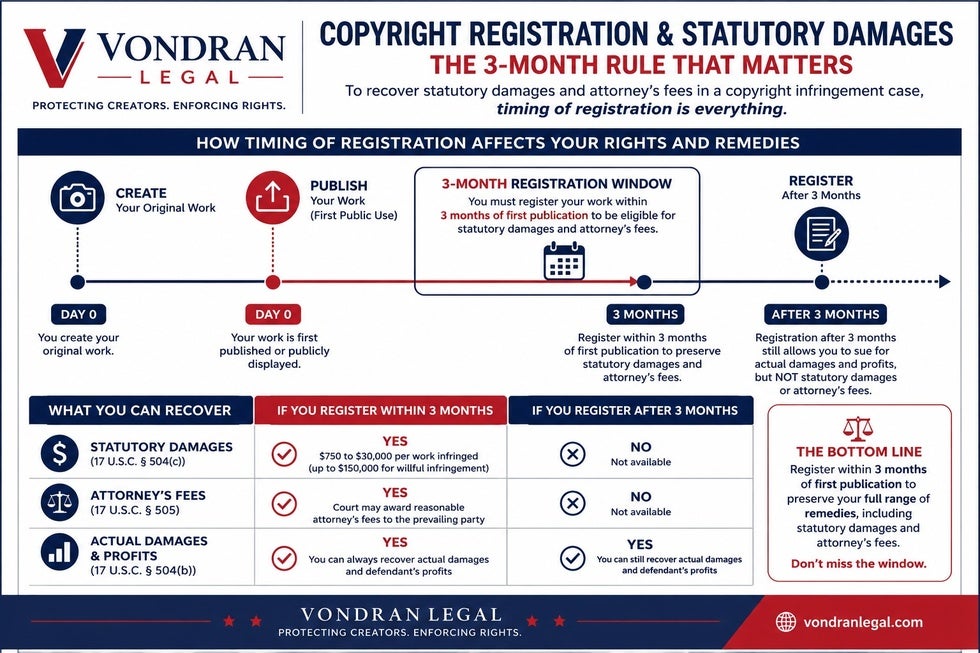
Accordingly, Congress enacted 17 U.S.C. § 412, which generally bars statutory damages and attorney's fees unless one of two things occurs:
Option One
The work is registered within three months after first publication.
Option Two
The work is registered before the infringement commences.
If neither condition is met, statutory damages and attorney's fees are generally unavailable for that infringement.
What Does "Commences" Mean?
That question was answered by the Ninth Circuit in Derek Andrew v. Poof Apparel.
The Facts
Derek Andrew created a copyrighted clothing hang-tag used with its "Twisted Heart" clothing line.
Poof Apparel began distributing garments bearing an allegedly infringing hang-tag before Derek Andrew obtained copyright registration.
Later, after registration became effective, Poof continued distributing additional garments with essentially the same infringing tag.
The district court awarded:
- statutory damages, and
- nearly $300,000 in attorney's fees.
Poof appealed.
The Ninth Circuit Reversed
The Ninth Circuit held that the district court got it wrong.
The Court explained that the first act of infringement in a continuing series marks the commencement of the infringement for purposes of Section 412.
Simply continuing the same infringing conduct after registration does not create a brand-new infringement for purposes of statutory damages.
The Court wrote that:
"The first act of infringement in a series of ongoing infringements of the same kind marks the commencement of one continuing infringement under § 412."
Because Poof's infringement began before registration—and registration occurred well after first publication—the plaintiff lost eligibility for statutory damages and attorney's fees under the Copyright Act.
A Practical Example
Consider the following hypothetical.
- Photograph first published: January 31, 2018
- Defendant uploads the photograph to Facebook: March 30, 2019
- Copyright registration obtained: February 2020
- Photographer discovers infringement: February 5, 2026
Many photographers assume they should still recover statutory damages because:
"I didn't know about the infringement until 2026."
Unfortunately, that is generally not the legal test.
Instead, courts ask:
When did the infringement commence?
Here, it commenced on March 30, 2019, when the image was first uploaded.
Because:
- registration occurred after infringement commenced; and
- registration also occurred more than three months after first publication,
Section 412 would generally bar statutory damages and attorney's fees for that infringement.
The fact that the infringement remained online for years—or was not discovered until much later—does not ordinarily change that result.
Discovery Does Not Restart the Clock
This point surprises many creators.
There is no legal duty requiring photographers to scour the internet every day searching for unauthorized uses.
A photographer may act entirely reasonably in discovering an infringement years later.
Nevertheless, Section 412 focuses on when the infringement began—not when it was discovered.
That distinction can dramatically affect the value of a copyright case.
Can Later Conduct Ever Qualify?
Possibly.
Not every later use is merely a continuation of an earlier infringement.
Examples that may require closer analysis include:
- a new upload after registration,
- publication on a different website,
- creation of a derivative work,
- new advertising campaigns,
- licensing the image to third parties,
- or other genuinely separate acts of infringement.
Whether these constitute new infringements depends on the facts and applicable case law.
Simply leaving the original Facebook post online, however, will often be treated as a continuation of the original infringement rather than a newly commenced infringement under the reasoning of Derek Andrew.
Why Congress Created This Rule
The Ninth Circuit noted that Section 412 is intended to encourage early copyright registration.
If creators could wait years to register and still recover statutory damages after discovering old infringements, the incentive to register promptly would largely disappear. The court emphasized that interpreting "commencement" as the first act of a continuing infringement best advances Congress's policy of encouraging timely registration.
Practical Tips for Photographers
If you regularly publish photographs online, consider these best practices:
- Register important photographs promptly after publication.
- Consider batch registrations when available through the U.S. Copyright Office.
- Maintain publication records and original metadata.
- Keep organized licensing records.
- Use reverse image search tools periodically.
- Consult experienced copyright counsel promptly after discovering an infringement.
Waiting years to register may significantly reduce the remedies available, even where infringement is clear.
How Vondran Legal® Can Help
At Vondran Legal®, we represent photographers, artists, content creators, filmmakers, musicians, software developers, and businesses in copyright matters nationwide.
Our services include:
- Copyright infringement litigation
- Copyright registration strategy
- DMCA takedown notices and counter-notices
- Fair use opinions
- Copyright licensing disputes
- Settlement negotiations
- Federal copyright litigation
- Digital image infringement cases
- Website and social media infringement disputes
If your copyrighted work has been copied without permission—or if you have received a copyright demand letter—we can help evaluate your claims, available remedies, and litigation strategy.
Contact Vondran Legal® to schedule a confidential consultation and discuss your copyright matter with experienced intellectual property counsel.

