
UNDERSTANDING LANHAM ACT FALSE ENDORSEMENT CLAIMS AND CALIFORNIA RIGHT OF PUBLICITY LAWS
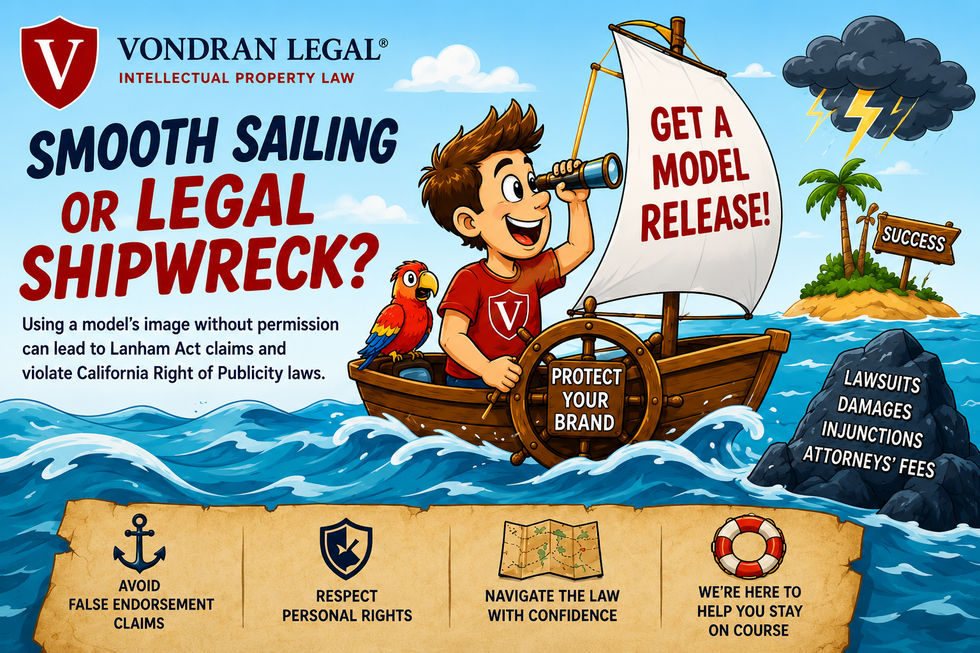
CAN YOU USE A MODEL'S PHOTOGRAPH IN ADVERTISING WITHOUT A RELEASE?
Many businesses assume that if they find a photograph on social media, purchase a graphic template online, hire a marketing company, or obtain an image from a third party, they can freely use that image to promote their products and services.
That assumption can lead to expensive litigation.
Across the United States, companies are increasingly being sued for using photographs of professional models, influencers, athletes, and entertainers in advertisements, social media campaigns, websites, product packaging, and promotional materials without obtaining proper authorization.
These lawsuits often involve claims under the federal Lanham Act for false endorsement and state law claims for violation of an individual's right of publicity.
If your business uses photographs in marketing campaigns, it is critical to understand the legal risks associated with commercial use of a person's image.
WHAT IS A MODEL RELEASE?
A model release is a legal agreement granting permission to use a person's name, image, likeness, voice, or appearance for commercial purposes.
A properly drafted release generally specifies:
- Who may use the image
- How the image may be used
- Duration of use
- Geographic scope
- Compensation
- Whether the image can be modified or altered
- Whether the image can be used in advertising
Without a valid release, businesses may face significant legal exposure when using a person's image in connection with products or services.
COMMON EXAMPLES OF UNAUTHORIZED IMAGE USE
Businesses frequently encounter legal problems when they use photographs in:
Social Media Marketing
- Facebook advertisements
- Instagram posts
- TikTok promotions
- YouTube thumbnails
Product Packaging
- Nutritional supplements
- Cosmetics
- Health products
- Fitness products
- Alcohol brands
- Consumer goods
Business Websites
- Homepage banners
- Landing pages
- Sales pages
- Blog articles
Printed Advertising
- Flyers
- Brochures
- Posters
- Billboards
Promotional Materials
- Event advertisements
- Nightclub promotions
- Restaurant marketing
- Trade show materials
The legal risk increases substantially when the image creates the impression that the person depicted endorses, sponsors, or is affiliated with the product or business.
THE LANHAM ACT AND FALSE ENDORSEMENT CLAIMS
One of the most powerful legal tools available to models and celebrities is Section 43(a) of the Lanham Act.
The Lanham Act is a federal trademark statute designed to prevent consumer confusion regarding the source, sponsorship, or endorsement of goods and services.
Many people are surprised to learn that a Lanham Act claim can arise even when no trademark has been copied.
WHAT IS FALSE ENDORSEMENT?
False endorsement occurs when a business uses a person's identity in a way that falsely suggests:
- Sponsorship
- Approval
- Endorsement
- Affiliation
- Connection with a brand
For example:
Imagine a nutritional supplement company uses a photograph of a fitness model on its packaging without permission.
Consumers may believe:
- The model uses the product
- The model endorses the product
- The model has a sponsorship arrangement with the company
If those assumptions are false, the company may face a federal false endorsement lawsuit.
ELEMENTS OF A LANHAM ACT FALSE ENDORSEMENT CLAIM
Although the legal standards vary by jurisdiction, courts often examine whether:
1. The Plaintiff Is Recognizable
The person depicted must generally be identifiable from the image.
2. Commercial Use Occurred
The image must be used in commerce.
Examples include:
- Advertising
- Marketing campaigns
- Product labels
- Commercial websites
3. Consumer Confusion Exists
The central issue is whether consumers are likely to believe the plaintiff:
- Endorsed the product
- Sponsored the business
- Was affiliated with the company
Likelihood of confusion is often the most heavily litigated issue in these cases.
WHY BUSINESSES OFTEN LOSE THESE CASES
Many defendants mistakenly assume:
- The photograph was publicly available.
- The image came from social media.
- The marketing agency supplied the image.
- The image was purchased from a designer.
- The image was altered.
None of those facts necessarily provide a complete defense.
A company may still face liability if the use creates a false impression of endorsement.
POTENTIAL DAMAGES UNDER THE LANHAM ACT
A successful plaintiff may seek:
Actual Damages
Compensation for:
- Lost endorsement opportunities
- Lost licensing revenue
- Reputational harm
Defendant's Profits
In some cases, courts may award profits attributable to the wrongful conduct.
Injunctive Relief
Courts may order the immediate removal of advertisements and packaging.
Attorneys' Fees
In exceptional cases involving willful conduct, attorneys' fees may be awarded.
PRODUCT PACKAGING CREATES UNIQUE RISKS
Using a model's image on product packaging can be particularly dangerous.
Why?
Because packaging often remains in commerce for months or years.
Unlike a social media post that disappears after a short period, product packaging may:
- Sit on store shelves
- Remain in warehouses
- Be sold nationwide
- Appear in online listings
This can substantially increase potential damages and litigation exposure.
CALIFORNIA'S RIGHT OF PUBLICITY LAW
California provides some of the strongest protections for individuals whose identities are commercially exploited.
California recognizes both:
Statutory Right of Publicity
California Civil Code Section 3344
Common Law Right of Publicity
Developed through court decisions.
WHAT IS THE RIGHT OF PUBLICITY?
The right of publicity protects a person's:
- Name
- Photograph
- Likeness
- Voice
- Signature
- Identity
from unauthorized commercial exploitation.
The purpose is straightforward:
People should have the right to control and profit from the commercial use of their identities.
CALIFORNIA CIVIL CODE SECTION 3344
Section 3344 prohibits the knowing use of another person's:
- Name
- Voice
- Signature
- Photograph
- Likeness
for advertising or selling products without prior consent.
To prevail, a plaintiff generally must show:
Use of Identity
The defendant used the plaintiff's image or likeness.
Commercial Purpose
The use promoted products or services.
Lack of Consent
No authorization existed.
Injury
The plaintiff suffered harm.
CELEBRITIES ARE NOT THE ONLY PLAINTIFFS
Businesses often assume only celebrities can sue.
That is incorrect.
California courts have recognized publicity rights claims involving:
- Models
- Actors
- Influencers
- Athletes
- Musicians
- Social media personalities
- Private individuals
The key question is whether the defendant commercially exploited the person's identity.
SOCIAL MEDIA DOES NOT EQUAL PERMISSION
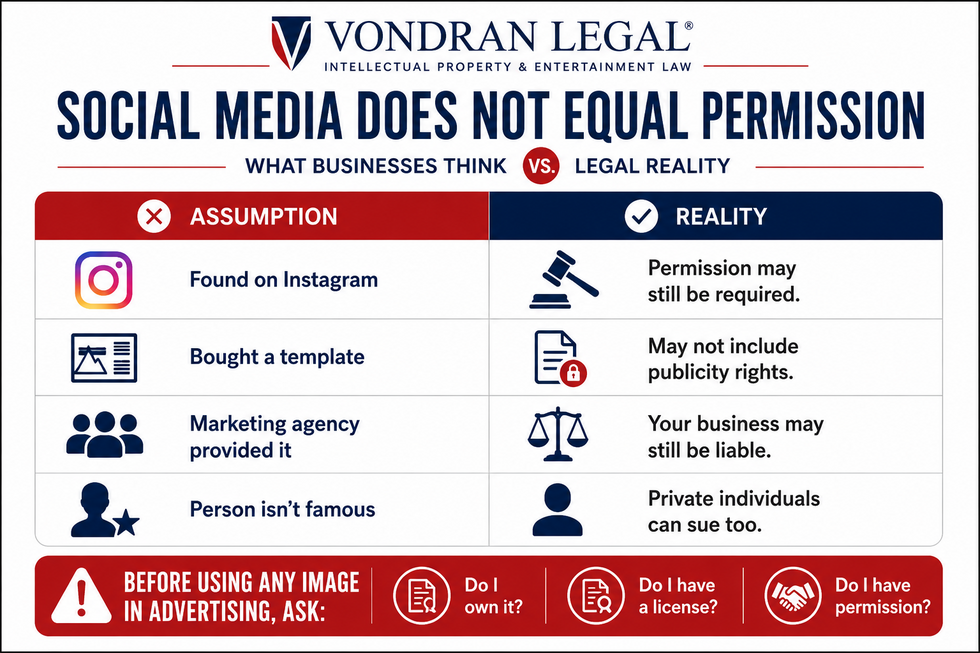
One of the most common misconceptions is:
"If it was posted publicly on Instagram, I can use it."
Wrong.
Posting a photograph online generally does not grant third parties a license to use that image in advertising campaigns.
The fact that a photograph is publicly visible does not eliminate:
- Copyright rights
- Publicity rights
- Privacy rights
- Endorsement rights
MARKETING AGENCIES CAN CREATE LIABILITY
Businesses frequently outsource marketing efforts to:
- Social media managers
- Graphic designers
- Advertising agencies
- Independent contractors
If those vendors use unauthorized images, the business itself may still be sued.
Before launching a campaign, businesses should verify:
- Image ownership
- Licensing rights
- Model releases
- Indemnification provisions
RISK MANAGEMENT STRATEGIES
To reduce legal exposure, businesses should:
Obtain Written Model Releases
Never rely on verbal permission.
Verify Licensing Rights
Review:
- Stock photo licenses
- Commercial use restrictions
- Third-party agreements
Maintain Documentation
Keep copies of:
- Releases
- Licenses
- Purchase records
Audit Marketing Materials
Review:
- Social media posts
- Websites
- Product packaging
- Advertising campaigns
Consult Counsel
A legal review before launch is substantially less expensive than defending a federal lawsuit.
FINAL THOUGHTS
Using a person's image without authorization can expose businesses to significant liability under both federal and state law.
From a federal perspective, the Lanham Act prohibits advertising practices that create false impressions of sponsorship, endorsement, or affiliation.
From a California perspective, the right of publicity protects individuals from unauthorized commercial exploitation of their identities.
Whether the image appears in a Facebook advertisement, a product label, a website banner, or a nationwide marketing campaign, businesses should ensure they have proper rights and releases before proceeding.
The cost of obtaining permission is almost always far less than the cost of defending a false endorsement or right of publicity lawsuit.
CONTACT A LANHAM ACT AND RIGHT OF PUBLICITY ATTORNEY
If your company has been accused of using a model's image without authorization, or if you are a model, influencer, athlete, or public figure whose likeness has been exploited for commercial purposes, contact experienced intellectual property counsel to discuss your legal rights and options.
