
Copyright Law for Video Game Developers - Mistakes to Avoid!
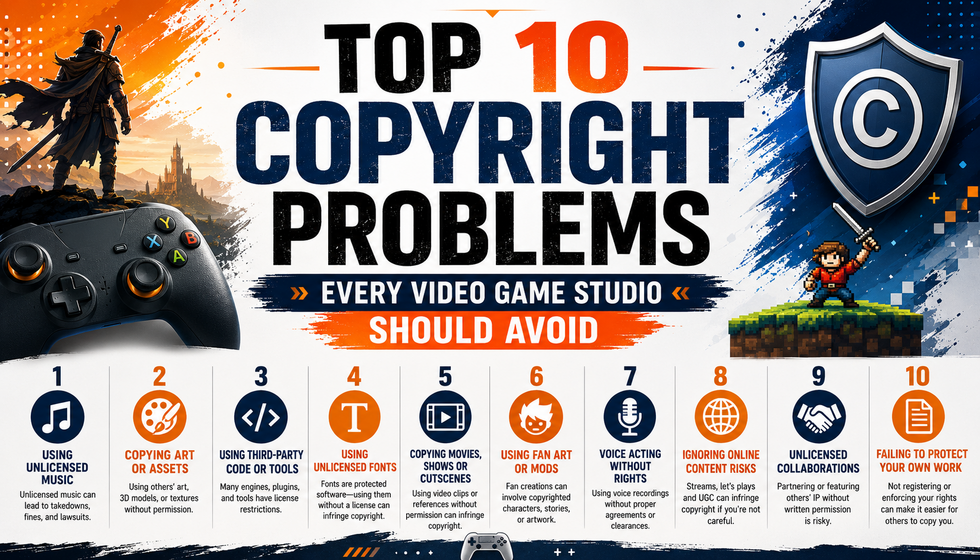
A Practical Copyright Guide for Game Developers, Publishers, Artists, and Producers
A modern video game may contain millions of lines of code, character designs, cinematic sequences, music, sound effects, dialogue, maps, textures, animations, user interfaces, promotional artwork, and contributions from dozens—or even hundreds—of people.
Each of those components may involve copyright.
That makes copyright law one of the most important legal subjects for any game studio. A studio can face problems not only when it copies another company's game, but also when it fails to secure ownership of its own artwork, uses improperly licensed music, incorporates restricted open-source code, mishandles user-generated content, or relies on artificial intelligence without documenting the human creative contribution.
Under U.S. law, copyright protects original expression fixed in a tangible medium, but it does not protect ideas, systems, processes, methods of operation, or concepts standing alone. For video games, the Copyright Office generally treats the software code and the audiovisual material displayed during gameplay as distinct copyrightable components, although they may sometimes be registered together when the same party owns both.
Here are ten of the most common copyright problems video game studios should address before they become expensive disputes.
1. Assuming the Studio Automatically Owns Everything Created for the Game
One of the most serious mistakes a studio can make is assuming that paying someone to create artwork, music, code, animation, or dialogue automatically gives the studio ownership of the copyright.
That assumption is frequently wrong.
Work created by an employee within the scope of employment may qualify as a work made for hire, meaning the employer is generally treated as the copyright owner. Independent contractors, however, usually retain ownership unless the work qualifies under the narrower statutory work-for-hire rules or the contractor signs a valid written assignment.
This issue commonly arises with freelance concept artists, composers, programmers, voice actors, animators, motion-capture vendors, outsourced studios, trailer producers, and marketing agencies. A purchase order or invoice stating “paid in full” may establish payment, but it may not transfer copyright ownership.
Copyright ownership can also be divided. One party may own the code, another the artwork, and another the music. The Copyright Act permits exclusive rights to be transferred separately, and transfers of copyright ownership generally must be documented in writing.
Every contributor agreement should therefore address ownership, work-made-for-hire status where legally applicable, assignment of rights, preexisting materials, approval rights, portfolio uses, moral rights, further assurances, and the right to create sequels, ports, expansions, remasters, and derivative works.
A game may be technically finished yet commercially unusable if the studio cannot prove that it owns the necessary rights.
2. Copying the Look and Feel of Another Game Too Closely
Game developers naturally draw inspiration from successful games. Copyright does not give anyone ownership of an abstract idea, genre, system, method, or general game mechanic. A battle-royale concept, racing format, health system, crafting mechanic, or puzzle rule is not automatically protected merely because one company used it first.
The danger arises when a studio copies the particular expression of those ideas.
Potentially protectable expression may include specific artwork, characters, dialogue, animations, sound design, level arrangements, graphical elements, story presentation, visual effects, and sufficiently original combinations of expressive choices.
The Copyright Office explains that copyright protection for computer programs does not extend to program logic, algorithms, systems, methods, concepts, or layouts standing alone. But courts have found infringement where a competing game copied expressive visual elements that were not necessary to implement the underlying game rules.
In Tetris Holding v. Xio Interactive, the court distinguished the unprotectable rules and functional concepts of the game from particular visual choices used to express those rules. The decision illustrates that a developer cannot necessarily escape liability merely by saying it copied only “gameplay” when the copied product also reproduces distinctive expressive details.
The safest development process is to document independent creation, use original assets, avoid copying reference material too literally, and conduct a comparative review when a new title is intentionally inspired by a well-known game.
3. Using Third-Party Art, Textures, Fonts, Sound Effects, or Asset Packs Without Understanding the License
Asset marketplaces make game development faster and less expensive, but they also create major copyright risks.
A studio may purchase a texture pack, font, 3D model, animation, sound library, icon set, or user-interface template and assume that payment permits every conceivable use. The license may actually restrict commercial use, redistribution, modification, sublicensing, use by contractors, use in templates, use in artificial-intelligence systems, or use in downloadable asset packages.
Problems also arise when a developer downloads an asset from a website that did not have authority to license it in the first place. A marketplace listing is not proof of ownership.
Studios should maintain a centralized asset ledger recording where each asset came from, who purchased it, which license applied on the purchase date, what products may use it, and whether attribution or other conditions are required.
The development team should also avoid mixing assets under incompatible terms. A single improperly licensed texture or font may create takedown risk shortly before launch, after physical merchandise has been printed, or after millions of copies have been distributed.
“Royalty free” does not mean “copyright free.” It generally means that the user does not pay a royalty for each use, subject to the terms of the applicable license.
4. Misusing Open-Source Software
Most modern games rely on open-source components. Open-source software can be extremely valuable, but “open source” does not mean “no legal obligations.”
Different licenses impose different requirements.
Permissive licenses may require preservation of copyright notices or attribution. Copyleft licenses may impose broader obligations involving distribution of source code or licensing of derivative works. Other licenses may contain patent provisions, restrictions on trademarks, disclosure requirements, or limitations that conflict with a studio's commercial distribution model.
The risk increases when developers copy code from online repositories, forums, tutorials, or code-generation tools without documenting its origin. A studio may discover late in development that a critical component carries license obligations inconsistent with the publisher's requirements or the platform's distribution terms.
Studios should adopt an open-source review policy that includes approved licenses, automated scanning, attribution tracking, source-code documentation, escalation procedures, and legal review of higher-risk components.
Open-source compliance should not be postponed until the final build. By then, removing a deeply integrated component may be technically and financially difficult.
5. Using Music Without Securing All Necessary Rights
Music is one of the most common sources of copyright trouble in games.
A commercially released song often involves at least two separate copyrights: the copyright in the musical composition and the copyright in the sound recording. Permission from the performer or record label may not necessarily cover the underlying composition, and permission from the songwriter may not necessarily cover a particular recorded performance.
A game studio must also consider how the music will be used. The required rights may differ for gameplay, trailers, advertisements, livestreams, esports broadcasts, downloadable soundtracks, social-media clips, user-generated videos, and future remastered editions.
A license may cover the initial game but not downloadable content, sequels, ports, cloud gaming, subscription platforms, virtual concerts, merchandising, or promotional campaigns.
Studios should negotiate territory, duration, media, promotional use, editing rights, looping, synchronization, streaming, creator-content use, and takedown procedures. It is particularly important to consider whether streamers will receive copyright claims when broadcasting gameplay containing licensed music.
Obtaining a song for the game without obtaining sufficient promotional and streaming rights may create a commercially awkward result: the studio can include the song in the game but cannot safely promote or encourage players to stream it.
6. Failing to Control Source Code and Confidential Development Materials
Source code is protected as a form of literary expression to the extent it contains copyrightable authorship. Copyright protection does not extend to the underlying ideas, functionality, algorithms, or methods themselves, but unauthorized copying of code may still constitute infringement.
Studios should control access to source code, development builds, proprietary tools, internal artwork, unreleased storylines, and technical documentation. While trade-secret law may also protect confidential materials, copyright ownership and registration can become important when code or assets are copied by former employees, vendors, competitors, or hackers.
Development repositories should include access restrictions, contribution histories, version controls, offboarding procedures, and written policies prohibiting unauthorized copying.
Studios should also separate third-party code from proprietary code. A poorly maintained repository may make it difficult to prove which portions were created internally, which were licensed, and which were introduced by contractors.
When registering computer programs, the Copyright Office permits applicants to submit portions of source code and provides procedures for deposits containing trade-secret material. This can allow a studio to pursue registration without publicly exposing the entire codebase.
7. Failing to Register Important Copyrights Early
Copyright generally exists when an original work is fixed in a tangible medium, but registration provides important enforcement benefits in the United States.
A game studio should not wait until infringement occurs to begin organizing its registrations.
A video game commonly contains at least two major categories of copyrightable material: the software program that operates the game and the audiovisual material displayed to the player. The Copyright Office recognizes video games as audiovisual works and also permits registration of qualifying computer-program authorship.
A thoughtful registration program may include:
- Source code and significant updated versions
- Audiovisual gameplay material
- Character artwork
- Concept art
- Cinematics
- Music
- Promotional videos
- Manuals and narrative materials
- Website content
- Major downloadable expansions
Ownership must be coordinated before filing. If different parties own the code, artwork, and music, one registration may not properly cover every component.
Studios should also accurately identify preexisting and third-party material. An application that improperly claims ownership of licensed or previously published content may create problems when enforcement begins.
Registration is not merely administrative housekeeping. It should be integrated into product milestones, release planning, and enforcement strategy.
8. Mishandling User-Generated Content, Mods, and Fan Creations
Player creativity can extend the life of a game, build community, and generate enormous goodwill. It can also create complicated copyright issues.
Players may produce maps, character skins, mods, artwork, videos, music, stories, custom servers, and downloadable game content. A studio's terms should explain what rights players retain, what license they grant the studio, whether content can be modified or promoted, and what kinds of material are prohibited.
The studio must also consider what happens when users upload copyrighted material belonging to someone else. A player may build a custom map containing movie characters, popular songs, sports logos, or copied artwork. The fact that a player uploaded the content does not guarantee that the platform or game company faces no risk.
For services that host user content, DMCA procedures may be relevant. Section 512 establishes limitations on liability for qualifying service providers that satisfy statutory conditions, including designated-agent, notice-and-takedown, and repeat-infringer requirements. A valid takedown notice must identify the copyrighted work, identify the allegedly infringing material, and provide enough information to locate it.
Studios should maintain a clear policy for takedowns, counter-notices, repeat infringement, restoration decisions, and abuse of the complaint process.
A community-friendly approach does not require the studio to surrender its copyright. It requires clear rules, proportional enforcement, and consistency.
9. Using Generative AI Without a Copyright and Provenance Policy
Artificial intelligence is increasingly used to create concept art, textures, code, dialogue, music, voices, animations, and marketing content. The speed is attractive, but the legal risks remain significant.
The U.S. Copyright Office has reaffirmed that human creativity remains central to copyright protection. The use of AI as an assistive tool does not automatically prevent copyright protection, but material generated entirely by AI without sufficient human authorship may not be protected. Mere prompting, standing alone, may not establish authorship, while human selection, arrangement, modification, or creative control may support protection in appropriate circumstances.
That creates several practical problems for studios.
First, the studio may be unable to claim exclusive copyright in important assets if human authorship is insufficient. Second, an AI output may resemble existing copyrighted material. Third, employees may upload confidential code, artwork, or unreleased game information into external systems. Fourth, vendor terms may reserve broad rights in inputs or outputs. Fifth, the studio may have difficulty proving how a final asset was created.
A responsible AI policy should address approved tools, prohibited inputs, human review, provenance records, prompt and output retention, similarity screening, confidentiality, vendor terms, warranties, indemnification, and registration disclosures.
The relevant question is not simply whether AI was used. It is how it was used, what human authors contributed, what material was entered into the system, and whether the studio can document the creation process.
10. Waiting Too Long to Respond to Infringement
Game infringement can spread rapidly through app stores, online marketplaces, social platforms, streaming sites, foreign websites, private servers, counterfeit merchandise, and downloadable clone games.
A studio that discovers infringement should first preserve evidence. That may include screenshots, screen recordings, source files, purchase records, URLs, account information, download data, dates, advertisements, and communications.
The next step is to identify exactly what has been copied. A strong enforcement claim should distinguish between unprotectable ideas or mechanics and protectable code, artwork, characters, music, audiovisual material, dialogue, or other expression.
The response may include a platform complaint, DMCA notice, app-store submission, cease-and-desist letter, negotiated license, domain proceeding, or litigation. The studio should evaluate the seriousness of the conduct, strength of ownership evidence, registration status, jurisdiction, public-relations impact, and likelihood of a counter-notice.
Aggressive enforcement without adequate investigation can backfire. Conversely, prolonged inaction may allow an infringer to gain users, revenue, search visibility, and perceived legitimacy.
The best enforcement strategy is usually graduated, documented, and proportional to the harm.
A Prelaunch Copyright Checklist for Game Studios
Before launch, the studio should be able to answer several fundamental questions.
Does the company have signed agreements with every employee, contractor, composer, artist, animator, programmer, vendor, and outside studio that contributed copyrightable material?
Can the studio trace the source and license for every third-party asset, font, sound, library, and software component?
Have important code and audiovisual assets been registered or scheduled for registration?
Has the development team reviewed open-source obligations?
Are all music, talent, streaming, trailer, and promotional rights documented?
Does the studio have written rules governing AI tools and confidential inputs?
Do the terms of service properly address user-generated content, mods, and takedown procedures?
Has the game been reviewed for similarities to competing titles, particularly where the team used another game as a design reference?
Can the studio prove the chain of title for the entire game?
If the answer to any of these questions is unclear, the issue should be addressed before the game becomes expensive to change.
Frequently Asked Questions About Video Game Copyright
Can copyright protect an idea for a video game?
No. Copyright generally does not protect abstract ideas, concepts, systems, procedures, or methods of operation. It may protect the original expression used to implement the idea, including artwork, code, characters, dialogue, music, animations, and audiovisual presentation.
Can game mechanics be copyrighted?
General mechanics and rules are usually treated as ideas, systems, or methods rather than protectable expression. However, a developer may still infringe by copying the specific artwork, audiovisual presentation, text, animations, sounds, or other expressive elements used to present those mechanics.
Does paying a freelancer mean the studio owns the copyright?
Not necessarily. Independent contractors often retain copyright unless a written agreement transfers ownership or the work qualifies as a statutory work made for hire. Studios should use written agreements before the work begins.
Can one registration cover the entire video game?
Sometimes a single application can cover the computer program and audiovisual material if the same party owns both, but ownership, publication status, authorship, and deposit requirements must be reviewed carefully. The Copyright Office provides specific guidance for video-game registrations.
Are character names protected by copyright?
Names, titles, and short phrases generally are not protected by copyright. They may, however, qualify for trademark protection when used as source identifiers. A sufficiently developed character may receive copyright protection based on its expressive attributes, even though the name alone is not copyrighted.
Is royalty-free music safe to use?
Only within the license terms. Royalty free does not mean unrestricted or free of copyright. The license may limit platforms, territories, commercial uses, advertising, livestreaming, redistribution, or modifications.
Can players stream our game without permission?
Streaming gameplay implicates copyright because it may reproduce, display, and publicly perform audiovisual content. Many studios expressly permit and encourage streaming through published content policies or implied licenses. Music and third-party licensed content may create separate restrictions.
Can a studio use fan art in its marketing?
Not automatically. Even when fan art depicts the studio's characters, the fan may own copyright in the artist's original contribution. The studio should obtain permission or rely on terms that clearly grant appropriate rights.
Does a DMCA takedown automatically prove infringement?
No. A DMCA notice is a statutory request directed to a service provider; it is not a court judgment. The recipient may submit a counter-notice, and the parties may ultimately need to resolve ownership, authorization, fair use, or substantial similarity through negotiation or litigation.
Can AI-generated game art be copyrighted?
Copyright protection depends on the presence of human authorship. AI-assisted work may contain protectable human-created elements, but material generated entirely by AI may not qualify. Studios should document human selection, modification, arrangement, and creative control.
What is the difference between copyright ownership and owning a copy?
Buying a digital asset, physical drawing, hard drive, or commissioned file does not necessarily transfer the copyright. Ownership of a material object is separate from ownership of the exclusive copyright rights.
When should a game studio involve copyright counsel?
Counsel should ideally become involved before contractor work begins, before licensed content is incorporated, before a title is published, before an important AI workflow is adopted, before a DMCA notice is sent, and before a major infringement dispute escalates.
Final Thoughts: Copyright Should Be Part of the Development Pipeline
Copyright review should not occur only after a lawsuit or takedown notice arrives.
A well-run game studio incorporates copyright into vendor onboarding, contractor agreements, source-control practices, asset tracking, open-source review, AI policies, music clearance, content moderation, registration, and launch approval.
The central questions are straightforward:
Who created this material?
Who owns it?
What agreement transfers or licenses it?
Can we use it on every planned platform and in every planned territory?
Did we copy protectable expression from another game?
Can we prove the chain of title?
Have we protected the game's most valuable creative assets?
The most valuable video-game franchises are built from copyrightable assets. Protecting those assets from the beginning can help a studio avoid takedowns, ownership disputes, delayed launches, failed publishing deals, and expensive litigation.
Attorney Steve® Vondran and Vondran Legal® assist video game developers, publishers, software companies, artists, and technology businesses with copyright ownership, licensing, registrations, DMCA disputes, software infringement claims, content clearance, and intellectual property litigation.

