
Vondran Legal® IP Law For Video Game Companies
How Game Developers Can Protect Game Titles, Characters, Logos, Branding, and Trade Dress
Creating a successful video game requires far more than writing code. Developers spend years building recognizable worlds, naming characters, designing interfaces, creating logos, producing merchandise, and developing a visual identity that players immediately associate with a particular studio or franchise.
Many of those valuable elements may be protected by trademark law.
Trademark law is concerned primarily with source identification. In other words, trademarks help consumers identify who created, published, sponsored, or approved a particular product or service. In the video game industry, trademarks may include game titles, studio names, logos, slogans, character names, esports brands, virtual product names, and sometimes the distinctive overall visual presentation of a game or product.
Trade dress is a related form of trademark protection. It can protect the distinctive overall appearance or presentation of a product when that appearance identifies its source and is not merely functional. In a gaming context, potential trade dress issues may arise from a game's distinctive visual presentation, graphical arrangement, packaging, promotional appearance, or combination of nonfunctional design features.
The United States Patent and Trademark Office may refuse a trademark application when the proposed mark is confusingly similar to an existing mark used with related goods or services. Importantly, the marks do not have to be identical. The central question is whether consumers are likely to become confused about the source, sponsorship, affiliation, or approval of the relevant products.
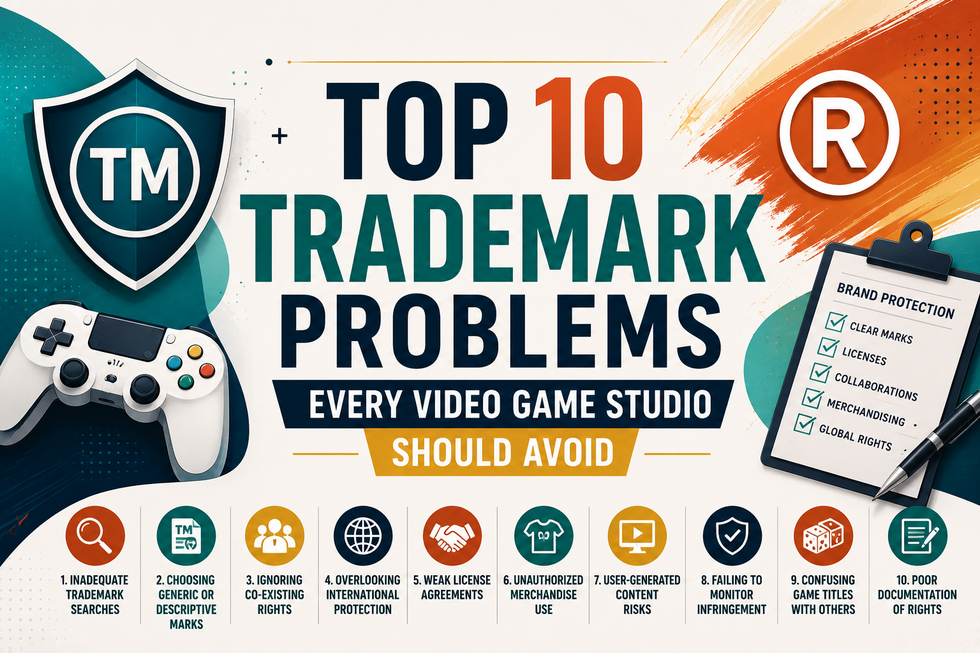
Here are ten of the most common trademark and trade-dress problems every game studio should try to avoid.
1. Selecting a Game Title Without Conducting a Proper Trademark Search
One of the most expensive mistakes a studio can make is choosing a game title, investing heavily in development and promotion, and only later discovering that another company already has superior rights in a confusingly similar name.
Developers sometimes perform only a quick internet or app-store search. That is a useful starting point, but it is not necessarily a sufficient trademark clearance process. A more complete search may need to examine federal trademark applications and registrations, state records, common-law uses, game-distribution platforms, domain names, social-media accounts, foreign trademark records, and related entertainment products.
The analysis should not be limited to exact matches. A proposed title may create a problem even when it differs in spelling, punctuation, spacing, or one additional word. Similarities in sound, meaning, appearance, or commercial impression may still support a likelihood-of-confusion claim.
A studio should also examine related goods and services. A prior mark does not necessarily need to cover an identical video game. Rights involving downloadable software, mobile applications, entertainment services, online communities, tabletop games, merchandise, streaming content, or esports may create complications depending on the circumstances.
The USPTO emphasizes that trademark searching should focus not only on whether two marks are similar, but also on whether the associated goods or services are related.
A clearance search should therefore occur before the studio announces the game, purchases expensive advertising, commissions trailers, or builds substantial goodwill around the title.
2. Assuming a Domain Name, Company Name, or App-Store Listing Creates Trademark Rights
Registering a corporation, limited liability company, domain name, social-media handle, or app-store account does not necessarily establish that the name is legally available as a trademark.
A state may permit a company to register a business name because no identical business entity is listed in that state. That does not mean the name is clear under federal trademark law. Similarly, owning a domain name does not provide immunity from an infringement claim.
Trademark rights generally arise through use of a mark to identify the source of goods or services, although a federal intent-to-use application may allow a studio to reserve priority before commercial launch if the statutory requirements are satisfied.
Developers should treat domain-name registration and corporate formation as separate from trademark clearance. The USPTO specifically distinguishes trade names and domain names from trademark use and registration.
A studio that purchases a domain first and investigates trademark rights later may discover that it owns a web address it cannot safely use as the name of its game.
3. Choosing a Weak, Descriptive, or Generic Game Brand
Not every name is equally protectable.
A distinctive, original title is usually easier to register and enforce than a title that merely describes the game's subject, genre, function, or features. A highly descriptive title may require evidence that consumers have come to recognize it as a source identifier. A generic term for a category of products generally cannot function as an exclusive trademark for that category.
For game developers, this issue often appears when a studio selects a title consisting primarily of ordinary genre terminology, such as words describing racing, combat, puzzles, kingdoms, warfare, survival, sports, or simulation. The title may communicate the game's theme, but it may be difficult to monopolize.
Weak marks also produce enforcement problems. Even if a studio obtains some protection, it may be required to tolerate numerous similar uses by competitors.
A stronger branding strategy frequently involves choosing a fanciful, arbitrary, or suggestive name that is memorable but does not simply describe the game. Before finalizing a title, the development and marketing teams should ask two separate questions:
Can we use this name?
and
Can we meaningfully protect this name?
Those are not always the same question.
4. Failing to Secure Rights in Character Names, Factions, Locations, and In-Game Brands
A game studio's most valuable trademarks may extend far beyond the title of the game.
Players may associate particular character names, fictional corporations, factions, locations, weapons, tournaments, currencies, or in-game products with a particular franchise. Some of those names may eventually become standalone brands used in merchandise, animation, publishing, esports, or licensing.
A studio should identify these potential assets early and develop a filing strategy based on commercial importance. Not every fictional term requires a trademark application, but the most prominent names should be evaluated before the game becomes successful and third parties begin filing applications or selling unauthorized merchandise.
Studios should also consider whether a proposed fictional brand conflicts with a real-world company. Naming a fictional pharmaceutical company, automobile manufacturer, restaurant, weapon, clothing line, or financial institution can create trademark, dilution, false-association, or reputational issues if the name resembles an existing brand.
The fictional nature of the game does not automatically eliminate legal risk. The analysis may depend on how the mark is presented, whether it identifies in-game goods, whether it appears in promotional materials, and whether consumers could perceive sponsorship or affiliation.
5. Copying Another Game's Logos, Interface, or Overall Visual Identity
Developers often understand that directly copying another studio's logo is risky. The more difficult question arises when a game does not use the exact same logo but adopts a highly similar typeface, color arrangement, menu presentation, icon system, screen layout, promotional style, or overall visual identity.
That is where trade dress may become relevant.
Trade dress can potentially protect the total image and overall appearance of a product or service. A claimant ordinarily must establish that the asserted trade dress is distinctive, nonfunctional, and likely to cause confusion. Product-design trade dress generally requires proof that the design has acquired distinctiveness or secondary meaning; it is not automatically treated as inherently distinctive.
In a video game dispute, a plaintiff may argue that a competitor copied a distinctive combination of visual elements that players associate with the original game. This might include a particular arrangement of the playfield, recurring visual motifs, color combinations, borders, presentation screens, or other nonfunctional details.
In Tetris Holding, LLC v. Xio Interactive, Inc., the court considered copyright and trade-dress claims involving a game alleged to have copied the recognizable visual presentation of Tetris. The court distinguished between functional game rules and arbitrary expressive design choices, noting that certain visual features were not necessary to make the game function.
This does not mean one company can use trademark law to monopolize an entire game genre. Functional features, ordinary design conventions, and elements necessary to gameplay generally raise substantial limits. But a developer should be cautious when the total presentation of a new game makes players immediately think it came from, was licensed by, or was approved by another studio.
6. Treating Game Mechanics and Trade Dress as the Same Thing
Trademark and trade-dress law do not ordinarily provide ownership over abstract game rules or purely functional mechanics.
A studio may be inspired by another game's general concept, scoring system, progression model, combat structure, or puzzle rules without necessarily committing trademark infringement. The danger arises when the studio combines similar mechanics with branding or visual features that create source confusion.
Developers should therefore separate two questions:
First, is the feature functional or necessary to gameplay?
Second, is the studio copying a distinctive source-identifying presentation?
For example, a health bar is a common functional device. A particular health-bar design, animation, sound, color sequence, placement, and accompanying iconography might present a more complicated issue when considered as a whole. Likewise, an inventory menu is functional, but an unusually distinctive total presentation may have source-identifying significance.
Trade-dress protection cannot ordinarily be used to prevent competitors from using features essential to competition or features whose exclusive control would place competitors at a significant non-reputational disadvantage. Functionality is therefore one of the central limitations on trade-dress claims.
The proper analysis is rarely as simple as saying, “You cannot trademark a game mechanic.” The legal question may concern the combination of functional and nonfunctional elements, what consumers recognize as a brand identifier, and whether the challenged presentation creates confusion.
7. Using Real-World Trademarks Inside a Game Without Analyzing the Context
Games frequently depict real-world products, locations, clothing, vehicles, businesses, and cultural references. Those uses may increase realism, but they can also create trademark issues.
Not every appearance of a trademark in an expressive work is infringement. The legal analysis often considers whether the mark is being used as a source identifier for the developer's own product, whether the use is artistically relevant, whether it explicitly misleads consumers, and whether it falsely suggests sponsorship or endorsement.
The risk increases when a real-world brand is featured prominently in advertising, used as the name of the game, placed on merchandise, or presented in a manner that implies an official partnership.
The Supreme Court's decision in Jack Daniel's Properties, Inc. v. VIP Products LLC underscores that when another party's trademark is used as a designation of source for the defendant's own goods, ordinary likelihood-of-confusion principles may apply even if the defendant characterizes the product as humorous or expressive.
Studios should therefore distinguish incidental or contextual references from branding uses. The marketing team should not imply that a brand has sponsored or approved the game unless the studio has obtained authorization.
Particular caution is appropriate when depicting famous trademarks in connection with illegal conduct, dangerous products, adult content, political messages, or reputationally sensitive storylines.
8. Launching Merchandise Without Expanding the Trademark Strategy
A studio may clear and register a game title for downloadable software but fail to consider shirts, toys, posters, collectibles, printed publications, entertainment events, or streaming services.
Trademark rights are tied to particular goods and services. A filing that covers only software may not fully address the studio's broader commercial plans. If the game succeeds, third parties may begin selling merchandise before the studio expands its filing portfolio.
A strong strategy should consider anticipated uses such as:
- Downloadable and recorded game software
- Online entertainment services
- Mobile applications
- Clothing
- Toys and collectibles
- Printed materials
- Sound recordings
- Streaming and video content
- Esports competitions
- Online marketplaces
- Virtual goods and digital collectibles
The studio should avoid filing indiscriminately for products it does not genuinely intend to offer. Instead, trademark planning should align with realistic expansion and licensing goals.
Licensing also requires quality control. If a studio authorizes manufacturers, tournament operators, influencers, or partners to use its marks, it should establish brand standards and approval procedures. Failure to control licensed trademark use may weaken the brand and create inconsistent consumer experiences.
9. Mishandling Fan Games, Mods, Esports, Streaming, and Community Uses
Gaming brands often grow because of active player communities. Fans may create mods, artwork, videos, tournaments, merchandise, guides, companion tools, or entirely new games inspired by the original franchise.
A studio that ignores all unauthorized use may allow serious infringement or consumer confusion to spread. A studio that attacks every fan project may damage its reputation and alienate its most loyal players.
The solution is a deliberate enforcement policy.
Studios should distinguish among noncommercial fan expression, commercial exploitation, counterfeit goods, malicious software, unauthorized servers, cheat programs, misleading tournaments, and projects that falsely imply official approval.
A fan-use policy can explain permissible and prohibited conduct. It may address use of logos, monetization, merchandise, sponsorships, domain names, disclaimers, mature content, and modification of official assets.
Community tournament rules are especially important. An organizer may use game titles and logos to describe an event, but promotional materials should not falsely suggest that the studio officially sponsors or operates the tournament.
The legal team should also coordinate with community-management and public-relations personnel. Enforcement is not solely a legal decision. In the gaming industry, the tone, timing, and proportionality of a response can significantly affect player trust.
10. Failing to Monitor, Maintain, and Enforce the Trademark Portfolio
Trademark protection does not end when a registration certificate issues.
Studios should monitor new applications, app stores, game platforms, marketplaces, domain registrations, social media, counterfeit merchandise, unauthorized tournaments, and suspicious digital products. Early detection often makes enforcement less expensive and more effective.
Registrations must also be maintained through required filings. Ownership records should be updated after corporate restructurings, acquisitions, or transfers. Licenses should be documented, and use specimens should accurately show how the mark appears in commerce.
Enforcement should be consistent but not mechanical. A studio should evaluate the strength of its rights, seriousness of the confusion, commercial harm, player impact, jurisdiction, public-relations concerns, and probability of escalation.
Possible responses may include:
- Platform trademark complaints
- Marketplace takedowns
- Domain-name proceedings
- Cease-and-desist correspondence
- Negotiated coexistence agreements
- Licensing arrangements
- Trademark oppositions or cancellations
- Federal litigation
The objective is not necessarily to file the most lawsuits. It is to prevent consumer confusion, protect brand value, and preserve a consistent relationship between the game and its players.
Trademark and Trade-Dress Checklist for Game Developers
Before announcing or launching a game, a studio should confirm that it has reviewed the proposed title, studio name, principal character names, logos, slogans, major fictional brands, expansion titles, social-media accounts, and domain names.
The studio should also examine whether its artwork, menus, icons, packaging, promotional materials, and total visual identity are too close to those of another game. Conversely, it should identify distinctive elements of its own presentation that may deserve protection.
Legal review should occur again when the studio adds merchandise, esports events, collaborations, streaming productions, licensed content, sequels, or international distribution. A mark that was cleared for one product or territory may require additional analysis when the business expands.
Frequently Asked Questions About Video Game Trademarks
Can a Video Game Title Be Trademarked?
Yes. A distinctive game title may function as a trademark when it identifies the source of game-related goods or services. However, the availability and strength of the mark depend on existing rights, distinctiveness, use, and the goods or services identified in the application.
Titles of a continuing series are generally better positioned for trademark protection than the title of a single creative work, although video games can present particular questions because they may constitute downloadable software and ongoing entertainment services in addition to expressive works.
Is Copyright or Trademark More Important for a Video Game?
They protect different things. Copyright may protect original code, artwork, music, dialogue, characters, and audiovisual expression. Trademark protects source identifiers such as titles, logos, and branding. Trade dress may protect a distinctive nonfunctional overall presentation.
A successful studio commonly relies on both.
Can a Studio Trademark a Character Name?
Potentially, yes, particularly when the character name functions as a brand for games, merchandise, entertainment services, or a series of products. Merely mentioning a name within a single story may not be enough. The relevant question is whether consumers perceive the name as identifying the source of goods or services.
Can a Game Studio Own a Color Scheme?
A color or combination of colors may sometimes function as a trademark after consumers come to associate it with a single source. However, color protection is difficult when the colors are functional, common within the industry, or insufficiently source identifying.
A studio is generally in a stronger position when the color scheme is part of a distinctive combination of design elements rather than an attempt to control a basic color used throughout a genre.
Can a User Interface Be Protected as Trade Dress?
Possibly, but not every interface qualifies. A claimant would generally need to identify a specific combination of features that is distinctive, nonfunctional, and likely to cause confusion when copied.
Common or efficiency-driven interface elements are less likely to receive broad protection. Courts will be cautious about allowing trade-dress law to interfere with legitimate competition or to grant perpetual control over functional design concepts.
Does Adding a Disclaimer Prevent Trademark Infringement?
Not automatically. A disclaimer may reduce confusion in some circumstances, but it does not cure every infringing use. The prominence, wording, placement, and overall presentation matter.
A small statement that a product is “unofficial” may be insufficient when the title, logo, advertising, or design otherwise strongly implies sponsorship.
Can We Mention Another Game in Advertising?
Comparative references may sometimes be lawful, particularly when they accurately identify another product and do not imply sponsorship. However, studios should avoid using another company's logo or trade dress more prominently than necessary, making false claims, or suggesting an official affiliation.
Marketing teams should obtain legal review before building a campaign around another company's brand.
Can We Use a Parody of a Famous Brand Inside Our Game?
Possibly, but labeling something a parody does not automatically eliminate risk. The analysis may involve artistic expression, likelihood of confusion, dilution, source-identifying use, and the context in which the mark appears.
The risk increases when the parody is used to brand the developer's own product or merchandise, rather than appearing only as part of the game's expressive content.
Should We Register a Trademark Before the Game Is Finished?
A studio may consider filing an intent-to-use application before launch when it has a bona fide intention to use the mark in commerce. This may help establish an earlier priority date, but the registration ordinarily will not issue until the required use and filing conditions are satisfied.
The decision should follow a clearance search. Filing early does not make an otherwise conflicting mark safe.
What Should We Do if Another Game Has a Similar Name?
Do not immediately send an aggressive demand. First determine who used the mark first, what rights each party owns, how similar the marks are, whether the games and distribution channels are related, and whether actual confusion exists.
Possible solutions include a name change, coexistence agreement, geographic limitation, license, platform complaint, opposition proceeding, or litigation. The correct response depends heavily on timing and commercial context.
Final Thoughts: Build Trademark Protection Into the Development Process
Trademark problems become much more expensive after launch.
Changing a title during early development may be frustrating. Changing it after millions of players have downloaded the game, merchandise has been manufactured, trailers have circulated, and international marketing campaigns have begun can be devastating.
Studios should therefore incorporate trademark review into the same milestone process used for code, art, security, monetization, and platform compliance. Legal teams should be consulted before names and visual identities become commercially irreversible.
The essential questions are straightforward:
Is the proposed brand available?
Is it distinctive enough to protect?
Does any part of the game imply affiliation with someone else?
Are we copying another game's source-identifying visual presentation?
Have we protected the title, characters, logos, and extensions that matter most?
A well-planned trademark strategy does more than prevent lawsuits. It helps a game studio build a recognizable, licensable, and enduring franchise.
Attorney Steve® Vondran and Vondran Legal® assist video game developers, publishers, software companies, artists, creators, and technology businesses with trademark clearance, registration, licensing, enforcement, trade-dress disputes, copyright matters, and intellectual property litigation. Legal issues should be evaluated before a game title, character, campaign, or product becomes too expensive to change.

