
VONDRAN LEGAL® | TRADE DRESS AND DESIGN PATENT LAW
INTRODUCTON
Imagine your company develops a product that becomes an overnight success.
The product has a distinctive appearance. Consumers immediately recognize it, competitors begin taking notice, and before long, similar looking products begin appearing online and in retail stores across the country.
Many business owners instinctively believe trademark law provides the answer.
Often, it does not.
While trademarks protect brand names, logos, and other source identifiers, they frequently provide only limited protection when competitors copy the appearance of a product without copying its branding.
This is where two powerful forms of intellectual property law become especially important: trade dress and design patents.
Although these legal rights often appear together in infringement lawsuits, they serve different purposes, require different proof, and provide different advantages. Understanding those differences can help businesses better protect their products while reducing litigation risk.
WHAT IS TRADE DRESS?
Trade dress is a specialized branch of trademark law.
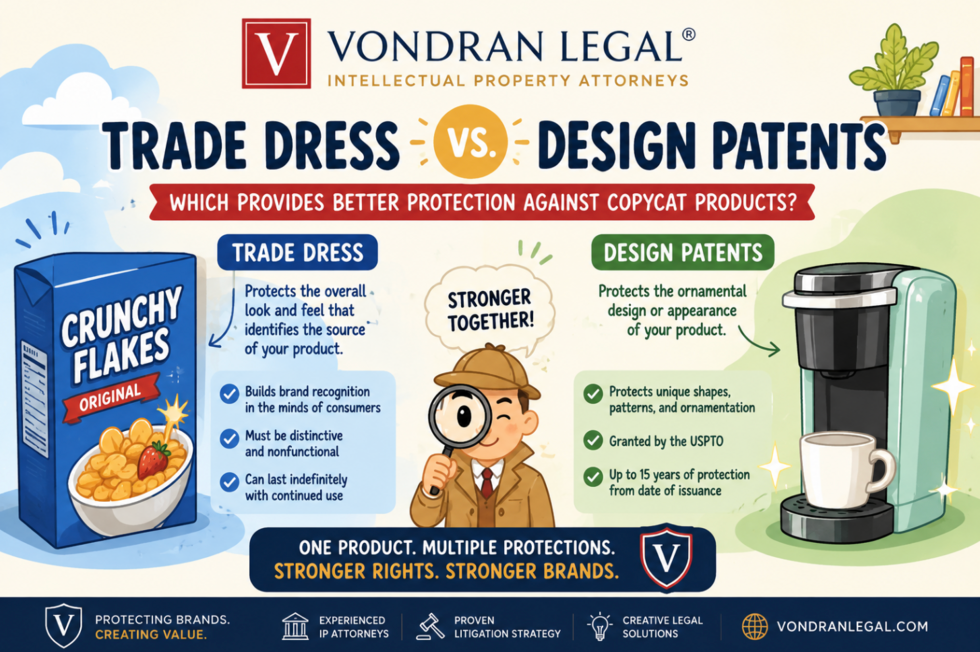
Rather than protecting a company name or logo, trade dress protects the overall visual appearance of a product or its packaging when that appearance identifies the source of the goods.
Trade dress may include:
- Product packaging
- Product configuration
- Color combinations
- Product shape
- Store layouts
- Distinctive visual features
Perhaps the best known trade dress case is Two Pesos, Inc. v. Taco Cabana, Inc., 505 U.S. 763 (1992).
In that case, the United States Supreme Court held that inherently distinctive trade dress may receive protection under the Lanham Act without proof of secondary meaning. The Court recognized that the overall appearance of a business can function much like a trademark when consumers associate that appearance with a single source.
That decision remains one of the cornerstones of modern trade dress law.
NOT EVERY PRODUCT DESIGN QUALIFIES FOR TRADE DRESS PROTECTION
Trade dress protection is not automatic.
A business generally must demonstrate that its trade dress is:
- Distinctive
- Nonfunctional
- Used to identify the source of the goods
One of the most significant limitations involves functionality.
In TrafFix Devices, Inc. v. Marketing Displays, Inc., 532 U.S. 23 (2001), the Supreme Court reaffirmed that functional product features cannot receive trade dress protection.
The Court explained that trademark law should not be used to create perpetual monopolies over useful product features that should remain available to competitors.
In other words, trade dress protects branding, not engineering.
This distinction frequently becomes one of the central issues in product design litigation.
WHAT IS A DESIGN PATENT?
A design patent protects the ornamental appearance of an article of manufacture.
Unlike utility patents, which protect functional inventions, design patents protect the way a product looks.
Examples include:
- Decorative bottle shapes
- Consumer electronics
- Furniture
- Jewelry
- Packaging
- Consumer products
- Product configurations
Design patents are issued by the United States Patent and Trademark Office and generally provide 15 years of protection from the date of issuance for newer patents.
Unlike trade dress, a design patent does not require consumer recognition.
Protection begins immediately after the patent issues.
DESIGN PATENT INFRINGEMENT FOCUSES ON VISUAL SIMILARITY
Courts analyze design patent infringement differently than trademark infringement.
One of the leading decisions is Egyptian Goddess, Inc. v. Swisa, Inc., 543 F.3d 665 (Fed. Cir. 2008).
In that case, the Federal Circuit adopted what is commonly known as the ordinary observer test.
Rather than comparing individual design elements one by one, courts examine whether an ordinary purchaser would consider the accused design substantially similar to the patented design when viewed as a whole.
This practical approach remains the primary standard used in design patent infringement litigation today.
TRADE DRESS AND DESIGN PATENTS PROTECT DIFFERENT RIGHTS
Although businesses frequently discuss these rights together, they protect very different interests.
A design patent protects ornamental design.
Trade dress protects consumer recognition.
This distinction is important.
A company may obtain a design patent shortly after developing a new product.
Trade dress protection often develops much later after consumers begin associating the appearance of the product with a single source.
Because these protections arise at different stages of a product's life cycle, many companies pursue both.
CAN A PRODUCT HAVE BOTH?
Absolutely.
Many successful companies build layered intellectual property portfolios.
One product may simultaneously be protected by:
- Trademarks
- Trade dress
- Design patents
- Utility patents
- Copyrights
- Trade secrets
This layered strategy provides businesses with multiple legal theories should competitors begin marketing copycat products.
Recent lawsuits involving consumer goods illustrate this approach, with plaintiffs frequently asserting both trade dress and design patent claims in the same action.
APPLE V. SAMSUNG CHANGED DESIGN PATENT LITIGATION
One of the most widely discussed design patent disputes involved Apple Inc. v. Samsung Electronics Co.
The litigation centered on whether Samsung smartphones infringed Apple's design patents covering the appearance of the iPhone.
Although the dispute involved several legal issues, the United States Supreme Court issued an important decision addressing how damages should be calculated under the design patent statute.
The case highlighted the enormous value design patents can hold for companies whose products compete largely on appearance and consumer appeal.
It also demonstrated that product design itself can represent a valuable intellectual property asset deserving significant legal protection.
WHICH IS BETTER FOR STOPPING DUPES?
There is no universal answer.
The appropriate legal strategy depends on several factors, including:
- Whether a design patent exists
- Whether consumers recognize the product's appearance
- Whether the copied features are ornamental or functional
- The age of the product
- The available evidence
Many modern lawsuits involving copycat products combine trademark, trade dress, design patent, copyright, false advertising, and unfair competition claims to maximize available legal protections.
As discussed during the recent webinar, businesses increasingly rely on overlapping intellectual property rights rather than any single legal theory when challenging dupe products.
PRACTICAL CONSIDERATIONS FOR BUSINESSES
Businesses investing in innovative product design should think about intellectual property protection early in the product development process.
Among other things, companies should consider:
- Filing design patent applications before public disclosure whenever appropriate.
- Evaluating whether product packaging or configuration may eventually qualify for trade dress protection.
- Registering trademarks that strengthen overall brand identity.
- Maintaining documentation demonstrating consumer recognition.
- Monitoring competitors for potential infringement.
A proactive intellectual property strategy is often significantly less expensive than attempting to recover market share after copycat products have already entered the marketplace.
FINAL THOUGHTS
Trade dress and design patents are among the most valuable tools available to businesses seeking to protect innovative product designs.
Although they frequently overlap, each protects different legal interests and serves a distinct purpose within a comprehensive intellectual property strategy.
Companies developing successful consumer products should evaluate these protections early rather than waiting until copycat products appear.
At Vondran Legal®, our intellectual property attorneys regularly advise businesses regarding trade dress protection, design patent strategy, trademark registration, infringement litigation, licensing, unfair competition, and comprehensive brand protection programs.
If your company has developed a distinctive product or believes competitors are unfairly copying your product designs, contact Vondran Legal® at (877) 276-5084 for a free consultation.
