
Vondran Legal® Brand Protection Law Firm: What "Class ACT" Means for Brand Owners, Creators, Artists, Musicians, and Trademark Applicants
By Attorney Steve® | Vondran Legal®
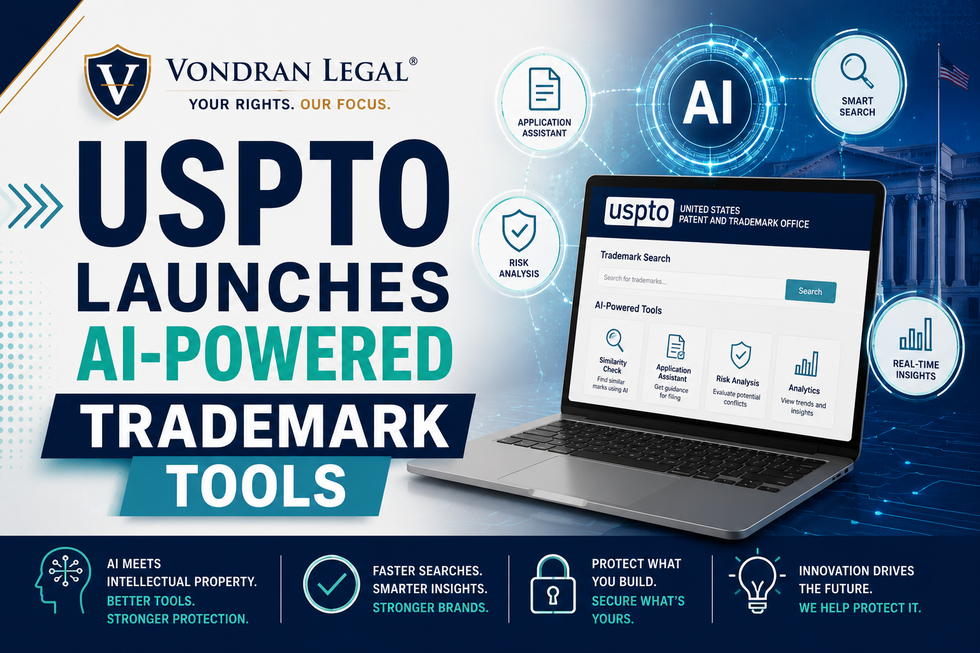
Artificial intelligence has officially arrived at the United States Patent and Trademark Office (USPTO), and it is poised to significantly improve the way trademark applications are searched, classified, and examined.
In March and April 2026, the USPTO announced several new AI-powered initiatives, including its groundbreaking Trademark Classification Agentic Codification Tool ("Class ACT") and an AI-powered image search system for trademark applicants and practitioners. These new tools are designed to reduce processing delays, improve search accuracy, and make trademark prosecution more efficient while preserving human oversight by experienced trademark examiners.
If you own a business, create logos, sell merchandise, perform as a musician, publish online content, develop software, or build a personal brand, these new tools could directly affect how you protect your intellectual property.
Table of Contents
- What Is USPTO Class ACT?
- When Did It Launch?
- Why Did the USPTO Create It?
- What Does Class ACT Actually Do?
- Understanding International Trademark Classes
- What Are Design Search Codes?
- What Is a Pseudo Mark?
- New AI Image Search
- Who Benefits?
- What This Means for Creators and Artists
- How This Helps Musicians
- How This Helps Businesses
- What AI Does NOT Replace
- Why Trademark Attorneys Still Matter
- How Vondran Legal Can Help
- Frequently Asked Questions
What Is USPTO Class ACT?
Class ACT stands for:
Trademark Classification Agentic Codification Tool
It is the USPTO's first AI-powered agent designed to automate many of the administrative tasks that occur before a trademark application reaches an examining attorney.
Rather than replacing human trademark examiners, Class ACT performs repetitive, high-volume tasks that previously delayed examination for months.
According to the USPTO, the system can immediately assign:
- International trademark classes
- Design Search Codes
- Pseudo marks
These classifications make trademark applications searchable by both USPTO examiners and the public.
When Did It Launch?
The rollout occurred in stages:
March 19, 2026
The USPTO announced Class ACT, describing it as the agency's first agentic AI tool for trademark preprocessing.
April 2, 2026
The USPTO announced additional AI enhancements, including:
- AI image search (beta)
- AI mark description generator
- AI color claim generator
- Continued implementation of Class ACT.
The USPTO has also indicated that additional AI-powered trademark tools are expected in the future.
Why Did the USPTO Develop Class ACT?
Trademark filings have grown dramatically over the past decade.
Applications containing:
- logos,
- stylized wording,
- unconventional spellings,
- graphic designs, or
- missing classifications
required USPTO personnel to manually perform coding before examination.
This preprocessing often delayed applications by several months.
Class ACT removes much of that bottleneck by automating those coding functions, allowing applications to become searchable almost immediately while still being reviewed by USPTO personnel.
What Does Class ACT Actually Do?
1. Assigns International Trademark Classes
Every trademark application must identify the appropriate class of goods or services under the Nice Classification system.
Examples include:
- Class 9 – Software
- Class 25 – Clothing
- Class 35 – Advertising
- Class 41 – Education and entertainment
- Class 42 – Software as a Service (SaaS)
Selecting incorrect classes can lead to:
- Office Actions
- additional filing fees
- prosecution delays
- narrower protection than intended
Class ACT automatically recommends appropriate classifications for unclassified applications.
2. Generates Design Search Codes
Design Search Codes index visual elements in trademarks.
Examples include:
- stars
- mountains
- eagles
- lions
- trees
- musical notes
- crowns
- geometric shapes
Historically, USPTO employees manually assigned these codes.
Class ACT now performs that task almost instantly.
3. Creates Pseudo Marks
Pseudo marks improve searchability for unusual spellings.
Examples:
- EZ → EASY
- KWIK → QUICK
- 4U → FOR YOU
This helps identify marks that may sound alike even if they are spelled differently.
That greatly improves likelihood-of-confusion searches.
The New AI Image Search Tool
One of the most exciting additions is the USPTO's AI-powered image search.
Instead of searching using only Design Search Codes, users can upload an image of a proposed logo and receive visually similar trademark results.
Think of it as a reverse image search tailored specifically to trademarks.
This is especially valuable for:
- logo designers;
- startups;
- advertising agencies;
- artists creating brand identities; and
- trademark attorneys conducting clearance searches.
How Can These Tools Help Rights Holders?
While these tools are designed primarily to improve trademark examination, they also offer practical benefits for rights holders seeking to protect their brands.
Businesses
Companies can:
- evaluate new logos before investing in branding;
- identify potentially conflicting marks earlier; and
- refine branding before filing.
Graphic Designers
Designers can test proposed logos before presenting them to clients, reducing the risk of creating a design that closely resembles an existing trademark.
Artists
Artists who license their work as brand identifiers can use AI image search to identify potentially conflicting design marks before commercialization.
Keep in mind, however, that the USPTO's trademark tools do not determine copyright ownership or whether artwork has been licensed. Trademark and copyright are separate legal rights.
Musicians
Musicians often rely heavily on trademarks.
Examples include:
- band names;
- artist names;
- tour names;
- record label names;
- festival names;
- merchandise logos; and
- album series used as source identifiers.
These new AI tools can help identify potential conflicts before expensive marketing campaigns or merchandise launches.
Influencers and Content Creators
Creators increasingly build valuable brands around:
- YouTube channels;
- podcast names;
- Twitch channels;
- newsletters;
- clothing lines;
- educational courses; and
- online communities.
A thorough trademark clearance search—including AI-assisted image searches—can reduce the risk of adopting a brand that conflicts with an existing registration.
What These Tools Do NOT Do
Despite the excitement surrounding AI, these tools do not decide whether a trademark should register.
The USPTO has emphasized that human review remains part of the process.
AI does not determine:
- likelihood of confusion under the DuPont factors;
- descriptiveness or genericness;
- acquired distinctiveness;
- functionality;
- fraud;
- ownership disputes;
- trademark infringement;
- copyright ownership; or
- fair use.
Those legal determinations continue to require experienced attorney analysis and examiner judgment.
Why Trademark Lawyers Are Still Essential
Artificial intelligence can improve efficiency, but it cannot replace legal strategy.
An experienced trademark attorney can help:
- select the correct filing strategy;
- identify risks beyond the USPTO database, including common-law users;
- conduct comprehensive clearance searches;
- respond to Office Actions;
- negotiate coexistence agreements;
- enforce trademark rights;
- defend against infringement claims; and
- develop a long-term brand protection strategy.
AI is a powerful tool—but it is not a substitute for legal advice.
How Vondran Legal Can Help
At Vondran Legal®, we help businesses, creators, and entrepreneurs protect and enforce their intellectual property throughout the United States.
Our trademark services include:
- Trademark clearance searches
- AI-assisted logo evaluations
- Federal trademark applications
- Office Action responses
- Trademark monitoring strategies
- Trademark licensing agreements
- Cease-and-desist letters
- Trademark infringement defense
- TTAB opposition and cancellation proceedings
- Brand enforcement and portfolio management
- Intellectual property audits for growing businesses
We also advise clients whose brands overlap with copyright, publicity rights, entertainment law, software, artificial intelligence, and digital media.
Whether you are launching a startup, introducing a new product line, protecting a music brand, or expanding an online creator business, we can help you build a comprehensive intellectual property strategy that keeps pace with rapidly evolving AI technologies.
Frequently Asked Questions (FAQ)
What is USPTO Class ACT?
Class ACT is the USPTO's AI-powered Trademark Classification Agentic Codification Tool that automatically assigns international classes, design search codes, and pseudo marks to trademark applications.
Does AI approve trademark applications?
No. AI assists with administrative preprocessing, but human examining attorneys still make substantive legal decisions regarding registrability.
Can AI image search tell me whether my artwork is copyrighted?
No. The USPTO's image search is designed for trademark searching, not copyright ownership or licensing.
Will these tools speed up trademark applications?
Potentially yes. By reducing preprocessing from months to minutes, applications may move to substantive examination more quickly, although overall timelines will still depend on USPTO workloads and examiner review.
Should I rely only on AI before filing a trademark?
No. AI tools are valuable supplements, but they should not replace a comprehensive trademark clearance search, common-law investigation, and legal analysis.
Do these tools help musicians and creators?
Yes. Musicians, artists, influencers, podcasters, software developers, and other creators who build brands around names, logos, and merchandise can use these tools as part of a broader strategy to identify potential conflicts before launch.
Can a trademark attorney use these AI tools to help my business?
Absolutely. Trademark counsel can integrate AI-powered searches into a comprehensive clearance process, interpret the results, assess legal risk, and develop filing and enforcement strategies tailored to your business goals.
Protect Your Brand Before Someone Else Does
The USPTO's adoption of Class ACT and AI-powered image search represents one of the most significant technological advancements in trademark practice in years. These tools promise faster processing, improved searchability, and more efficient trademark examination, but they are only part of the equation. Effective brand protection still requires thoughtful legal strategy, careful clearance analysis, and proactive enforcement. If you are launching a new business, expanding your product line, building a personal brand, or protecting creative assets, experienced trademark counsel can help you take full advantage of these innovations while avoiding costly legal pitfalls. Contact Vondran Legal® to discuss your trademark strategy and how these new AI tools can support the protection of your valuable intellectual property.

