
VONDRAN LEGAL® – DUPES, TRADEMARK & TRADE DRESS LAW
INTRODUCTION
Luxury handbags. Viral beauty products. Designer fragrances. Premium athletic wear. High-end furniture.
Today, nearly every successful consumer product has a "dupe."
A quick search on TikTok, Instagram, or YouTube will reveal thousands of videos featuring creators who promise to help consumers "save money" by purchasing products that look, feel, or function like expensive luxury goods. Entire social media accounts are now dedicated to finding the "best dupes" for everything from Lululemon® apparel to Hermès® handbags and Sol de Janeiro® beauty products.
The trend has become so popular that some companies openly market themselves as brands that specialize in creating affordable alternatives to premium products.
Naturally, this raises an important legal question:
Are dupes actually legal?
The answer is yes... sometimes.
Contrary to popular belief, not every dupe violates intellectual property law. On the other hand, simply avoiding the original company's logo does not automatically make a product lawful.
Like many areas of intellectual property law, the answer depends on the specific facts, the type of product involved, and the intellectual property rights the original company owns.
Let's take a closer look.
WHAT EXACTLY IS A "DUPE"?
The word "dupe" is short for "duplicate," but today's marketplace uses the term much more broadly.
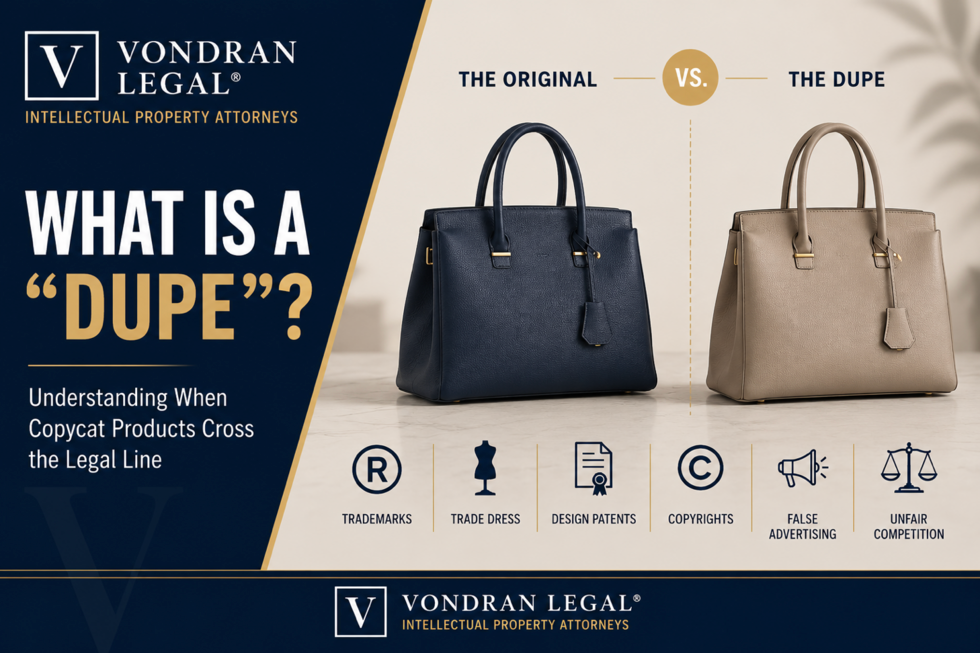
Generally speaking, a dupe is a lower-priced product that is intentionally designed to resemble a more expensive or well-known product.
The goal is not necessarily to fool consumers into believing they are purchasing the original product. Instead, the seller hopes consumers will recognize the similarities and decide that paying a fraction of the price is a worthwhile tradeoff.
Examples might include:
- a handbag inspired by a luxury designer purse;
- a skincare cream advertised as comparable to a premium cosmetic brand;
- leggings that closely resemble a popular athletic apparel company;
- furniture designed to evoke the appearance of a high-end designer piece.
Social media has fueled this phenomenon in ways that simply did not exist a decade ago. Influencers regularly compare products side-by-side, encouraging followers to purchase the "same look for less." As a result, "dupe culture" has become one of the fastest-growing trends in consumer retail.
DUPES ARE DIFFERENT FROM COUNTERFEITS
One of the biggest misconceptions is that every dupe is a counterfeit.
That simply is not true.
A counterfeit generally copies protected trademarks, logos, or branding in an attempt to convince consumers they are buying an authentic product.
Think of a handbag bearing the Louis Vuitton® monogram or a pair of sneakers displaying Nike's famous Swoosh® without authorization.
Those products are classic examples of trademark infringement and counterfeiting.
A dupe, however, usually takes a different approach.
Rather than copying the trademark itself, the manufacturer attempts to capture the overall aesthetic or style of the product while marketing it under its own brand name.
Consumers often understand they are not buying the original product. In fact, many purchasers intentionally seek out dupes because they know they are less expensive alternatives.
That distinction often makes the legal analysis significantly more complicated.
IF IT DOESN'T COPY THE LOGO, IS IT LEGAL?
Not necessarily.
Many businesses assume that removing a logo or changing the brand name eliminates legal risk.
Unfortunately, intellectual property law is much broader than trademark registration alone.
A product can potentially infringe another company's rights even when no logo has been copied.
Depending on the circumstances, a company may have rights in the product's appearance, packaging, ornamental features, advertising claims, copyrighted artwork, or other protectable elements.
This is why companies facing dupe products often assert multiple legal claims at the same time rather than relying on a single theory of liability.
THE LEGAL TOOLBOX GOES BEYOND TRADEMARKS
When people hear "intellectual property," they often think only about trademarks.
In reality, businesses may rely on several different areas of law to protect their products.
These may include:
- trademark infringement;
- trade dress infringement;
- design patent infringement;
- copyright infringement;
- false advertising;
- unfair competition.
Each of these protects something different.
For example, trademarks protect source identifiers such as names and logos.
Trade dress may protect the overall look and feel of a product or its packaging if consumers associate that appearance with a single company.
Design patents protect ornamental product designs.
Copyright may protect artistic or graphic elements incorporated into a product.
False advertising laws prohibit misleading comparisons between competing products.
Because these legal rights overlap, many modern dupe lawsuits involve several causes of action asserted together. As discussed during a recent webinar on the evolving "dupes defense playbook," successful enforcement increasingly depends on evaluating every available intellectual property right rather than relying solely on traditional trademark claims.
WHY TRADEMARK CLAIMS ARE NOT ALWAYS EASY
One of the most surprising aspects of dupe litigation is that traditional trademark infringement claims are not always the strongest claims.
Why?
Trademark law generally focuses on consumer confusion.
If consumers knowingly purchase a lower-priced alternative while fully understanding it is not made by the original company, proving trademark infringement can become much more difficult.
That is why many recent lawsuits have focused on legal theories beyond simple trademark infringement.
Instead of arguing that consumers were confused by the brand name, companies increasingly argue that competitors copied the overall appearance of their products, unfairly traded on years of goodwill, or made false claims about product equivalency.
TRADE DRESS AND DESIGN PATENTS ARE BECOMING MORE IMPORTANT
As dupe culture continues to grow, many businesses are investing heavily in protecting the appearance of their products.
Trade dress protection may apply to distinctive packaging, product configuration, or the overall visual impression of a product if it serves as a source identifier and is not merely functional.
Similarly, design patents can protect ornamental aspects of a product's design.
These rights have become increasingly valuable because many dupe products avoid copying logos while attempting to replicate nearly everything else.
Recent lawsuits involving companies such as Lululemon, Coach, Nike, Stanley, Williams-Sonoma, and Sol de Janeiro illustrate this trend. Rather than focusing exclusively on trademarks, these companies have increasingly relied on trade dress, design patents, unfair competition, and related legal theories to protect their products.
FALSE ADVERTISING IS AN EMERGING BATTLEGROUND
Another legal theory receiving significant attention involves false advertising.
Many companies market their products using language such as:
- "Luxury quality without the luxury price."
- "Comparable to..."
- "The same product for half the cost."
- "Just like the original."
There is nothing inherently unlawful about comparative advertising.
However, businesses must be able to substantiate objective claims they make about their products.
If a company advertises that its product performs the same as a premium competitor—or implies that consumers are receiving an equivalent product when they are not—that marketing may create potential liability under the Lanham Act or state unfair competition laws.
This is an area of law that continues to evolve rapidly as courts address the growing influence of social media and influencer marketing.
EVERY DUPE MUST BE EVALUATED INDIVIDUALLY
Perhaps the most important takeaway is this:
There is no universal rule that determines whether a dupe is lawful.
Every case depends on its own facts.
Among other things, courts may examine:
- whether consumers are likely to be confused;
- whether protected trade dress has been copied;
- whether product features are functional or ornamental;
- whether a design patent exists;
- whether copyrighted artwork has been reproduced;
- whether advertising claims are truthful and substantiated; and
- whether the overall marketing unfairly capitalizes on another company's reputation.
In short, simply calling something a "dupe" does not answer the legal question.
It merely begins the analysis.
FINAL THOUGHTS
The popularity of dupe products shows no signs of slowing down.
As consumer demand continues to grow, we expect litigation involving copycat products, trade dress, design patents, false advertising, and unfair competition to increase as well.
For businesses introducing products inspired by existing brands, understanding these legal risks before launch can help avoid expensive disputes down the road.
Likewise, companies whose products are being copied should consider whether their intellectual property portfolio provides the strongest possible protection, not just through trademarks, but also through copyrights, design patents, trade dress, and other available rights.
At Vondran Legal®, our intellectual property attorneys regularly represent businesses, creators, designers, e-commerce companies, manufacturers, and entrepreneurs in matters involving trademark law, copyright law, trade dress, design patents, unfair competition, and false advertising.
If your company is developing a new product, or believes another business is unfairly copying yours, our experienced IP attorneys may be able to help. Contact Vondran Legal® at (877) 276-5084 for a free consulation.
