
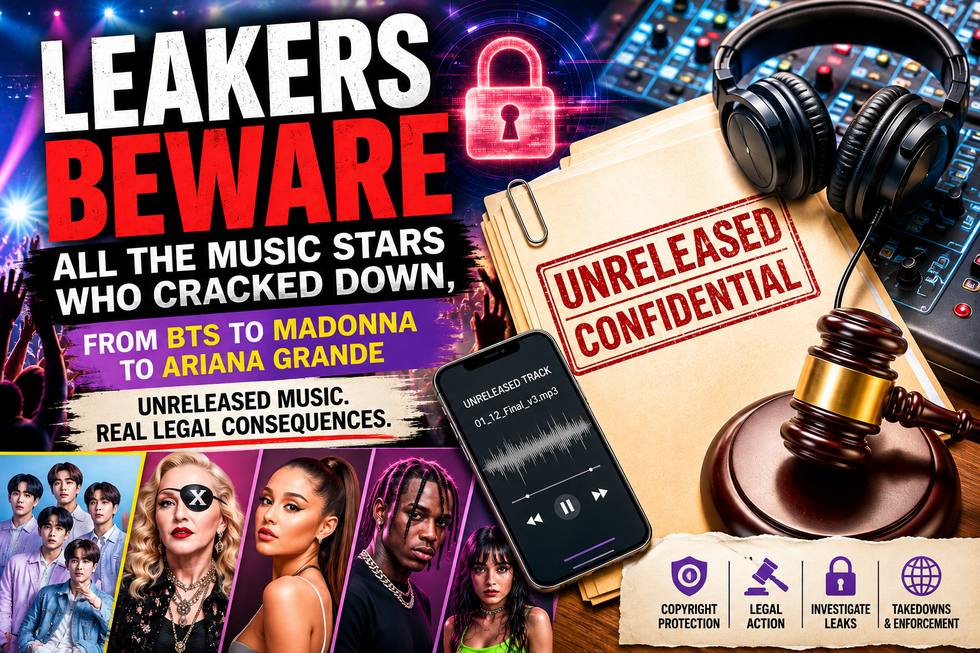
FROM BTS TO MADONNA TO ARIANA GRANDE, MUSIC LEAKS CAN HAVE SERIOUS LEGAL CONSEQUENCES
For artists, releasing a new song or album is rarely a spontaneous event; Writing, recording, producing, marketing, and planning can take months or years. Labels coordinate promotional campaigns, streaming platforms prepare featured placements, merchandise launches are timed to coincide with album drops, and concert tours frequently revolve around new music.
When an unreleased song suddenly appears online weeks or months before its intended release, that strategy can unravel overnight.
Music leaks have plagued the recording industry for decades. Some involve hackers who gain unauthorized access to cloud storage or recording servers. Others stem from insiders, collaborators, engineers, or even manufacturers who obtain early copies of albums. Once an unreleased recording reaches the internet, it can spread across social media, file-sharing platforms, messaging apps, and unauthorized websites within hours.
Over the years, numerous artists, including BTS, Madonna, Ariana Grande, Playboi Carti, Charli XCX, and others, have publicly addressed leaked music and, in some cases, pursued legal action or worked aggressively to remove unauthorized recordings from the internet.
While fans sometimes view leaked songs as harmless previews, the legal issues surrounding unreleased music are far more significant than many realize.
UNRELEASED MUSIC IS STILL PROTECTED BY COPYRIGHT
One of the biggest misconceptions surrounding music leaks is that a song must be officially released before copyright protection exists.
Under United States copyright law, copyright protection generally attaches as soon as an original work is fixed in a tangible medium of expression. In the music industry, that often occurs when a song is recorded, regardless of whether it has been commercially released.
An unreleased recording can therefore receive the same copyright protection as a song that has topped the Billboard charts.
The fact that the public has never heard the song does not place it in the public domain, nor does it give others permission to copy, upload, distribute, or monetize it.
WHY LEAKS CAN CAUSE ENORMOUS FINANCIAL DAMAGE
Leaked songs can undermine an entire business strategy.
Record labels invest substantial sums in developing an artist's release schedule. Marketing campaigns are coordinated months in advance. Streaming platforms negotiate exclusive promotional opportunities. Music videos are produced, advertising campaigns are purchased, and media appearances are carefully timed to maximize public attention.
A leak can disrupt those plans in numerous ways. Fans may lose interest after hearing unfinished recordings. Journalists may review songs before the artist considers them complete. Streaming numbers can suffer if listeners have already obtained unauthorized copies, and marketing campaigns built around surprise releases may lose much of their impact.
In some situations, artists abandon projects altogether after significant portions of an album have leaked online.
For emerging artists, the financial consequences can be especially severe.
COPYRIGHT INFRINGEMENT IS ONLY THE BEGINNING
When most people think about music leaks, they immediately think about copyright infringement. While copyright law certainly plays an important role, it is often only one piece of a much larger legal picture.
Depending on how the recordings were obtained, additional legal claims may include breach of contract, breach of confidentiality agreements, trade secret misappropriation, computer fraud, unauthorized access to computer systems, theft of confidential business information, and other civil or criminal claims.
For example, a recording engineer who signs a non-disclosure agreement before working on an album may face contractual liability if confidential recordings are intentionally shared before release. Likewise, hackers who gain unauthorized access to cloud storage or recording systems may face criminal investigations in addition to civil lawsuits.
The legal analysis depends upon the facts, but copyright law is rarely the only issue.
HOW ARTISTS AND RECORD LABELS RESPOND
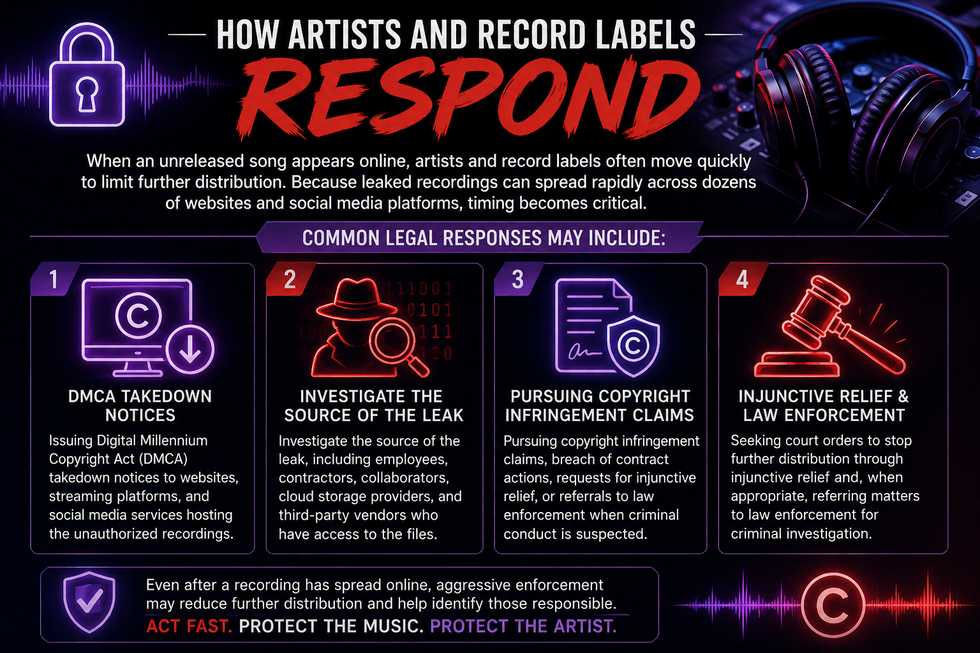
When an unreleased song appears online, artists and record labels often move quickly to limit further distribution. Because leaked recordings can spread rapidly across dozens of websites and social media platforms, timing becomes critical.
Common legal responses may include:
- Issuing Digital Millennium Copyright Act (DMCA) takedown notices to websites, streaming platforms, and social media services hosting the unauthorized recordings.
- Investigate the source of the leak, including employees, contractors, collaborators, cloud storage providers, and third-party vendors who have access to the files.
- Pursuing copyright infringement claims, breach of contract actions, requests for injunctive relief, or referrals to law enforcement when criminal conduct is suspected.
Even after a recording has spread online, aggressive enforcement may reduce further distribution and help identify those responsible.
THE DIGITAL AGE HAS MADE LEAKS MORE DIFFICULT TO CONTAIN
Years ago, leaked albums often circulated through physical CDs or small file-sharing communities. Today, unauthorized recordings can reach millions of listeners within minutes.
Private messaging groups, encrypted applications, cloud storage links, anonymous file-sharing services, and social media platforms allow digital files to spread faster than ever before. Even if an original upload is removed, copies may continue to appear across dozens of websites.
This creates a difficult reality for artists and copyright owners. Completely eliminating leaked content from the internet may be impossible, but prompt legal action can still reduce widespread distribution, preserve valuable evidence, and discourage future infringement.
For that reason, many artists maintain relationships with legal teams and digital enforcement companies that monitor the internet for unauthorized copies of their music.
WHAT FANS SHOULD KNOW
Many music fans believe that downloading or sharing a leaked song is relatively harmless because the artist will eventually release the music anyway.
That assumption can be risky.
Uploading, distributing, or publicly sharing unauthorized recordings may constitute copyright infringement regardless of whether the work has been officially released. Individuals who repost leaked songs to websites, social media accounts, or file-sharing platforms may also receive DMCA takedown notices, account suspensions, or, in some circumstances, become targets of legal action.
Simply because a song has leaked online does not mean it is lawful to copy or redistribute it.
PROTECTING UNRELEASED CREATIVE WORKS
The music industry's experience offers valuable lessons for businesses beyond entertainment.
Companies developing software, films, books, advertising campaigns, video games, product designs, or proprietary technology often face similar risks involving confidential creative materials. Strong contracts carefully drafted non-disclosure agreements, secure digital storage systems, limited access controls, and prompt legal action when confidential works are misappropriated can significantly reduce the likelihood of costly leaks.
Once confidential intellectual property becomes widely available online, restoring exclusivity can be extremely difficult.
Prevention is almost always less expensive than litigation.
FINAL THOUGHTS
The excitement surrounding unreleased music often overshadows an important legal reality: songs do not lose copyright protection simply because they have not yet been released. From BTS and Madonna to Ariana Grande and countless other artists, leaked recordings have prompted aggressive enforcement efforts to protect valuable intellectual property and carefully planned commercial releases.
As technology continues to make digital files easier to copy and distribute, artists, record labels, and other creative businesses will likely continue investing heavily in protecting confidential works before they ever reach the public.
For creators, the lesson is clear. Protect your unreleased works with strong contracts, secure storage practices, and proactive legal planning. For fans, remember that just because a song appears online does not mean it was lawfully shared.
NEED HELP PROTECTING YOUR CREATIVE WORKS?
Whether you are a musician, producer, record label, content creator, or a business developing valuable intellectual property, taking proactive steps before confidential work is leaked can significantly reduce legal risk. Copyright registration, carefully drafted licensing agreements, non-disclosure agreements, and effective enforcement strategies all play an important role in protecting creative assets.
Vondran Legal® represents artists, musicians, content creators, software developers, entertainment companies, and businesses in copyright, trademark, licensing, technology, and intellectual property disputes. If your copyrighted works have been copied, leaked, or misappropriated, experienced legal counsel can help evaluate your rights and available legal remedies.
