
The Dirty Secret Behind Million-Dollar IP Judgments: Vondran Legal® Copyright Infringement Insights
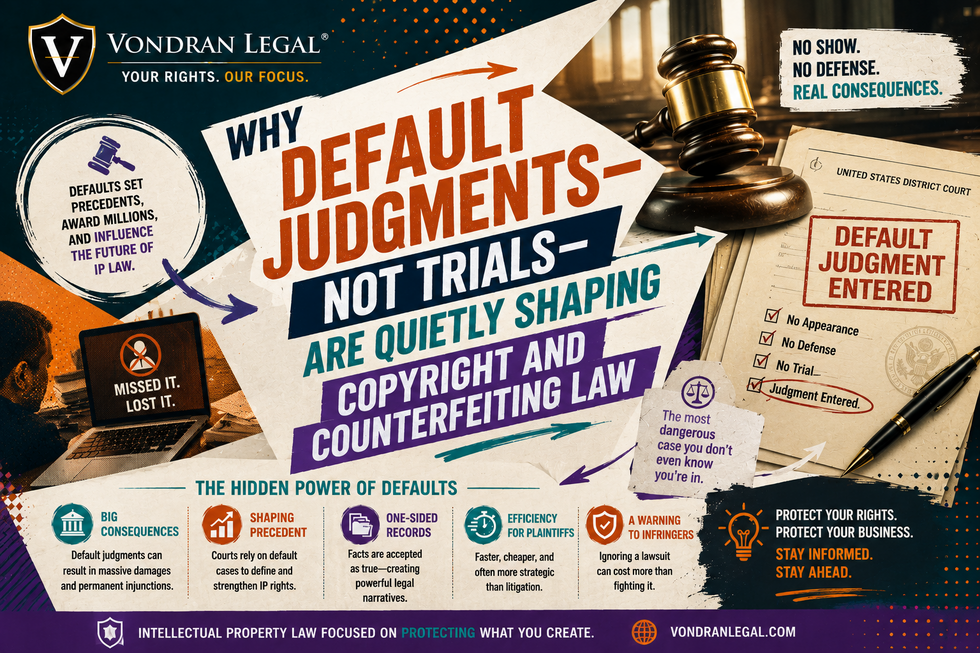
SEO Title: Why Default Judgments Are Quietly Reshaping Copyright and Counterfeiting Litigation
Meta Description: Most of the largest copyright and trademark judgments are won by default—not at trial. Learn why default judgments are becoming one of the most powerful enforcement tools in intellectual property litigation and what businesses should know.
The Dirty Secret Behind Million-Dollar IP Judgments: Why Default Judgments—Not Trials—Are Quietly Shaping Copyright and Counterfeiting Law
When lawyers discuss major copyright or trademark decisions, they usually focus on fair use, likelihood of confusion, substantial similarity, or statutory damages.
But there is another trend quietly reshaping intellectual property litigation—and surprisingly few attorneys are talking about it.
Many of the largest copyright and trademark judgments in the United States were never decided on the merits at all.
Instead, they were entered because the defendant failed to appear, failed to answer, or otherwise defaulted.
That distinction matters.
It changes how businesses should evaluate demand letters, litigation strategy, settlement negotiations, and even risk assessment.
A Pattern Hidden in Plain Sight
Consider several cases frequently cited by intellectual property enforcement firms.
Fox News Network v. Does 1-10
Fox obtained approximately $4.15 million in statutory copyright damages against operators of unauthorized streaming services after the defendants defaulted.
There was no jury trial.
No lengthy evidentiary hearing.
The defendants simply failed to defend the case.
American Chemical Society v. Sci-Hub
The American Chemical Society obtained approximately $4.8 million in statutory damages against Sci-Hub for unauthorized distribution of scientific journals.
Again—
Default judgment.
The defendants never meaningfully participated.
Montblanc-Simplo GmbH v. Ilnitsky
One of the largest IP judgments you'll see cited.
Over $32 million.
Sounds terrifying.
But here's what many lawyers fail to mention.
Most of the recovery came from trademark counterfeiting damages, not copyright damages.
Even more importantly—
It too was entered after default.
Electronic Creations Corp. v. Gigahertz
Maximum statutory damages of $150,000 for infringement of a single copyrighted work.
Again—
The defendant did not successfully defend the case.
This Changes the Conversation
Many demand letters cite these cases as though they represent ordinary litigation outcomes.
They do not.
They represent what can happen when defendants disappear.
That is an entirely different risk profile.
For businesses receiving software audit demands, copyright infringement letters, trademark claims, or counterfeiting accusations, understanding this distinction is critical.
Default Judgments Create Their Own Body of Law
Here's the fascinating part.
Default judgments rarely create groundbreaking legal precedent.
Yet they are increasingly becoming the practical benchmark that rights holders use during settlement negotiations.
Why?
Because they demonstrate what courts are willing to award when infringement allegations go unanswered.
The result is a powerful psychological tool.
Demand letters frequently reference eight-figure judgments.
Recipients assume those awards resulted from contested trials.
Often they did not.
Why This Matters for Software Audits
The distinction becomes especially important in software licensing disputes.
Companies facing claims from publishers such as Autodesk, Dassault Systèmes, Siemens, Hexagon, or Ansys may receive letters emphasizing that copyright law authorizes statutory damages of up to $150,000 per infringed work.
Legally, that's true.
Practically, however, software audit disputes often involve very different issues:
- License interpretation
- Number of installations
- Concurrent versus named users
- Educational licenses
- Employee conduct
- Scope of authorization
- Recordkeeping failures
- Contract interpretation
Most of these cases never resemble commercial piracy operations.
Nor do they resemble international counterfeit trafficking.
Counterfeiting Cases Are Often Different Animals Entirely
Trademark counterfeiting cases involve a different level of culpability.
Typical facts include:
- Selling fake luxury goods
- Counterfeit pharmaceuticals
- Unauthorized sports merchandise
- Fake electronics
- Intentional use of another company's exact trademark
Congress intentionally created enhanced statutory damages to deter organized counterfeiting operations.
That makes sense.
But those same eye-popping judgments often get cited in disputes involving far less egregious conduct.
Understanding the distinction can dramatically change settlement strategy.
Why Plaintiffs Love Default Judgments
Default judgments offer several strategic advantages.
They avoid expensive discovery.
No depositions.
No expert witnesses.
No summary judgment briefing.
Allegations become largely uncontested.
When a defendant defaults, well-pleaded factual allegations are generally deemed admitted for purposes of liability.
That dramatically simplifies the plaintiff's burden.
Courts may infer willfulness.
When defendants intentionally ignore lawsuits, courts are often more willing to conclude the infringement was willful.
Willfulness directly affects statutory damages.
Permanent injunctions become easier.
Without an opposing party presenting evidence, courts frequently grant broad injunctive relief alongside monetary damages.
The Real Story Isn't the Damage Award
The headline says:
"$32 Million Judgment."
The more important question is:
How did the plaintiff get there?
Was there:
- a contested trial?
- expert testimony?
- extensive discovery?
- dispositive motions?
- credibility findings?
Or...
Did the defendant simply never show up?
Those are very different stories.
A Lesson for Businesses
One of the biggest mistakes businesses make after receiving an IP demand letter is assuming they have only two choices:
Pay.
Or ignore it.
Ignoring the matter can transform a manageable licensing dispute into a catastrophic default judgment.
Responding early often creates opportunities to:
- negotiate;
- preserve defenses;
- challenge damages;
- dispute willfulness;
- demonstrate licensing history;
- correct compliance issues; and
- potentially resolve the matter before litigation.
The Bigger Trend Few Lawyers Are Discussing
As intellectual property enforcement becomes increasingly data-driven—particularly through software audits, online monitoring, AI detection tools, blockchain investigations, and automated infringement tracking—we may see more lawsuits filed against defendants who never meaningfully participate.
That means default judgments could become an even larger part of the intellectual property landscape.
Ironically, these decisions may influence settlement negotiations far more than published appellate opinions.
They shape expectations.
They influence risk calculations.
And they often become the first cases cited in demand letters.
Understanding that dynamic may be just as important as understanding copyright law itself.
Key Takeaways
- Many of the largest copyright and trademark judgments arise from default judgments, not contested trials.
- Default judgments often involve commercial piracy, counterfeit operations, or defendants who never appeared in court.
- Businesses should not assume these cases predict the outcome of a fully litigated software audit or licensing dispute.
- Plaintiffs frequently cite large statutory damage awards during settlement negotiations because they establish the outer limits of potential exposure.
- Responding promptly to a demand letter and participating in the legal process can significantly affect litigation strategy and settlement opportunities.
Frequently Asked Questions
Does a default judgment mean the plaintiff automatically wins?
Generally, yes, if the defendant fails to respond. However, the court must still determine that the complaint states a valid legal claim and that the requested damages are supported by the law and the evidence submitted.
Why are default judgments so common in counterfeiting cases?
Many counterfeiters operate anonymously, overseas, or through shell companies. They often choose not to defend U.S. lawsuits, making default judgments a common enforcement mechanism.
Are software copyright cases treated the same as counterfeit goods cases?
Not necessarily. Software disputes often involve licensing agreements, contract interpretation, authorization, and compliance issues that differ significantly from intentional counterfeiting operations.
Can statutory damages reach $150,000 per copyrighted work?
Yes. Under 17 U.S.C. § 504(c)(2), a court may award up to $150,000 per work for willful copyright infringement. Whether such damages are awarded depends on the specific facts and procedural posture of the case.
Should businesses ignore a copyright or trademark demand letter?
Ignoring a legitimate legal demand can substantially increase the risk of a default judgment. Businesses should evaluate the claims promptly and consult experienced intellectual property counsel before deciding how to respond.
Final Thoughts
The biggest lesson from these headline-grabbing intellectual property cases isn't that courts are routinely handing out eight-figure awards after hard-fought trials. It's that procedure often drives outcome. A defendant who defaults may effectively forfeit the opportunity to challenge liability, willfulness, or damages, allowing allegations to become the foundation for extraordinary judgments.
For copyright owners, trademark holders, and businesses accused of infringement alike, understanding the procedural dynamics behind these cases is just as important as understanding the substantive law. Sometimes, the most consequential battle in IP litigation isn't over fair use or likelihood of confusion—it's simply making sure you're in the courtroom to tell your side of the story.

