
Disney v. Midjourney: The Next Frontier in AI Copyright Litigation—Why Discovery Battles May Shape the Future of Generative AI
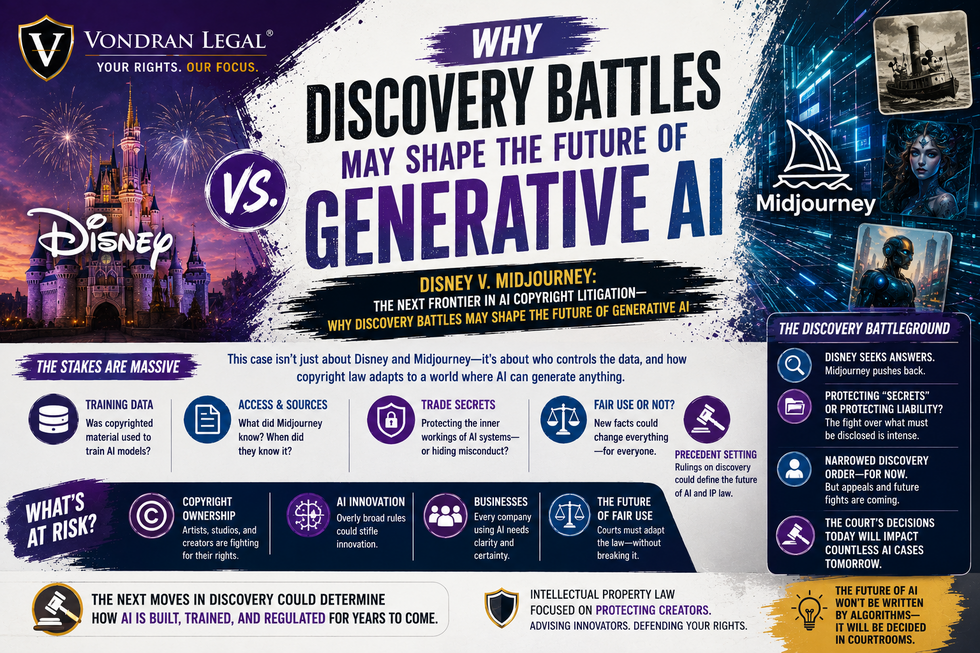
By Attorney Steve® | AI Copyright Litigation | Intellectual Property Law | Vondran Legal®
Artificial intelligence copyright litigation is evolving rapidly. Just a year ago, the primary legal debate centered on whether AI developers could lawfully train large language models and image-generation systems using copyrighted works under the doctrine of fair use. Today, however, the legal battlefield is shifting.
Increasingly, the most significant fights are not over whether copyrighted works were used—they are over what AI companies must disclose during discovery.
The lawsuit Disney Enterprises, Inc., et al. v. Midjourney, Inc., pending in the U.S. District Court for the Central District of California, may become the first major case defining how far copyright plaintiffs can go in demanding access to an AI company's proprietary technology.
For AI developers, software companies, investors, and in-house counsel, this may prove just as consequential as any eventual ruling on fair use.
The Case at a Glance
Case: Disney Enterprises, Inc., et al. v. Midjourney, Inc.
Court: United States District Court, Central District of California
Case No.: 2:25-cv-05275-JAK-AJR
Judge: Hon. John A. Kronstadt
Filed: June 11, 2025
Case docket:
https://dockets.justia.com/docket/california/cacdce/2%3A2025cv05275/973999
The Allegations
Disney, Universal, and numerous affiliated studios—including Marvel, Lucasfilm, DreamWorks, DC Comics, Hanna-Barbera, and others—allege that Midjourney infringed their copyrights in two principal ways:
1. Training
The studios contend Midjourney copied copyrighted images without authorization to train its generative AI models.
2. Outputs
They also allege that Midjourney generates images that closely resemble iconic copyrighted characters, including:
- Darth Vader
- Elsa
- Iron Man
- Spider-Man
- Shrek
- The Minions
- Homer Simpson
- Buzz Lightyear
- Chewbacca
among many others.
Unlike earlier lawsuits brought by individual artists or stock photography companies, this is the first major copyright action brought by Hollywood's largest motion picture studios against an AI image-generation platform.
Where AI Copyright Litigation Started
Most AI copyright lawsuits filed over the past several years have focused on one overarching issue:
Can AI companies lawfully train models using copyrighted works without obtaining licenses?
Courts have begun issuing opinions addressing this question.
Among the most significant developments:
- Anthropic litigation
- Meta AI litigation
- Various cases involving Stability AI
- Getty Images litigation
- Andersen v. Stability AI
These cases generally ask whether the ingestion of copyrighted works into machine learning systems constitutes transformative fair use or copyright infringement.
Although courts have reached different procedural outcomes, one common theme has emerged:
Training questions are extraordinarily complex.
The Next Phase: Discovery
The Disney litigation illustrates that AI copyright litigation is no longer simply about legal doctrines.
It is increasingly about evidence.
Plaintiffs are now asking:
- How does the model actually work?
- What safeguards exist?
- What copyrighted material entered the system?
- What engineering decisions were made?
- How are prompts processed?
- How are outputs generated?
To answer those questions, plaintiffs increasingly seek access to technical information never before requested in ordinary copyright cases.
What Plaintiffs May Seek During Discovery
Modern AI litigation may involve requests for:
- Source code
- Model architecture
- Neural network implementation
- Training datasets
- Fine-tuning documentation
- Prompt processing logic
- Content filtering systems
- Copyright moderation tools
- Safety evaluations
- Engineering documentation
- Internal testing reports
- Version histories
- Repository information
- System logs
- Internal communications
For AI companies, these materials often represent the crown jewels of the business.
Why Source Code Is Such a Big Deal
Traditional copyright litigation usually focuses on evidence such as:
- emails
- contracts
- licensing agreements
- invoices
- financial records
Generative AI litigation is fundamentally different.
Here, the software itself may become evidence.
Plaintiffs argue they cannot determine how copyrighted works are reproduced without understanding the underlying technology.
Defendants respond that source code and engineering repositories constitute highly valuable trade secrets that cannot simply be handed over to competitors.
That tension is quickly becoming one of the defining issues in AI litigation.
The Protective Order in Disney v. Midjourney
One important development has already occurred.
The parties stipulated to a comprehensive protective order governing confidential information.
Significantly, the order creates a special designation for:
"Highly Confidential – Source Code."
This designation recognizes that source code deserves heightened protection.
Importantly, however, the protective order does not require Midjourney to produce source code.
Instead, it establishes procedures that would govern production if the court later determines that source code is discoverable.
Typical Source Code Protections
Protective orders in software litigation frequently require:
- inspection only on standalone computers
- no internet access
- attorney-eyes-only review
- strict limits on copying
- secure inspection rooms
- logging of every inspection
- restrictions on printed excerpts
Patent litigation has used these procedures for years.
Many commentators believe they will soon become standard in AI copyright cases as well.
The Federal Rules Already Provide the Framework
Several provisions of the Federal Rules of Civil Procedure are especially important.
Rule 26(b)(1)
Discovery must be:
- relevant
- proportional to the needs of the case
Courts are expected to weigh the importance of the requested information against the burden and risk of disclosure.
Rule 26(c)
Courts may issue protective orders protecting:
- trade secrets
- confidential research
- proprietary commercial information
This rule will likely become one of the most frequently cited rules in AI discovery disputes.
Rule 34
Allows parties to request electronically stored information, including software and source code where appropriate.
The real dispute is not whether software can be requested.
It is how much access is appropriate.
Fair Use Is No Longer the Only Story
Much public attention has focused on fair use.
That makes sense.
Whether AI training constitutes transformative use remains enormously important.
But discovery may prove equally significant.
Why?
Because discovery determines what evidence each side has available before summary judgment or trial.
If plaintiffs obtain broad access to engineering documentation, source code, and model development records, they may strengthen their ability to prove infringement.
Conversely, if courts sharply limit discovery, AI defendants may preserve valuable trade secrets while narrowing the evidence available to plaintiffs.
The procedural rulings may ultimately shape future litigation as much as the substantive copyright rulings themselves.
Retrieval-Augmented Generation (RAG) Will Create New Discovery Battles
The next generation of AI disputes may not focus exclusively on model training.
Instead, courts may increasingly examine Retrieval-Augmented Generation ("RAG") systems.
Potential discovery requests could involve:
- vector databases
- embedding models
- retrieval pipelines
- ranking algorithms
- retrieval logs
- caching systems
- indexing methods
Rather than asking:
"What did the model learn?"
future plaintiffs may ask:
"How does the system retrieve copyrighted material during inference?"
That distinction could significantly reshape AI litigation over the next several years.
Practical Lessons for AI Companies
Organizations developing generative AI should begin preparing long before litigation arrives.
Good governance includes maintaining records concerning:
- dataset provenance
- licensing decisions
- model versions
- fine-tuning activities
- engineering changes
- copyright reviews
- safety testing
- moderation updates
- repository management
- source-code access controls
These records can demonstrate responsible AI governance while making discovery responses more efficient if litigation occurs.
Practical Lessons for Lawyers
Attorneys representing AI companies should consider:
- identifying trade-secret assets early;
- implementing document-retention policies;
- preparing model-development documentation;
- drafting protective-order language before litigation begins;
- segregating confidential engineering materials;
- educating engineering teams regarding litigation holds; and
- coordinating copyright compliance with AI governance programs.
Discovery preparedness is quickly becoming a competitive advantage.
Why This Case Matters
Disney v. Midjourney represents much more than another copyright lawsuit.
It may establish important precedent regarding:
- the scope of AI discovery;
- access to source code;
- protection of AI trade secrets;
- production of engineering repositories;
- balancing copyright enforcement with innovation; and
- how courts evaluate proprietary AI technology under the Federal Rules of Civil Procedure.
The outcome could influence virtually every future lawsuit involving generative AI.
Key Takeaways
- AI copyright litigation is entering a new procedural phase.
- Discovery disputes may become just as important as fair use.
- Source code is emerging as one of the most valuable—and contested—forms of evidence.
- Protective orders will likely play an increasingly central role in AI litigation.
- Courts must balance copyright enforcement against the protection of trade secrets.
- Companies developing AI systems should establish comprehensive documentation and governance practices before litigation begins.
- Organizations using RAG architectures should anticipate future discovery requests involving retrieval systems, vector databases, and inference pipelines.
- Businesses that prepare today will be significantly better positioned to defend tomorrow's AI litigation.
Need Counsel for AI Copyright, Discovery, or Trade Secret Litigation?
As AI litigation becomes more technically sophisticated, companies need counsel who understand both intellectual property law and the procedural realities of federal litigation. From AI governance and copyright compliance to trade secret protection, discovery strategy, DMCA issues, and federal court litigation, experienced legal guidance can help organizations reduce risk while protecting valuable AI assets.
Contact Vondran Legal®
Nationwide Intellectual Property and AI Litigation Counsel
Resources
- Disney Enterprises, Inc., et al. v. Midjourney, Inc., No. 2:25-cv-05275 (C.D. Cal. filed June 11, 2025). Docket available at Justia: Disney v. Midjourney docket
- Federal Rules of Civil Procedure 26(b)(1), 26(c), and 34.
- Recent docket information reflecting ongoing discovery disputes and protective-order proceedings.

