
Attorney Steve's Advice to Future Lawyers: AI Is Changing Everything—Choose Your Legal Career Wisely
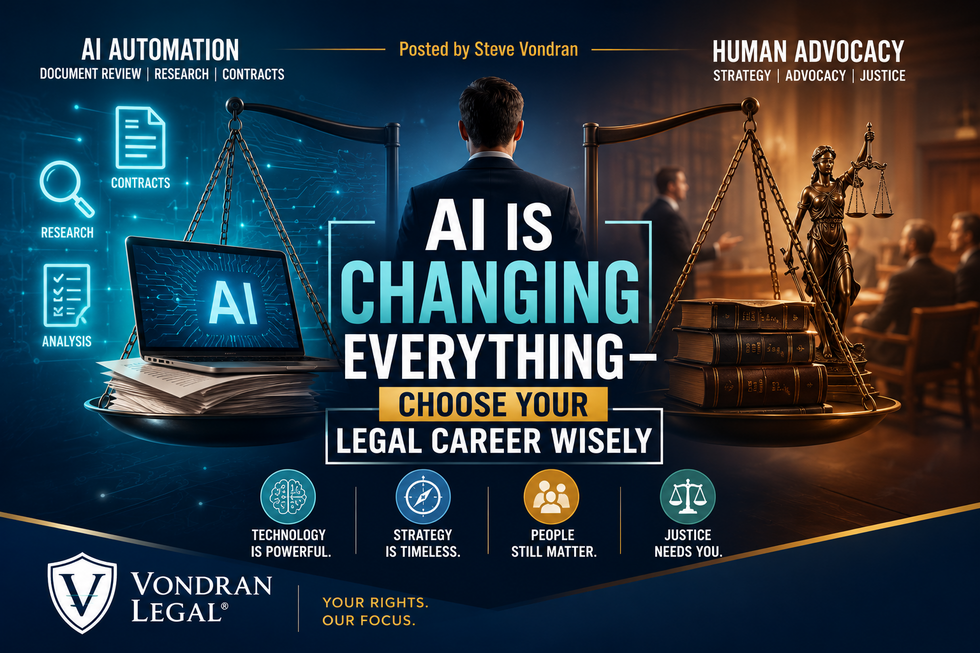
Artificial intelligence is no longer science fiction.
It is here.
And every day it becomes faster, smarter, and more capable.
Whether you are a student considering law school, a recent graduate, or someone thinking about changing careers, I believe you need to have an honest conversation with yourself before investing hundreds of thousands of dollars and several years of your life pursuing a legal career.
Law remains, in my opinion, one of the most honorable professions in society. Alongside physicians, lawyers have the privilege of helping people through some of the most important moments of their lives. We protect constitutional rights. We defend businesses. We safeguard creativity. We help families. We solve disputes. We hold people accountable.
That calling has not changed.
But the way lawyers practice law is changing rapidly.
AI Is Not Coming—It Has Already Arrived
Artificial intelligence is transforming virtually every profession.
Medicine.
Accounting.
Engineering.
Marketing.
Software development.
Finance.
Education.
Journalism.
Architecture.
Manufacturing.
Customer service.
The list goes on and on.
Law is simply one profession among thousands being reshaped by AI.
The lawyers who recognize this reality early will have an enormous advantage.
The lawyers who ignore it may find themselves competing against software that works twenty-four hours a day, never gets tired, and can review thousands of pages of information in minutes.
The Traditional Transactional Practice Is Changing
Historically, many lawyers built outstanding careers handling transactional work.
That includes:
-
Reviewing contracts
-
Drafting agreements
-
Negotiating business deals
-
Conducting due diligence
-
Preparing legal documents
-
Advising clients on business transactions
-
Sending cease-and-desist letters
-
Reviewing corporate records
For decades, this work required armies of associates spending hundreds of billable hours reading documents.
Today?
AI can review a 200-page agreement in seconds.
It can identify inconsistencies.
It can summarize key provisions.
It can compare multiple contracts simultaneously.
It can flag unusual clauses.
It can generate first drafts of legal documents almost instantly.
That does not mean transactional lawyers are disappearing.
Far from it.
Clients will always need experienced legal judgment.
Complex negotiations still require human decision-making.
Sophisticated transactions still require experienced attorneys.
But I do believe the economics of this practice area are changing dramatically.
Law firms may simply need fewer lawyers performing routine document review than they did five or ten years ago.
That reality deserves serious consideration by anyone entering the profession today.
Litigation Still Requires Lawyers
Years ago, I made a deliberate decision to build my practice around litigation.
Why?
Because litigation is fundamentally different.
Litigation involves people.
Strategy.
Persuasion.
Negotiation.
Judgment.
Credibility.
Court appearances.
Witness examinations.
Depositions.
Motion practice.
Trial advocacy.
Human interaction.
Can AI help litigators?
Absolutely.
It already does.
I use AI every single day.
It helps analyze cases.
It helps summarize documents.
It helps brainstorm legal arguments.
It helps organize evidence.
It helps improve efficiency.
But AI cannot stand in front of a federal judge and argue a motion.
It cannot cross-examine a witness.
It cannot build trust with a jury.
It cannot negotiate face-to-face with opposing counsel.
It cannot replace the professional judgment developed through years of courtroom experience.
For the foreseeable future, litigation remains one of the areas of legal practice where human advocacy continues to be indispensable.
Litigation Isn't About Fighting
One misconception I hear all the time is:
"I don't want to be a litigator because I don't like conflict."
That is understandable.
But it also misunderstands what litigation really is.
Professional litigators are not simply argumentative people.
The best litigators solve problems.
They analyze facts.
They evaluate risks.
They negotiate settlements.
They communicate professionally.
They advocate respectfully.
Yes, disagreements happen.
That is why courts exist.
But most lawyers treat each other professionally.
Litigation is not about creating conflict.
It is about resolving conflict.
Law School Is a Major Investment
Before attending law school, ask yourself difficult questions.
Why do I want to become a lawyer?
What kind of work excites me?
Do I enjoy writing?
Research?
Public speaking?
Negotiation?
Advocacy?
Business?
Technology?
Do I want to be in a courtroom?
Do I enjoy solving difficult problems?
Am I comfortable making important decisions under pressure?
These questions matter.
Law school is expensive.
Student debt can be significant.
The legal profession is rewarding, but it also demands long hours, continuous learning, and lifelong professional development.
You should enter it intentionally—not simply because it seems like a prestigious profession.
AI Literacy May Become Every Professional's Greatest Skill
This advice isn't limited to lawyers.
Every profession is changing.
Whether you become a lawyer...
A physician...
An engineer...
A CPA...
A teacher...
A real estate broker...
A software developer...
Or an entrepreneur...
Learning how to effectively use artificial intelligence may become one of the most valuable professional skills you ever acquire.
The professionals who succeed won't necessarily be those competing against AI.
They will be the ones who learn to work alongside it.
Build a Career That AI Complements—Not Replaces
If I were advising someone entering the workforce today, I would encourage them to look for careers that emphasize uniquely human strengths:
-
Strategic judgment
-
Leadership
-
Advocacy
-
Negotiation
-
Creativity
-
Emotional intelligence
-
Client relationships
-
Ethical decision-making
-
Complex problem-solving
Those skills become even more valuable as AI becomes more powerful.
Technology changes.
Human trust does not.
My Advice
If you're considering law school, don't let AI discourage you.
Instead, let it help you plan wisely.
Study where the profession is headed—not just where it has been.
Think carefully about the kind of lawyer you want to become.
Develop expertise in emerging technologies.
Learn how AI works.
Understand its strengths.
Understand its limitations.
And most importantly, build a practice that combines technology with the uniquely human qualities that clients will always need.
Law remains one of the greatest professions in the world.
But the lawyers who thrive over the next twenty years will not simply know the law.
They will know how to leverage technology, exercise sound judgment, build meaningful relationships, and solve problems that machines alone cannot.
The future belongs to professionals who embrace change rather than fear it.
The question isn't whether AI will change the legal profession.
It already has.
The real question is whether you'll be prepared to change with it.
—Attorney Steve®
"Preparing lawyers, creators, businesses, and innovators for the future of law in the age of artificial intelligence."

