
Vondran Legal® - AI Copyright Registration, DMCA Counter-Notices, and the Human Authorship Test.
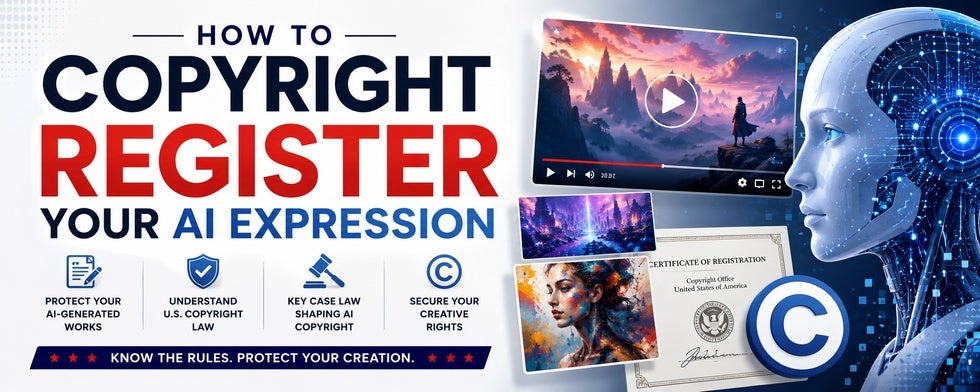
What Happens When Someone Copies Your AI-Generated Artwork?
Imagine this increasingly common situation.
You create an image using an artificial intelligence platform such as ChatGPT, Grok, Midjourney, DALL-E, Stable Diffusion, Adobe Firefly, InvokeAI, or another generative AI tool. You spend hours developing prompts, adjusting instructions, generating variations, changing compositions, selecting elements, editing the results, and ultimately publishing the finished image on your website.
Someone finds the image and copies it.
You submit a Digital Millennium Copyright Act ("DMCA") takedown notice. The website or marketplace removes the allegedly infringing material.
Then the accused copier submits a DMCA counter-notification.
Suddenly, the copyright owner has a serious deadline problem.
Under 17 U.S.C. §512(g), after a service provider receives a compliant counter-notification, the provider ordinarily restores the material not less than 10 and not more than 14 business days later, unless the original complaining party provides notice that it has filed an action seeking a court order restraining the subscriber from engaging in the allegedly infringing activity.
For conventional photographs, illustrations, videos, music, and other traditional works, the next steps may be relatively straightforward.
But what happens when the copied image was created using artificial intelligence?
That raises a much more difficult question:
Is there actually a copyright that can be enforced?
As of August 2026, U.S. copyright law does not establish a blanket rule that anything touched by artificial intelligence is unprotectable. Quite the opposite. The U.S. Copyright Office has repeatedly said that human-created expression remains protectable even when AI is part of the creative process.
But there is an equally important limitation:
Artificial intelligence cannot itself supply the human authorship required by U.S. copyright law.
That distinction can determine whether an AI-assisted artist receives a registration, whether the registration is extremely narrow, whether a federal infringement lawsuit is viable, and ultimately whether a DMCA takedown can realistically be maintained after a counter-notice.
The Fundamental Rule: Copyright Protects Human Authorship
The modern Copyright Office position is summarized in its January 2025 report, Copyright and Artificial Intelligence, Part 2: Copyrightability.
The Office concluded that existing copyright law is capable of addressing generative AI without creating a new category of copyright protection. According to the Office, AI-assisted works may be copyrightable when a human author has determined sufficient expressive elements of the resulting work.
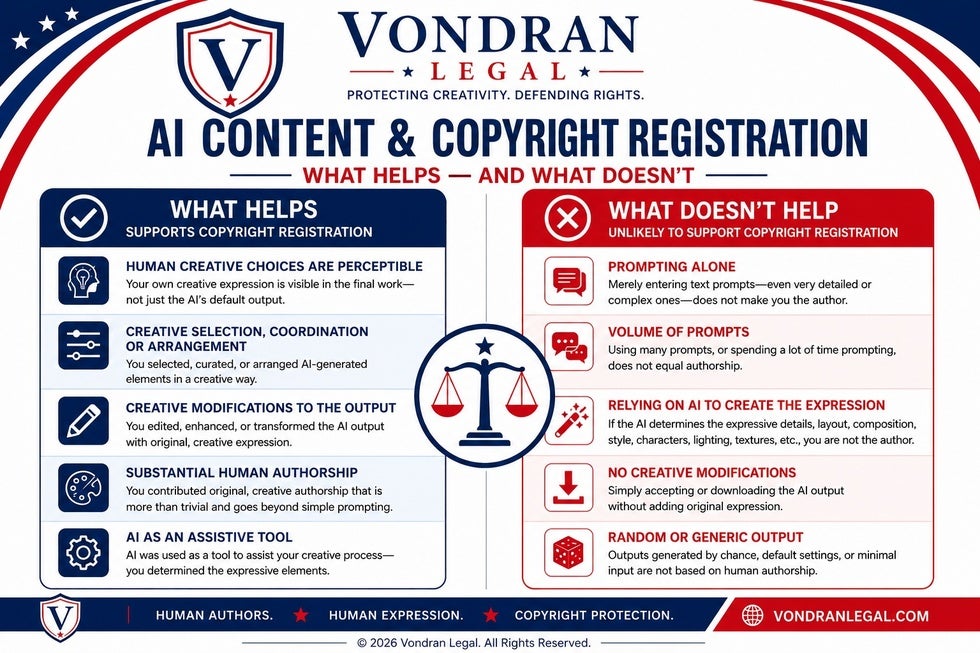
The Office specifically identified several potentially protectable situations:
-
Human-authored expression remains perceptible in the resulting AI-assisted work.
-
A person creatively selects, coordinates, or arranges AI-generated material.
-
A person makes sufficiently creative modifications to AI-generated material.
-
AI functions as an assistive tool rather than as the source of the copyrightable expression.
At the same time, the Office concluded that merely providing prompts generally does not make the user the author of the resulting AI-generated expression.
That is the starting point for almost every AI copyright analysis.
The question should therefore rarely be framed as
"Was AI used?"
The better question is:
"Which expressive elements of the finished work were actually determined by a human?"
That distinction matters enormously.
Does Writing an Extremely Detailed Prompt Create Copyright in the AI Output?
This is one of the most important unresolved practical questions.
Suppose an artist enters:
"Create a futuristic courthouse at sunset overlooking Los Angeles, viewed from a low-angle perspective, with three marble columns in the foreground, a female lawyer standing on the left side, dramatic amber backlighting, shallow depth of field, reflections on wet pavement, a 35mm cinematic composition, and a red briefcase placed approximately one-third from the right edge."
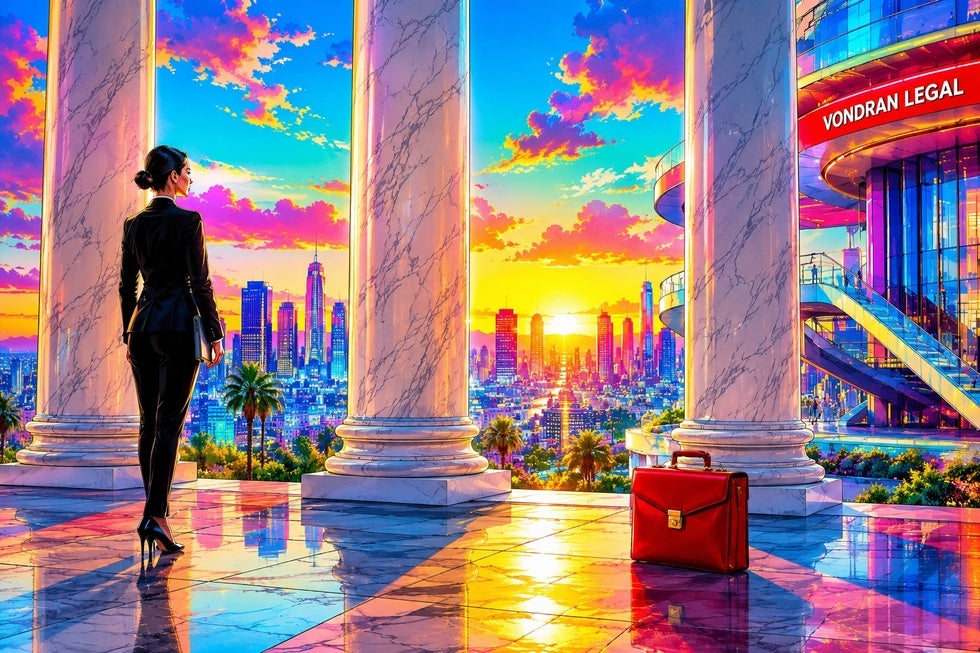
That prompt unquestionably contains a large number of creative choices.
But the Copyright Office currently distinguishes between copyright in the prompt itself and copyright in whatever the AI system produces in response to that prompt.
The 2025 AI Report acknowledges that sufficiently creative prompt language might itself qualify for copyright protection. But copyrightability of the prompt does not automatically transfer to the output.
The Office's concern is essentially one of control over expressive execution.
A person may ask an AI system to produce a woman with a red briefcase standing beside a courthouse. But the AI may independently determine hundreds or thousands of expressive details:
the woman's face, her precise posture, every fold in her clothing, the geometry of the courthouse, the clouds, reflections, lighting patterns, texture, coloration, perspective, architectural details, shadows, and the precise relationship between all of those elements.
The Office therefore asks who actually determined the expressive elements appearing in the finished work.
That makes prompting-only cases significantly more difficult.
And importantly, entering 500 prompts instead of five does not necessarily solve the problem.
Extensive iterative prompting proves effort.
It may prove creative intention.
It may prove substantial involvement.
But effort and authorship are not synonymous under copyright law.
The Jason Allen Case Could Be Extremely Important
One of the most significant pending AI-copyright cases is Allen v. Perlmutter, Case No. 1:24-cv-02665 in the U.S. District Court for the District of Colorado.
Jason Allen created the well-known image Théâtre D'opéra Spatial using Midjourney. His process reportedly involved more than 600 prompt iterations and additional processing.
The Copyright Office nevertheless refused registration of the AI-generated portions of the image.
Allen sued the Copyright Office, arguing in substance that he should be considered the human author because AI was merely the technological tool through which he exercised creative control.
The Copyright Office takes the opposite position: repeatedly requesting images until the system outputs something the user considers acceptable is different from the user personally determining the resulting expression.
As of July 2026, Allen remained one of the copyright cases being watched for a decision in the second half of 2026, with summary-judgment proceedings having been briefed.
This distinction is extremely important.
The Supreme Court's AI copyright case discussed below does not answer the harder Allen question.
Thaler v. Perlmutter: AI Cannot Be the Author
The leading appellate authority is Thaler v. Perlmutter, 130 F.4th 1039 (D.C. Cir. 2025).
Stephen Thaler sought registration for an image called A Recent Entrance to Paradise, identifying his AI system—the Creativity Machine—as the author.
The Copyright Office refused registration.
The D.C. Circuit affirmed, holding that the Copyright Act requires human authorship.
But Thaler should not be overstated.
The D.C. Circuit specifically confronted a work whose identified author was the machine itself. The court did not establish a complete test for determining how much involvement by a human using generative AI is sufficient to constitute authorship.
Thaler sought Supreme Court review.
On March 2, 2026, the U.S. Supreme Court denied certiorari. The D.C. Circuit judgment therefore remains intact.
The resulting proposition is now strong:
A work authored exclusively by a machine does not qualify for copyright under the Copyright Act.
But this proposition does NOT necessarily mean:
Every work created using artificial intelligence is uncopyrightable.
The unresolved boundary concerns AI-assisted human authorship.
That is precisely why cases such as Allen matter so much.
A New 2026 Case: Suryast v. Perlmutter
Another potentially significant AI-authorship case was filed on May 8, 2026.
Suryast U.S. Enterprises, LLC v. Perlmutter, No. 2:26-cv-04999, is pending in the U.S. District Court for the Central District of California.
The underlying work presents a different issue from a pure text-to-image generation case.
The artist began with his own photograph and then used the RAGHAV AI system to transform the image using stylistic input associated with Vincent van Gogh's Starry Night.
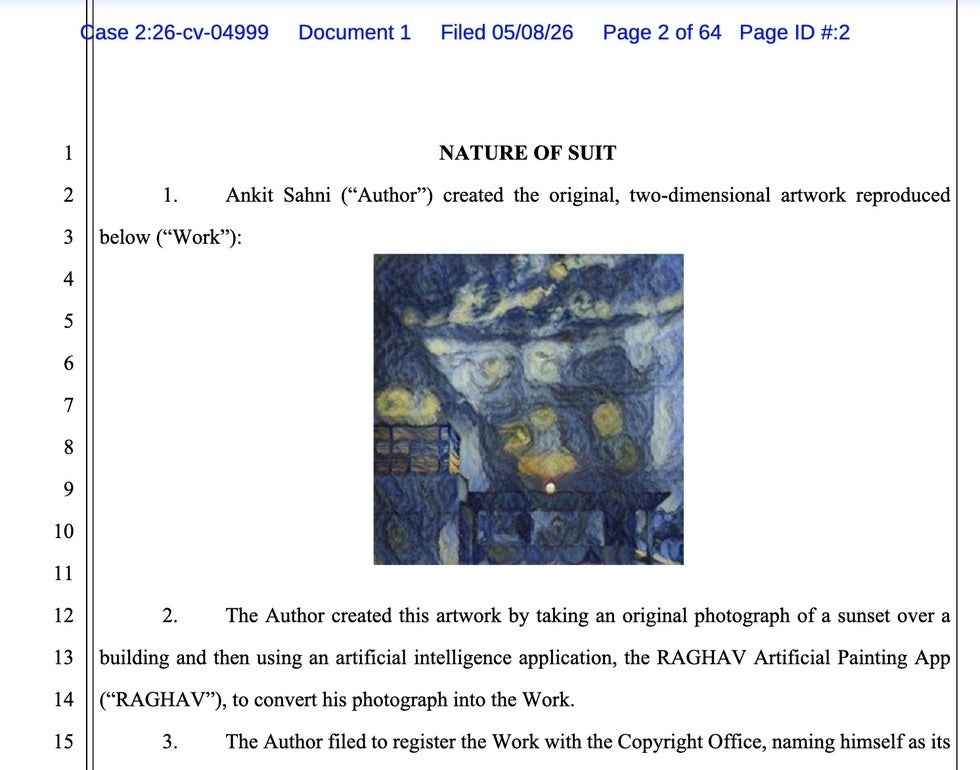
The Copyright Office had previously concluded that the resulting AI-processed image did not contain sufficient human authorship because the applicant exercised insufficient creative control over what RAGHAV generated.
That case may eventually help determine something critically important for photographers and designers:
When does AI modification of a copyrightable human work preserve enough human expression to support copyright in the resulting image?
Copyright Office Example: Rose Enigma
The Copyright Office's own experience demonstrates why these cases must be examined element by element.
In connection with the work Rose Enigma, the Copyright Office registered the work with the registration expressly limited to human pictorial authorship that remained perceptible and separable from excluded non-human expression.
The Office contrasted that work with Suryast, where it concluded that the applicant's copyrightable source photograph was not sufficiently perceptible in the final AI-generated output to support the claimed authorship of that resulting image.
This illustrates a recurring principle:
Putting copyrighted human material into an AI system does not necessarily make everything coming out of the system copyrighted.
The question becomes what human-authored expression survived into the output.
The "Single Piece of American Cheese" Registration Is Particularly Interesting
Another fascinating Copyright Office development involves the registration titled A Single Piece of American Cheese.
The Copyright Office's public record shows Registration No. VAu 1-543-942, effective August 5, 2024, with a registration decision dated January 30, 2025.
The registration expressly excludes:
"2-D artwork, AI generated image components."
But it registers:
"Selection, coordination, and arrangement of material generated by artificial intelligence."
That provides an excellent illustration of how AI-related registration can work.
A person may not own copyright in each individual AI-created element.
But the person may nevertheless create copyrightable expression by selecting, positioning, combining, coordinating, or arranging those elements.
The resulting copyright is narrower than copyright in every component of the image.
But narrower does not necessarily mean worthless.
Selection and Arrangement May Be the Most Important AI Copyright Doctrine
Imagine that someone generates:
-
an AI-created ocean;
-
an AI-created moon;
-
an AI-created ship;
-
an AI-created astronaut;
-
an AI-created city skyline.
If the person simply tells an AI system, "Put these into an attractive image," the resulting expressive arrangement may remain substantially AI-determined.
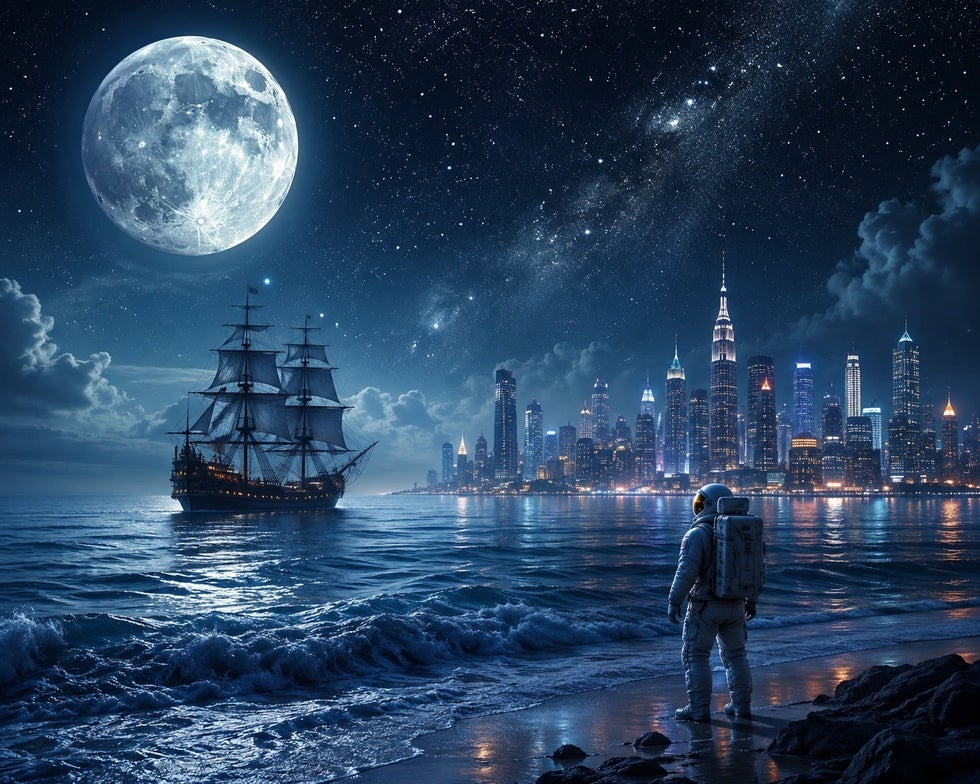
But suppose the person manually imports those elements into Photoshop.
The person then:
-
chooses which elements appear;
-
determines their size;
-
determines their placement;
-
changes opacity;
-
crops individual objects;
-
removes portions;
-
creates masks;
-
determines foreground and background;
-
chooses the exact relationship between elements;
-
adjusts lighting;
-
adds manually created text;
-
paints new shadows;
-
changes colors;
-
redraws portions;
-
independently designs the overall composition.
That is a dramatically stronger copyright case.
The individual AI components may remain outside the copyright claim.
But the human selection, coordination, arrangement, modification, and independently created material may qualify for protection.
AI Editing Versus AI Regeneration
Another important distinction for lawyers investigating these cases is the difference between genuine manual editing and merely asking the AI to try again.
These two workflows can sound similar when a client describes them casually.
Client A says:
"I revised the image 40 times."
What actually happened?
If "revised" means:
"I entered another prompt and the AI regenerated the image,"
the human-authorship claim may remain relatively weak.
But if "revised" means:
"I opened the image in Photoshop, manually removed the building, drew new architectural features, created the text myself, composited three photographs I took, repainted the sky, changed the layout, and created the lighting effects manually,"
the analysis becomes substantially different.
That is why lawyers handling these cases should avoid conclusory client descriptions such as:
-
"I created it."
-
"I edited it."
-
"I worked on it for 30 hours."
-
"I prompted it hundreds of times."
Those statements are not likely enough.
Ask:
What exactly did you do?
Can AI-Generated Videos Be Copyrighted?
The same fundamental principles apply to video.
Consider a video containing:
-
AI-generated video clips;
-
human-shot footage;
-
human narration;
-
copyrighted music owned by the creator;
-
manually created titles;
-
human-written dialogue;
-
original editing;
-
deliberate sequencing;
-
transitions;
-
color grading;
-
graphics;
-
compositing.
Even if certain individual AI-generated video frames or clips lack copyright protection, the larger audiovisual work may contain substantial copyrightable human authorship.
Potentially protectable authorship could include:
-
screenplay;
-
narration;
-
dialogue;
-
editing;
-
arrangement;
-
selection and sequencing;
-
human cinematography;
-
animation performed manually;
-
original graphics;
-
musical composition;
-
sound recording;
-
synchronization decisions;
-
other human-created audiovisual expression.
Again, the proper question is not simply:
"Was AI involved?"
It is:
"What human-authored expression exists in the work being claimed?"
The DMCA Counter-Notice Problem
Now return to the practical problem that started this discussion.
Someone copies an AI-assisted image.
The copyright claimant sends a DMCA notice.
The platform removes the image.
The accused user files a counter-notification.
Section 512(g)(2)(C) states that the service provider generally restores the material between 10 and 14 business days after receiving the counter-notification, unless its designated agent receives notice that the original claimant filed an action seeking a court order restraining the subscriber from engaging in infringing activity relating to the material.
Notice what the statute says.
It says:
filed an action.
It does not say:
-
sent another cease-and-desist letter;
-
threatened litigation;
-
demanded settlement;
-
told the platform litigation was being considered.
For purposes of the statutory DMCA framework, the critical event is filing the action seeking judicial restraint.
Attorney Steve® Tip: Some people have tried to file claims with the fairly new copyright claims board. However, this is a BOARD and not a COURT. The board has no power to issue an injuction, so techincally, this is an invalid move. However, I have heard of times where creators did this and YouTube appeared to accept it.
But Doesn't Copyright Registration Have to Happen Before Filing Suit?
For most United States works, yes.
17 U.S.C. §411(a) imposes the registration prerequisite for a civil copyright infringement action.
The Supreme Court resolved an important dispute concerning this requirement in Fourth Estate Public Benefit Corp. v. Wall-Street.com, LLC, 586 U.S. 296 (2019).
The Court rejected the so-called "application approach."
Simply submitting the registration application is generally not enough.
The Copyright Office must act on the registration claim.
That can create a serious timing problem when a DMCA counter-notice clock is running.
Special Handling: Expedited Copyright Registration
The Copyright Office offers an expedited procedure known as Special Handling.
As of 2026, the additional special-handling fee is $860 per claim, in addition to the applicable registration filing fee.
Once special handling has been approved, the Office states that it will make every attempt to examine the claim within approximately five working days.
Critically, however:
Five working days is a goal—not a guarantee. Typical registration time would be approximately 2-3 months.
And examination within five days does not necessarily mean issuance of a registration certificate.
The Office may instead:
-
register the work;
-
correspond with the applicant concerning an issue; or
-
refuse registration.
For a close AI-authorship application, correspondence is an especially important timing risk.
If the examiner asks:
"Please identify precisely which material was created by artificial intelligence and which material was created by the human author,"
the DMCA clock does not stop simply because the applicant is corresponding with the Copyright Office.
An Extremely Important Point: A Copyright Office Refusal Can Still Permit a Federal Lawsuit
This is one of the most important procedural points for attorneys analyzing AI-generated works under a DMCA deadline.
A Copyright Office refusal does not necessarily prevent the applicant from filing an infringement action.
Section 411(a) expressly provides that where the required deposit, application, and fee have been properly delivered and registration has been refused, the applicant may institute an infringement action if notice of the action and a copy of the complaint are served upon the Register of Copyrights.
The applicable Copyright Office regulation provides additional procedures for serving the Register and also references service upon the appropriate United States Attorney and the Department of Justice.
That produces an important practical distinction.
Special handling does not merely offer the possibility of getting a registration quickly.
It can also potentially obtain a registration decision quickly.
If the result is a refusal, §411(a) provides a mechanism for bringing the registrability issue into federal court as part of the infringement action.
Of course, this does not magically make an AI-generated work copyrightable.
The plaintiff still must prove that protectable human-authored expression exists.
But procedurally, a refusal does not necessarily lock the courthouse door.
⚖️ Attorney Steve® Tip: A Copyright Office Refusal Does NOT Necessarily Bar Your Federal Lawsuit
Here is an important procedural point that copyright litigators should know: a Copyright Office refusal does not necessarily mean you cannot file a copyright infringement lawsuit. Under 17 U.S.C. § 411(a), when a claimant has properly submitted the required application, deposit, and fee but the Copyright Office refuses registration, the claimant may still institute an infringement action, provided the required notice and copy of the complaint are served on the Register of Copyrights. A helpful case is Morelli v. Tiffany & Co., 186 F. Supp. 2d 563, 564–65 (E.D. Pa. 2002), where the Copyright Office refused registration of jewelry designs because it found insufficient copyrightable authorship. The district court nevertheless recognized that the refusal itself did not prevent the claimant from pursuing an infringement action under § 411(a).
The subsequent decision, Paul Morelli Design, Inc. v. Tiffany & Co., 200 F. Supp. 2d 482 (E.D. Pa. 2002), illustrates what happens next. The copyrightability issue ultimately reached the jury, which determined that the designs were not copyrightable. The takeaway is procedural, not substantive: a Copyright Office refusal does not make an otherwise uncopyrightable work copyrightable, but neither does the refusal necessarily lock the federal courthouse doors.
This could be particularly important for AI-assisted works where the Copyright Office questions whether sufficient human-authored expression exists. A claimant may lose the copyrightability battle—but, assuming the requirements of § 411(a) are satisfied, a refusal does not necessarily prevent that battle from being fought in federal court.
Expedited Registration Does Not Create a Lower Copyrightability Standard
Another misconception should be avoided.
"Special handling" is expedited processing.
It is not expedited approval.
The substantive copyrightability standard does not change because the applicant paid the special-handling fee or faces imminent litigation.
An entirely AI-generated work does not become copyrightable simply because:
-
someone copied it;
-
the copying was blatant;
-
the defendant acted unfairly;
-
the creator spent 100 hours prompting;
-
the creator urgently needs to sue;
-
the DMCA counter-notice deadline expires next week.
The Copyright Office will still ask:
Where is the human authorship?
The Registration Application Must Disclose AI-Generated Material
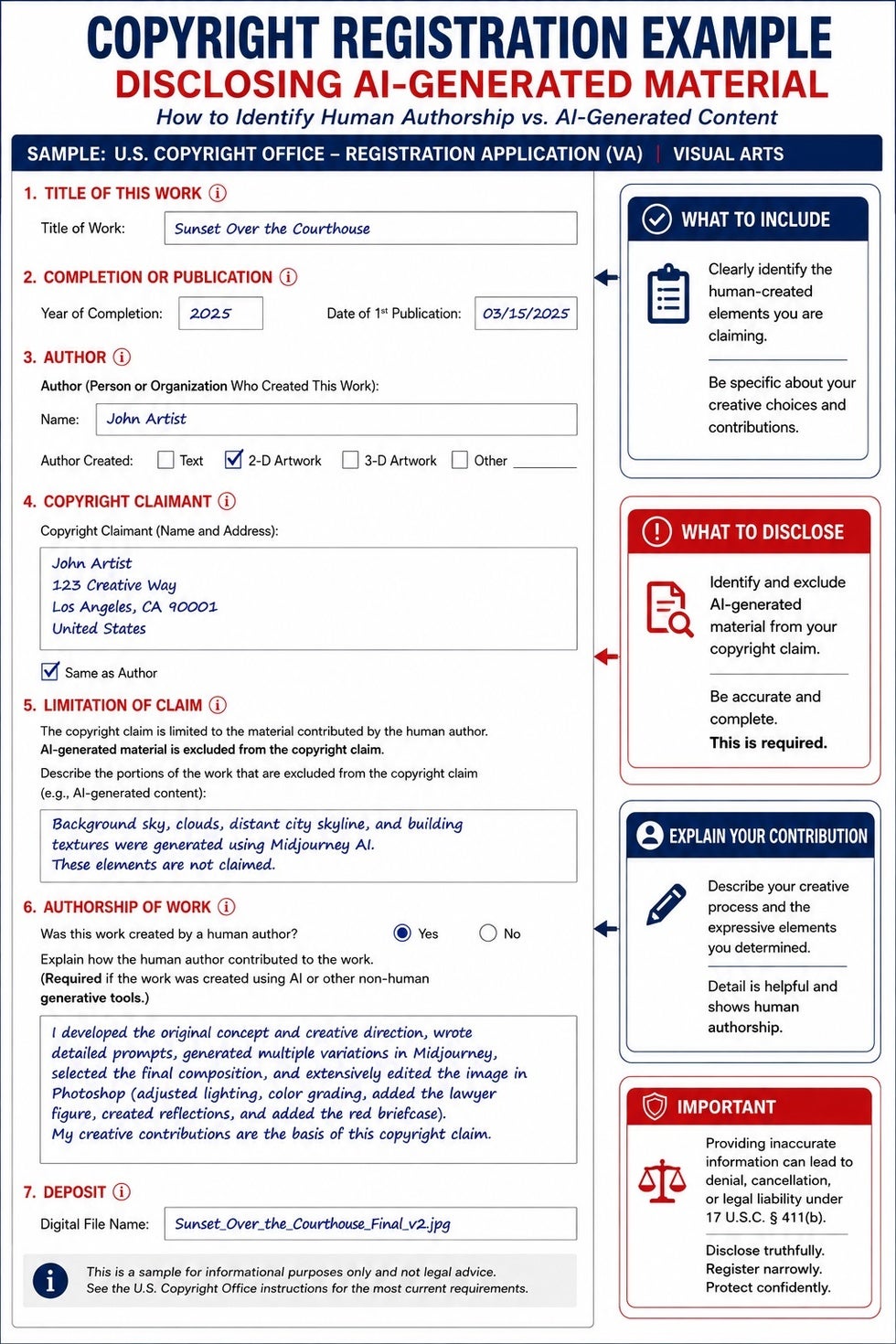
The Copyright Office has also made clear that applicants must appropriately disclose AI-generated material.
Applicants generally should identify the human-authored material being claimed and exclude non-human-generated material where appropriate.
Failing to disclose material facts concerning AI authorship can create significant litigation problems.
Section 411(b) specifically addresses inaccurate information contained in copyright registration certificates and provides a procedure for referring certain material inaccuracies to the Register of Copyrights.
The practical lesson is straightforward:
Do not attempt to solve an AI copyright problem by pretending AI was not involved.
A narrow but accurate registration is usually far more defensible than an aggressive registration built upon an inaccurate authorship claim.
Registration Is Only Half the Infringement Analysis
Suppose the Copyright Office grants a registration covering:
"Human selection, coordination and arrangement of AI-generated materials."
The plaintiff then sues someone who copied the finished image.
The next question is:
What did the defendant copy?
That can become decisive.
Imagine the plaintiff's copyright covers only an original arrangement of otherwise unprotectable AI-generated components.
If the defendant copies that particular arrangement substantially verbatim, there may be an infringement argument.
But suppose the defendant independently uses one AI-generated component while creating a completely different layout.
The registered selection-and-arrangement copyright may provide very little help.
Similarly, suppose the plaintiff manually paints a red dragon into an otherwise AI-generated landscape.
Copyright may exist in the human-created dragon.
But if the accused defendant copies only the AI-generated mountains and not the dragon, the plaintiff may have difficulty establishing copying of protectable expression.
Registration therefore should not be analyzed in isolation.
Infringement Analysis
Ask:
What precisely is protectable?
Then ask:
Did the defendant copy that material?
Statutory Damages and Attorney's Fees May Be Unavailable
Even when registration is possible, another economic issue may radically change the case.
Section 412 generally prevents recovery of statutory damages and attorney's fees for infringement commencing before registration unless the applicable statutory timing requirements are satisfied.
For published works, registration within three months after first publication can preserve these remedies for infringement commencing during that period.
Otherwise, an owner whose work was already infringed before registration may often be limited principally to actual damages, infringer's profits where available, and injunctive relief.
This matters enormously when evaluating whether emergency federal litigation is economically rational.
Getting a registration today does not necessarily retroactively create statutory damages for an infringement that began months earlier.
BONUS MATERIALS: To learn more about copyright infringement damages click here to watch my video.
How Strong Is an AI Copyright Case? A Practical Risk Spectrum
Rather than treating AI copyrights as simply "valid" or "invalid," it can be useful to think in terms of a spectrum.
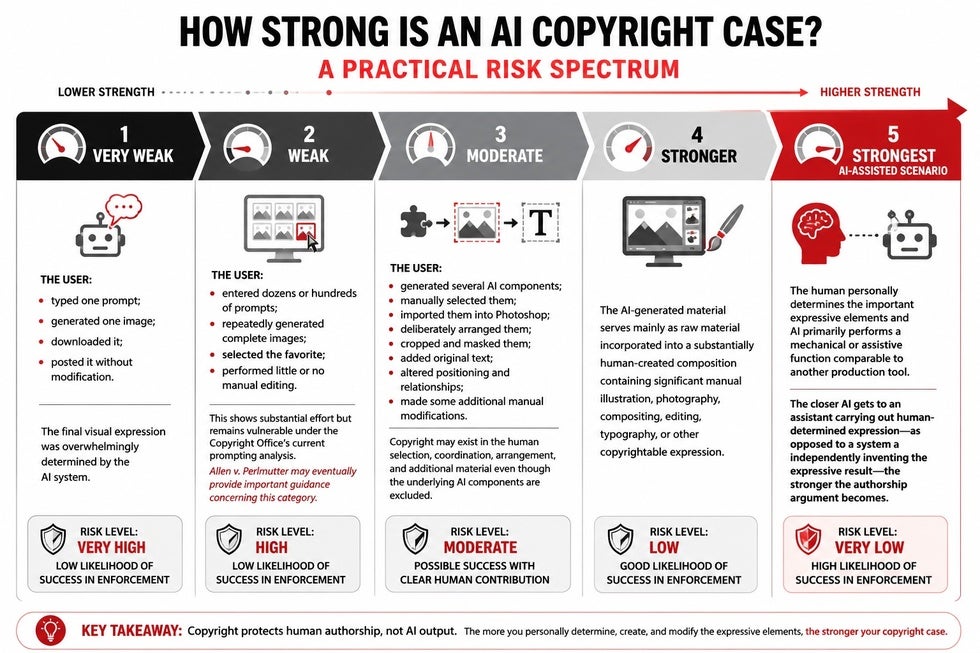
Very Weak
The user:
-
typed one prompt;
-
generated one image;
-
downloaded it;
-
posted it without modification.
The final visual expression was overwhelmingly determined by the AI system.
Weak
The user:
-
entered dozens or hundreds of prompts;
-
repeatedly generated complete images;
-
selected the favorite;
-
performed little or no manual editing.
This shows substantial effort but remains vulnerable under the Copyright Office's current prompting analysis.
Allen v. Perlmutter may eventually provide important guidance concerning this category.
Moderate
The user:
-
generated several AI components;
-
manually selected them;
-
imported them into Photoshop;
-
deliberately arranged them;
-
cropped and masked them;
-
added original text;
-
altered positioning and relationships;
-
made some additional manual modifications.
Copyright may exist in the human selection, coordination, arrangement, and additional material even though the underlying AI components are excluded.
Stronger
The AI-generated material serves mainly as raw material incorporated into a substantially human-created composition containing significant manual illustration, photography, compositing, editing, typography, or other copyrightable expression.
Strongest AI-Assisted Scenario
The human personally determines the important expressive elements and AI primarily performs a mechanical or assistive function comparable to another production tool.
The closer AI gets to an assistant carrying out human-determined expression—as opposed to a system independently inventing the expressive result—the stronger the authorship argument becomes.
AI-Generated / AI-Assisted Work — Copyright Intake Checklist
The following checklist can be used when evaluating a potential copyright claim involving AI-generated or AI-assisted images, videos, text, music, software, or other creative works. This is general information only and not legal advice.
A. Identify the AI Technology
-
What AI platform or model was used?
-
Midjourney?
-
DALL-E?
-
ChatGPT?
-
Stable Diffusion?
-
Adobe Firefly?
-
Photoshop Generative Fill?
-
Invoke AI?
-
Runway?
-
Sora?
-
Another system?
-
Which specific version of the model was used?
-
Was more than one AI platform involved?
-
What functions of the system were used?
-
Text-to-image?
-
Image-to-image?
-
Inpainting?
-
Outpainting?
-
Generative fill?
-
Style transfer?
-
Video generation?
-
Upscaling?
-
Object removal?
-
Other processing?
Different systems can provide different levels of human control.
B. Determine What Existed Before AI Was Used
-
Did the creator begin with a blank AI interface?
-
Or did the creator supply pre-existing material?
-
Was the source material created by the client?
-
Original photograph?
-
Drawing?
-
Illustration?
-
Logo?
-
Character?
-
Text?
-
Music?
-
Video?
-
Software code?
-
Was that underlying work itself copyrightable?
-
Does the creator own it?
-
Is the human-created material still perceptible in the final work?
This last question can be particularly important under the Copyright Office's Rose Enigma and Suryast analyses.
C. Reconstruct the Entire Creative Process
Ask:
"Start with the moment before you began creating this work. Walk me through every significant step until the final file existed."
Then document the actual verbs.
Did you:
-
write?
-
draw?
-
photograph?
-
paint?
-
crop?
-
mask?
-
composite?
-
arrange?
-
move?
-
resize?
-
recolor?
-
retouch?
-
erase?
-
redraw?
-
animate?
-
edit?
-
sequence?
-
synchronize?
-
select?
-
generate?
-
regenerate?
Distinguish manual creative actions from instructions requesting that the AI perform those actions.
D. Investigate the Prompting
-
Obtain the complete prompt history.
-
How many prompts were used?
-
Were prompts descriptive or highly specific?
-
Did the prompts describe composition?
-
Camera angle?
-
Character positioning?
-
Lighting?
-
Perspective?
-
Color?
-
Facial expression?
-
Object placement?
-
Texture?
-
Background?
-
Did the AI consistently follow those instructions?
-
Were individual elements generated separately?
-
Could the user predict the particular expressive result before generation?
-
Did the user merely select the most desirable result after seeing several unpredictable outputs?
Remember: prompt quantity alone should not be treated as proof of authorship.
E. Determine What Happened After Generation
This may be the most important section.
-
Was the output posted exactly as generated?
-
Was it opened in Photoshop, Illustrator, Procreate, Premiere, After Effects, Final Cut, Blender, a DAW, or another application?
-
What did the person change manually?
-
Were elements removed?
-
Were elements added?
-
Were portions redrawn?
-
Was new human-created text added?
-
Were original photographs incorporated?
-
Were multiple AI outputs composited?
-
Did you determine the exact placement and size of each element?
-
Was the background changed manually?
-
Were shadows manually created?
-
Were facial features manually modified?
-
Were colors manually selected?
-
Was typography independently designed?
-
Was the image manually cropped?
-
Was original illustration added?
-
Was the final composition materially different from any single AI output?
You should quantify and describe the actual work—not merely characterize it as "substantial editing."
F. Selection, Coordination, and Arrangement
-
Did you generate separate components?
-
Did you choose which components would appear?
-
Did you determine their relative positions?
-
Did you determine scale?
-
Did you determine foreground/background relationships?
-
Did you arrange several outputs into a unified composition?
-
Was the arrangement independently creative?
-
Can the human arrangement be distinguished from the underlying AI-generated elements?
The registration of A Single Piece of American Cheese demonstrates why these questions can matter.
G. Evidence of Human Authorship
-
Prompt history?
-
Original source files?
-
Photoshop PSD?
-
Illustrator AI file?
-
Procreate layers?
-
Premiere project?
-
After Effects project?
-
Version history?
-
Cloud revision history?
-
Draft exports?
-
Layer metadata?
-
Screenshots showing intermediate stages?
-
Original source photographs?
-
Sketches?
-
Screen recordings?
-
File-creation timestamps?
-
Emails transmitting drafts?
-
Messages discussing revisions?
-
Witnesses familiar with the creation process?
Do not merely ask whether this evidence exists.
Preserve it immediately.
H. Identify Exactly What Is Being Claimed
Before filing a registration application, try completing this sentence:
"The copyright claim is based upon the author's original __________."
Possible answers might include:
-
human illustration;
-
original photography;
-
text;
-
selection and arrangement;
-
compositing;
-
manually created graphical elements;
-
editing;
-
audiovisual sequencing;
-
music;
-
narration;
-
computer code;
-
other human authorship.
If the only possible answer is:
"The client wrote a lot of prompts,"
the registration risk should be recognized immediately.
I. Determine What Must Be Disclaimed
-
Which portions were generated entirely by AI?
-
Can those portions be specifically identified?
-
Can the application accurately exclude them?
-
Does the deposit make the distinction understandable?
-
Would explanatory correspondence or supplemental material help an examiner understand the human contribution?
-
Is the claimed authorship narrower than the complete finished work?
A narrow, accurately framed claim can be much stronger than an overreaching claim.
J. Registration and Timing
-
Has an application already been filed?
-
Has registration issued?
-
When was the work created?
-
When was it first published?
-
Where was it first published?
-
When did the alleged infringement begin?
-
Does §412 affect statutory damages?
-
Is litigation presently anticipated?
-
Has a DMCA counter-notification been received?
-
What exact date did the service provider receive it?
-
What exact restoration deadline has the platform provided?
-
Does special handling need to be requested?
-
Has the additional special-handling fee been budgeted?
-
Is there sufficient time for possible examiner correspondence?
K. If Registration Is Refused
-
Was the application, deposit, and fee properly submitted?
-
Has a written refusal issued?
-
Can an infringement action proceed under §411(a)?
-
Has counsel accounted for service on the Register of Copyrights?
-
Has counsel accounted for the regulatory service requirements?
-
Does the complaint clearly identify the claimed human authorship?
-
Is counsel prepared to litigate copyrightability itself?
-
Is an administrative reconsideration strategically useful?
-
Does reconsideration fit the litigation deadline?
Remember that the Copyright Office states that special handling is not available for requests to reconsider a refusal.
L. Analyze the Alleged Copying
This section is absolutely critical.
-
Did the accused infringer copy the exact finished image?
-
A substantially similar image?
-
Only one component?
-
Only an AI-generated component?
-
Human-created text?
-
Human-created illustration?
-
Human selection and arrangement?
-
Human-created photograph?
-
Did the defendant remove the human-created portions?
-
Is the similarity concentrated primarily in material being disclaimed from the registration?
The narrower the protectable authorship, the more carefully infringement must be analyzed.
M. DMCA Counter-Notice Checklist
-
Obtain the complete original takedown notice.
-
Obtain the complete counter-notification.
-
Verify when the service provider received the counter-notification.
-
Calculate the statutory business-day period.
-
Confirm the platform's stated restoration date.
-
Determine whether the platform has additional procedural requirements.
-
Identify the subscriber whose activity must be restrained.
-
Determine the appropriate jurisdiction.
-
Determine whether registration has issued.
-
If not, determine whether special handling is feasible.
-
Determine whether a refusal could permit suit under §411(a).
-
Prepare the complaint with the DMCA deadline in mind.
-
Determine what notice of filed litigation the platform requires.
-
Preserve evidence of transmission to the platform.
N. Economic Litigation Screen
-
What is the commercial value of the image?
-
Was the work timely registered?
-
Are statutory damages potentially available?
-
Are attorney's fees potentially recoverable?
-
What actual damages can realistically be proved?
-
What profits may be attributable to the infringement?
-
Is injunctive relief economically important?
-
Is the defendant collectible?
-
Is the principal goal monetary recovery?
-
Or is the principal goal keeping the copied work offline?
-
What will emergency federal litigation cost?
-
Is there a substantial risk of creating unfavorable AI-copyright precedent?
The last question deserves special attention in a close AI case.
A plaintiff bringing a prompting-only infringement case today may not simply be litigating copying.
The plaintiff may be asking a federal judge to decide an emerging question of AI authorship.
Three Questions That Can Quickly Triage an AI Copyright Case
For an initial consultation, three questions can reveal most of the immediate risk.
1. "After the AI produced something, what did you personally do to the actual image?"
This distinguishes prompting from direct human authorship.
2. "Show me every draft, layer, prompt, source file, and intermediate version you still have."
This distinguishes a theoretically good authorship story from one that can actually be proved.
3. "Exactly what did the defendant copy?"
This determines whether the alleged infringement involves the human-authored material in which copyright may actually exist.
What Are the Chances of Registering an AI-Assisted Image?
There is no defensible universal percentage.
The Copyright Office examines AI-involved works case by case.
But the current authorities permit some practical observations.
Prompting only
Current Copyright Office policy is unfavorable.
Even detailed and iterative prompting faces a substantial obstacle because the Office presently views prompts primarily as instructions rather than the execution of the output's expressive elements.
Prompting plus choosing among outputs
Still difficult.
Selection of a preferred whole output does not necessarily establish authorship in the output itself.
AI output plus significant manual editing
Much better.
Protectable copyright may exist in the independently created modifications.
Multiple AI outputs manually selected and arranged
Potentially registrable as selection, coordination, or arrangement if the human contribution possesses sufficient originality.
Human work used as an AI input
Potentially protectable to the extent the human-authored expression remains perceptible in the resulting work.
AI used merely as an assistive production tool
Potentially strong where the human—not the AI system—actually determines the expressive result.
The Biggest Litigation Mistake: Confusing Copying With Infringement
In an AI case, there may be overwhelming evidence that someone copied the plaintiff's exact file.
That still does not necessarily establish copyright infringement.
Copyright infringement requires copying of protectable expression.
If the entire visual expression copied from the plaintiff was generated by AI without sufficient human authorship, the plaintiff may have difficulty proving ownership of the copied expression.
That can produce an uncomfortable but legally important result:
Someone may have unquestionably copied something without violating copyright law.
Copyright does not prohibit copying as an abstract concept.
It prohibits unauthorized copying of protected expression.
Could Other Claims Still Exist?
Potentially.
Depending upon the facts, counsel should consider whether other rights may exist independently of copyright, including:
-
false designation of origin;
-
contract;
-
breach of platform terms;
-
unfair competition claims not preempted by the Copyright Act;
-
misappropriation theories where legally available;
-
contractual restrictions applicable to users of a platform.
Those claims require their own elements and should never be used simply as relabeled copyright claims where preemption applies.
But in an AI-image dispute, it is sensible to investigate the complete intellectual-property picture rather than assuming copyright provides the only potential remedy.
Practical Strategy When a DMCA Counter-Notice Is Already Running
When an AI-generated image is already under a counter-notice deadline, you may need to run several workstreams simultaneously.
First, reconstruct the creative history immediately.
Second, preserve every draft, layer, source image, prompt, revision, and metadata record.
Third, identify precisely which aspects of the final image constitute human authorship.
Fourth, determine how a registration application can accurately claim the human material while excluding AI-generated content.
Fifth, evaluate special handling.
As of 2026, special handling costs an additional $860 and the Copyright Office attempts examination within five working days, although it does not guarantee that result.
Sixth, prepare for all three possible Copyright Office outcomes:
registration, correspondence, or refusal.
Seventh, remember that a refusal can potentially permit an infringement action under §411(a), provided its requirements are satisfied.
Finally, make sure the contemplated infringement complaint rests upon the human-authored material rather than merely asserting ownership of an AI-generated image because "the client created it."
That distinction could determine the case.
Where the Law Stands in 2026
As of August 2026, several propositions appear relatively clear.
1. AI cannot independently be a copyright author.
Thaler v. Perlmutter establishes the human-authorship requirement, and the Supreme Court declined review on March 2, 2026.
2. Using AI does not automatically destroy copyright protection.
The Copyright Office expressly recognizes copyright in qualifying human expression contained within AI-assisted works.
3. Prompting by itself remains problematic.
The Copyright Office's current position is that merely providing prompts generally does not establish authorship of the resulting expression.
4. Human modifications can be protected.
The inquiry focuses upon the copyrightable expression actually contributed by the person.
5. Human selection and arrangement can potentially be protected.
The registration of A Single Piece of American Cheese provides an unusually concrete example.
6. Human source material may remain protected when perceptible in the final output.
The Office's discussion of Rose Enigma illustrates this principle.
7. The difficult prompting/control question remains under active litigation.
Allen v. Perlmutter presents perhaps the most important current test involving extensive iterative human prompting, while Suryast presents another human-control question involving transformation of human-created source material.
Final Takeaway
The legal question is no longer simply:
"Can AI art be copyrighted?"
That question is too broad.
The better analysis is:
What expressive elements were created by a human, what expressive elements were generated by artificial intelligence, can those contributions be separated, and what exactly did the defendant copy?
For creators, the safest practice is increasingly obvious:
Document human creativity while the work is being created.
Save the prompt history.
Save the original human materials.
Save intermediate AI outputs.
Save Photoshop and Illustrator layers.
Save drafts.
Save version histories.
Save source photographs.
Document manual edits.
Preserve timestamps.
And most importantly, be able to explain precisely what the human author contributed to the final work.
In the emerging world of AI copyright litigation, the question may not merely be:
"Can you prove the defendant copied your image?"
The more important question may be:
"Can you prove that what the defendant copied was your human-authored expression?"
That is likely to become one of the central copyright questions of the generative-AI era.
Steve Vondran is a California intellectual property & Entertainment Attorney. This article discusses general U.S. copyright principles and emerging AI copyright developments. AI-authorship law remains developing, including pending federal litigation. Specific DMCA deadlines, registration strategy, claims, remedies, jurisdiction, and litigation requirements should be analyzed based upon the particular facts of each matter. This is general legal information only and not legal advice.

