
WHAT EVERY BUSINESS NEEDS TO KNOW ABOUT THE LATEST GENINI AI LAWSUIT
Artificial intelligence is transforming nearly every industry. Businesses are using AI to draft emails, create marketing campaigns, summarize documents, write code, analyze contracts, and even generate artwork in seconds.
But behind the rapid growth of generative AI lies one of the largest intellectual property battles in modern history.
In July 2026, three major publishers—Hachette Book Group, Cengage Learning, and Elsevier—along with bestselling author Scott Turow, filed a proposed class action lawsuit against Google. The lawsuit alleges Google copied millions of copyrighted books without authorization to train its Gemini AI models. According to the complaint, some of those books were originally provided to Google under limited agreements for products such as Google Books and Google Play Books—not for commercial AI training. The plaintiffs seek damages and injunctive relief, and Google has not yet responded publicly to the allegations.
Whether Google ultimately prevails or not, the lawsuit raises questions that extend far beyond Silicon Valley.
If your business creates valuable content, this case could affect you.
THIS IS BIGGER THAN ONE LAWSUIT
Many people assume AI copyright lawsuits are simply disputes between tech giants and authors.
They're not.
The outcome of these cases may influence:
- How AI companies acquire training data
- Whether copyright owners must be compensated
- Future licensing models for AI
- The value of original digital content
- How businesses protect intellectual property in the AI era
These issues affect virtually every company that publishes online.
THE CENTRAL LEGAL QUESTION
At the heart of the lawsuit is a relatively simple question: If a company lawfully possesses copyrighted material for one purpose, may it later use that same material to train a commercial AI model?
The publishers argue the answer is no.
According to the complaint, Google received access to copyrighted books for limited purposes such as searchable previews or eBook distribution. The plaintiffs allege that using those same works to build Gemini exceeded the scope of the permissions granted.
Google, like other AI developers in similar litigation, is expected to rely in part on fair use and other legal defenses if the case proceeds.
The courts will ultimately decide where those boundaries lie.
WHY EVERY BUSINESS SHOULD PAY ATTENTION
Many businesses believe AI copyright disputes only matter if they publish books.
That assumption could be costly.
Businesses routinely create valuable copyrighted material, including:
- Blog articles
- Product descriptions
- Website copy
- Training manuals
- White papers
- Marketing materials
- Research reports
- Software documentation
- Videos
- Photographs
All these works may have value well beyond their original purpose.
As AI systems become increasingly sophisticated, original content has become a valuable business asset.
COULD YOUR CONTENT ALREADY BE TRAINING AI?
Many business owners ask an increasingly common question:
"Has my content already been used to train AI?"
The honest answer is:
Possibly.
Numerous lawsuits filed against AI developers allege that copyrighted works, including books, news articles, photographs, artwork, code, and other creative works, were copied during AI training without authorization. Different AI companies have responded with different defenses, and many of these disputes remain unresolved in federal courts.
For many website owners, determining whether their content has been used—and under what legal authority—remains difficult.
COPYRIGHT IS BECOMING A BUSINESS STRATEGY
Traditionally, businesses viewed copyright as protecting books, music, movies, and photographs.
That view is changing.
Today, original business content may represent:
- Competitive advantage
- Brand authority
- Search visibility
- Customer trust
- Licensing opportunities
- Potential AI training value
As AI companies compete for high-quality datasets, professionally created content may become even more valuable.
WHY REGISTRATION MATTERS MORE THAN EVER
One lesson continues to emerge from AI litigation:
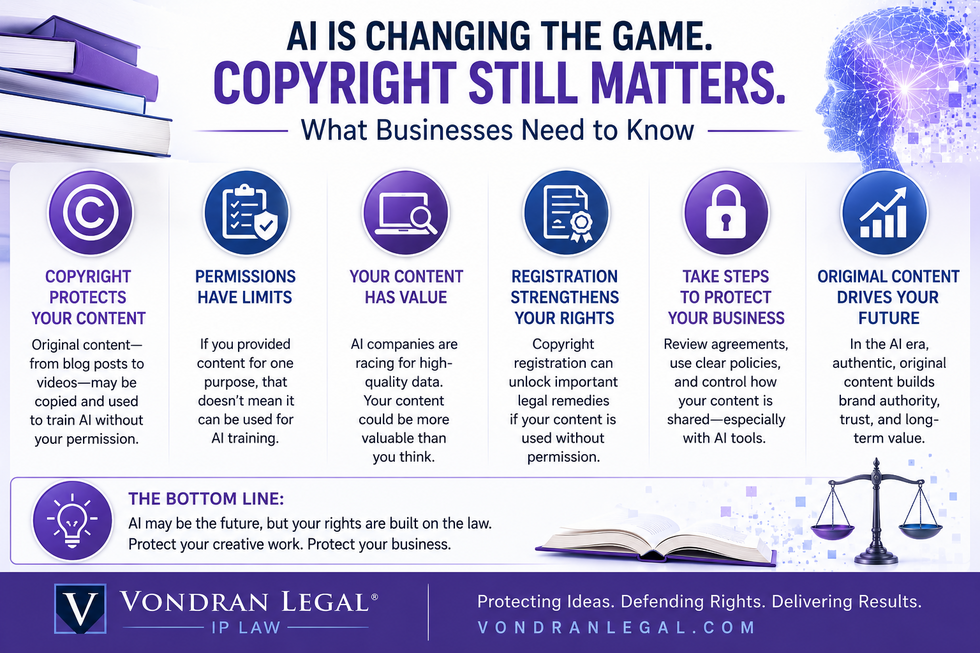
Businesses that properly protect their intellectual property are generally in a stronger legal position than those that do not.
Although copyright protection generally exists upon creation of an original work, federal copyright registration provides important procedural and enforcement benefits, including the ability to file an infringement lawsuit in a U.S. federal court and, in many circumstances, eligibility to seek statutory damages and attorney's fees. Those remedies can significantly affect litigation strategy.
For companies investing substantial time and resources into original content, registration should be part of a broader intellectual property strategy.
AI DOESN'T ELIMINATE COPYRIGHT LAW
One misconception continues to circulate:
"If AI created it, copyright no longer matters."
That simply is not how U.S. copyright law works.
Questions surrounding AI-generated outputs remain unsettled, and questions surrounding training data are even less settled.
Courts are now being asked to determine whether copying copyrighted works for AI development qualifies as fair use, requires licensing, or falls somewhere in between.
The answers may reshape intellectual property law for decades.
PRACTICAL STEPS BUSINESSES CAN TAKE TODAY
While the legal landscape continues to evolve, businesses should consider taking proactive measures.
1. Review Your Intellectual Property:
Identify your most valuable original content.
2. Register Important Copyrights:
Registration may provide stronger enforcement options if disputes arise.
3. Review Vendor Agreements:
Understand how AI platforms or third-party vendors may use uploaded materials.
4. Develop an Internal AI Policy:
Employees should understand what company materials may or may not be shared with AI platforms.
5. Continue Creating Original Content:
Authentic, high-quality content remains one of the strongest long-term business assets.
THE BIGGER PICTURE
The Google lawsuit is not just about books; it is about much bigger issues underlying the rise of AI, including ownership, permissions, and the rules governing how artificial intelligence can learn from the creative work of others.
Regardless of how this particular case is resolved, one thing is increasingly clear:
Original content has never been more valuable.
Businesses that proactively protect their copyrights, trademarks, proprietary materials, and digital assets will likely be better positioned as courts continue defining the legal boundaries of artificial intelligence.
At Vondran Legal®, we closely monitor developments involving AI, copyright, trademarks, technology law, and digital intellectual property. Whether your business is creating AI-powered products, publishing original content, or seeking to protect valuable creative assets, experienced legal guidance can help you navigate this rapidly changing landscape.
