
Meta tool seeks to stop infrginers: A Complete Legal Guide for Copyright Owners, Content Creators, and Businesses
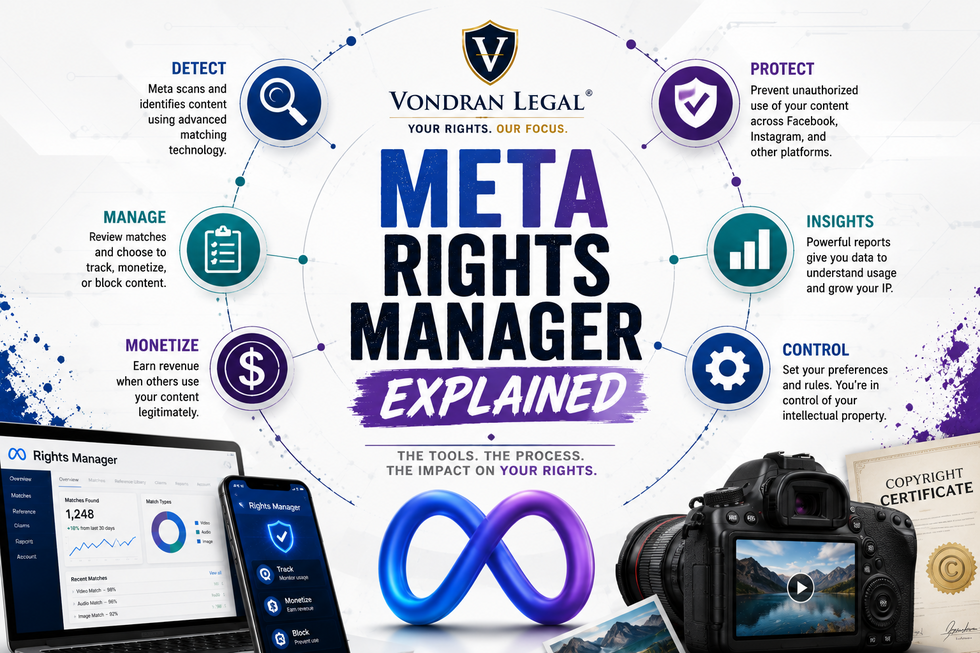
By Vondran Legal® | Copyright, DMCA & Social Media Attorneys
If your videos, photographs, music, podcasts, or other original content are constantly being copied on Facebook or Instagram, you may have heard about Meta Rights Manager. This powerful copyright enforcement platform allows eligible copyright owners to automatically detect and manage unauthorized uses of their content across Meta's platforms, including Facebook and Instagram.
Think of Meta Rights Manager as Facebook and Instagram's answer to YouTube's Content ID. Instead of manually searching for infringing posts and submitting dozens—or even hundreds—of DMCA takedown notices, Rights Manager allows qualifying copyright owners to upload reference files that Meta continuously compares against content uploaded by other users.
But despite its impressive capabilities, Rights Manager is not a magic solution. It has important limitations, it is not available to everyone, and many copyright disputes still require experienced legal counsel.
This guide explains everything creators and businesses should know.
What Is Meta Rights Manager?
Meta Rights Manager is an automated copyright protection system designed to help copyright owners identify and manage unauthorized use of their copyrighted works across Facebook and Instagram.
Once approved for access, users upload "reference files" of their original works into Rights Manager. Meta creates a digital fingerprint of those works and scans its platforms for matching uploads.
When a match is detected, the copyright owner can determine how Meta should respond.
Unlike traditional copyright enforcement—which depends largely on manual reporting—Rights Manager works continuously in the background.
What Types of Content Can Be Protected?
Rights Manager currently supports protection for many types of creative works, including:
-
Videos
-
Motion pictures
-
Short-form content
-
Audio recordings
-
Podcasts
-
Music
-
Images
-
Photographs
-
Certain live broadcasts
This makes the platform useful for:
-
YouTubers
-
Influencers
-
Photographers
-
Filmmakers
-
Sports leagues
-
News organizations
-
Publishers
-
Educational companies
-
Marketing agencies
-
Software training companies
-
Media businesses
How Rights Manager Works
The workflow is straightforward.
Step One: Apply for Access
Unlike YouTube Content ID, Rights Manager is not automatically available.
Meta reviews applications individually.
Applicants generally must demonstrate:
-
ownership of copyrighted content;
-
a legitimate need for automated copyright protection;
-
a Facebook Page; and
-
sufficient original content to justify access.
Step Two: Upload Reference Files
Once approved, the copyright owner uploads original files.
Examples include:
-
original videos;
-
master audio recordings;
-
original photographs; or
-
licensed works the applicant controls.
These become the "reference library."
Step Three: Meta Creates Digital Fingerprints
Meta analyzes each reference work and creates a digital fingerprint capable of recognizing matching content—even if users alter the file through compression, cropping, resizing, or minor edits.
Step Four: Continuous Platform Monitoring
Meta continuously scans uploads across Facebook and Instagram.
When content sufficiently matches a protected work, Rights Manager generates a match.
The copyright owner is then able to take action.
What Can Rights Manager Do?
Rights holders can generally choose among several enforcement options.
1. Block the Content
The content may be blocked:
-
worldwide;
-
in specific countries; or
-
within territories where rights are owned.
This is often appropriate when unauthorized uploads compete directly with the original.
2. Monetize the Match
Instead of removing the content, certain rights holders may claim advertising revenue generated from matching videos.
This resembles YouTube's Content ID monetization model.
3. Add Attribution
Rather than removing a post, Rights Manager can display attribution directing viewers to the original copyright owner.
Many publishers prefer this option because it increases traffic while preserving exposure.
4. Report Copyright Infringement
Rights Manager can also initiate copyright reporting that may result in removal of infringing material under Meta's copyright enforcement procedures.
Advantages of Rights Manager
The system offers several important benefits.
Automated Enforcement
Instead of searching manually for stolen content every day, Rights Manager continuously scans Meta's platforms.
For creators with hundreds or thousands of works, this saves enormous amounts of time.
Scalable Copyright Protection
Large content libraries become manageable.
Examples include:
-
educational courses;
-
online coaching programs;
-
fitness videos;
-
podcasts;
-
photography portfolios;
-
corporate marketing videos.
Faster Detection
Unauthorized uploads may be detected shortly after publication rather than weeks later.
Revenue Protection
Rather than allowing infringers to profit from copied videos, certain copyright owners may be able to redirect monetization.
Geographic Control
International rights holders can tailor enforcement according to territorial licensing arrangements.
The Biggest Drawbacks of Rights Manager
Despite its strengths, Rights Manager has limitations that many creators discover only after encountering a dispute.
It Is Not Available to Everyone
Perhaps the biggest frustration is simply obtaining access.
Many applicants are denied.
Meta has never published a complete checklist explaining exactly who qualifies. Access remains discretionary and depends on the applicant's overall circumstances.
It Does Not Decide Fair Use
Rights Manager detects matching content.
It does not determine whether the use is lawful.
The system generally cannot evaluate nuanced legal issues such as:
-
fair use;
-
commentary;
-
criticism;
-
parody;
-
news reporting;
-
educational uses;
-
implied license;
-
ownership disputes.
These remain legal questions requiring human analysis.
False Positives Can Occur
Automated matching systems occasionally identify content incorrectly.
Examples include:
-
licensed music;
-
collaborative projects;
-
public domain material;
-
authorized uses;
-
independently created content.
Users may dispute incorrect claims through Meta's internal processes.
It Cannot Replace Copyright Registration
One of the most common misconceptions is that Rights Manager "registers" copyrights.
It does not.
Uploading content into Rights Manager does not replace registration with the U.S. Copyright Office.
If litigation becomes necessary, registration of a U.S. work generally remains a prerequisite to filing an infringement lawsuit in federal court.
It Does Not Automatically Recover Damages
Rights Manager can:
-
block content;
-
monetize content;
-
provide attribution; or
-
facilitate reporting.
It cannot award:
-
statutory damages;
-
attorney's fees;
-
injunctions;
-
profits;
-
settlements.
Only courts can do that.
Rights Manager vs. DMCA Takedown Notices
Many creators ask whether Rights Manager replaces the Digital Millennium Copyright Act (DMCA).
The answer is no.
|
Rights Manager
|
DMCA
|
|---|---|
|
Automated detection
|
Manual reporting
|
|
Continuous monitoring
|
Individual notices
|
|
Requires Meta approval
|
Available to virtually any copyright owner
|
|
Can monetize matches
|
Primarily removes content
|
|
Detects future uploads
|
Targets identified infringements
|
Many sophisticated copyright owners use both systems together.
Rights Manager vs. YouTube Content ID
The comparison is natural.
Both systems:
-
create reference fingerprints;
-
detect matching uploads;
-
permit monetization;
-
provide blocking options.
However, YouTube's Content ID is generally considered more mature and widely deployed.
Meta Rights Manager continues expanding its capabilities and access.
When Should You Hire a Copyright Attorney?
Although Rights Manager automates many enforcement tasks, there are situations where legal counsel becomes essential.
Your Rights Manager Application Was Denied
An attorney can help evaluate:
-
ownership documentation;
-
licensing issues;
-
application deficiencies; and
-
alternative enforcement strategies.
Someone Files a Counterclaim or Dispute
When another user disputes ownership or asserts fair use, the legal issues become significantly more complex.
Legal analysis—not automated software—determines who is correct.
Your Content Generates Significant Revenue
If your business depends on original content, proactive copyright strategy is usually less expensive than reactive litigation.
A Competitor Is Systematically Copying Your Work
Large-scale infringement often requires:
-
cease-and-desist letters;
-
DMCA notices;
-
settlement negotiations;
-
preservation demands;
-
federal copyright litigation.
You Receive a False Copyright Claim
Not every Rights Manager claim is legitimate.
Businesses should obtain legal advice before admitting infringement or removing valuable content if ownership is genuinely disputed.
International Licensing Is Involved
Many companies own rights in only certain territories.
An attorney can coordinate licensing rights with Rights Manager's geographic enforcement settings.
Best Practices for Copyright Owners
To maximize protection:
-
Register important works with the U.S. Copyright Office.
-
Maintain organized records proving ownership.
-
Use written agreements assigning copyright from employees and contractors.
-
Monitor infringements consistently.
-
Develop an enforcement policy before problems arise.
-
Consider Rights Manager as one component of a broader intellectual property strategy.
Frequently Asked Questions
Is Meta Rights Manager free?
Generally, yes. Eligible copyright owners can apply without paying a licensing fee, although approval is not guaranteed.
Can I use Rights Manager for photos?
Yes. Meta expanded Rights Manager to include image matching technology, allowing photographers and visual creators to protect original images.
Does Rights Manager replace copyright registration?
No. Rights Manager is an enforcement tool, while copyright registration establishes important legal rights under U.S. copyright law.
Can Rights Manager determine fair use?
No. Automated matching identifies similarities, but fair use is a legal doctrine that depends on the facts of each case and, if disputed, may ultimately be resolved by a court.
Can small creators apply?
Yes. Meta has expanded eligibility over time, including to more independent creators and rights holders, but approval remains discretionary.
Conclusion
Meta Rights Manager is one of the most powerful copyright enforcement tools available for Facebook and Instagram. It enables qualifying creators, publishers, photographers, musicians, and businesses to automate much of the difficult work of detecting unauthorized uses of their original content. At the same time, it is not a substitute for a comprehensive intellectual property strategy. It does not resolve ownership disputes, determine fair use, replace U.S. copyright registration, or recover monetary damages.
For businesses whose intellectual property represents a significant investment, Rights Manager works best when combined with strong copyright registrations, carefully drafted licensing agreements, DMCA enforcement, and experienced legal counsel when disputes arise.
How Vondran Legal Can Help
At Vondran Legal, we represent creators, businesses, photographers, software companies, publishers, influencers, musicians, and online entrepreneurs in copyright protection matters throughout the United States. Our services include:
-
Copyright registration strategy
-
DMCA takedown notices and counter-notices
-
Meta Rights Manager guidance and disputes
-
YouTube Content ID and copyright claims
-
Copyright licensing and assignment agreements
-
Copyright infringement litigation
-
Federal court copyright actions
-
Fair use analysis and legal opinions
-
Settlement negotiations and enforcement strategies
If your original content is being copied online—or if you have received a copyright claim through Meta Rights Manager—experienced legal guidance can help protect your rights while minimizing unnecessary business disruption.

