
Why Short Contracts Can Create Big Legal Problems
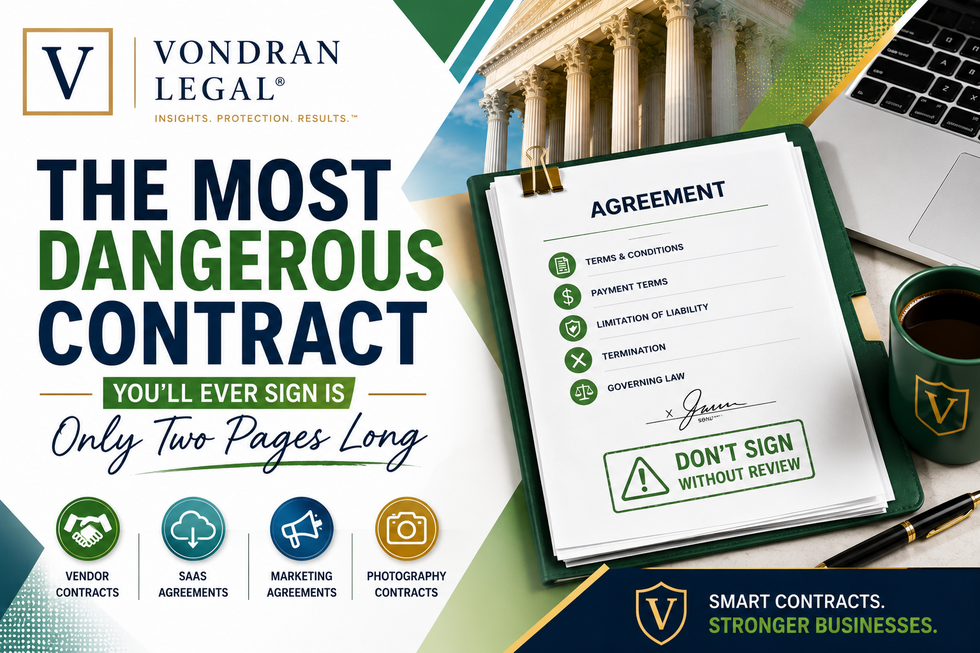
When people think about risky contracts, they usually picture a 75-page merger agreement or a complicated real estate transaction filled with legal jargon.
In reality, some of the most expensive legal disputes begin with a contract that takes less than five minutes to read.
A two-page vendor agreement.
A one-page photography contract.
A simple marketing proposal.
A software subscription agreement is accepted by clicking "I Agree."
At Vondran Legal®, we've seen firsthand how seemingly routine agreements can create significant legal issues months—or even years—after they're signed. The lesson is simple: the length of a contract rarely reflects its legal impact.
WHY SIMPLE CONTRACTS DESERVE SERIOUS ATTENTION
Businesses sign contracts every day.
Hiring a photographer.
Bringing on a marketing agency.
Subscribing to project management software.
Working with a freelance designer.
Ordering inventory from a supplier.
Because these agreements are routine, they're often signed without much thought.
Unfortunately, they're also where many businesses unknowingly give away valuable rights, assume unnecessary risks, or lock themselves into unfavorable terms.
The problem isn't always what's written in the contract.
Sometimes it's what's missing.
1. THE VENDOR AGREEMENT THAT LOCKS YOU IN
Vendor agreements are often treated as administrative paperwork.
They're anything but.
Buried in a few pages may be provisions that:
- Automatically renew the contract.
- Limit your ability to terminate early.
- Shift liability to your business.
- Require disputes to be resolved in another state.
- Restrict your ability to work with competitors.
Many business owners don't discover these provisions until they want to end the relationship.
By then, it may be too late.
Practice Takeaway
Before signing, ask:
- How can either party terminate?
- Is there an automatic renewal?
- Who bears responsibility if something goes wrong?
2. THE SAAS AGREEMENT YOU NEVER READ
Almost every business relies on cloud-based software.
Accounting platforms.
CRM systems.
Project management tools.
Email marketing software.
Most users click "Accept" without reviewing the terms.
Yet those online agreements frequently address issues such as:
- Ownership of uploaded content
- Data retention
- Account termination
- Service interruptions
- Limitation of liability
- Arbitration requirements
- Changes to the terms without notice
Many SaaS providers reserve broad rights while significantly limiting their own legal exposure.
Understanding those provisions before your business depends on the platform can help prevent unpleasant surprises later.
Practice Takeaway
If your business relies on software to operate, don't assume the legal terms are merely technical formalities.
3. THE MARKETING AGREEMENT THAT DOESN'T SAY WHO OWNS THE WORK
This is one of the most common issues businesses encounter.
A company hires a marketing agency to create:
- A logo
- Website content
- Videos
- Social media graphics
- Advertising campaigns
- Product photography
The business pays the invoice.
Months later, a dispute arises.
Who owns the work?
Many business owners assume that payment automatically transfers ownership.
Not necessarily.
Unless the agreement clearly addresses ownership or qualifies as a valid "work made for hire" arrangement under copyright law—or includes a proper assignment of rights—the creator may retain important intellectual property rights.
Practice Takeaway
Every creative services agreement should clearly define:
- Who owns the final deliverables?
- What rights each party retains.
- Whether the creator can reuse the work.
- Whether ownership transfers upon payment.
4. THE PHOTOGRAPHY CONTRACT THAT COSTS MORE THAN THE PHOTO SHOOT
Hiring a photographer seems straightforward.
You schedule the session.
Pay the invoice.
Receive the images.
But legal questions often arise later.
Can you:
- Use the photos in advertising?
- Print them on product packaging?
- Edit the images?
- Give them to another company?
- Use them indefinitely?
Many photography agreements grant only a limited license rather than transferring ownership of the copyright.
That distinction can become significant if the images later become part of your brand.
Practice Takeaway
If photographs will play an important role in your business, make sure the agreement clearly explains the scope of your rights—not just the price of the shoot.
WHAT EVERY SHORT CONTRACT SHOULD ANSWER
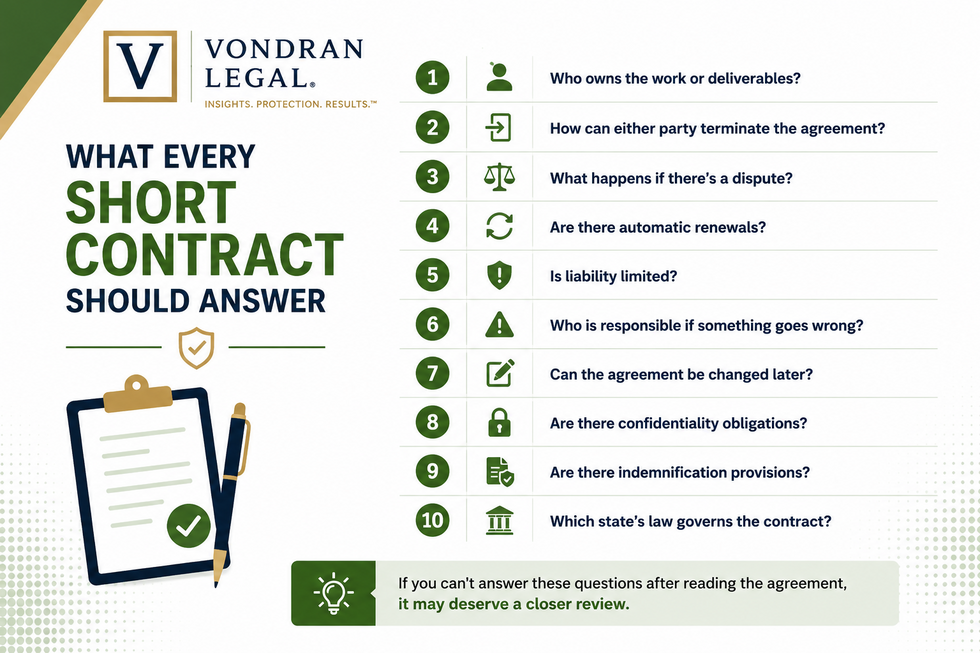
Before signing almost any business agreement, consider these questions:
- 1. Who owns the work or deliverables?
- 2. How can either party terminate the agreement?
- 3. What happens if there's a dispute?
- 4. Are there automatic renewals?
- 5. Is liability limited?
- 6. Who is responsible if something goes wrong?
- 7. Can the agreement be changed later?
- 8. Are there confidentiality obligations?
- 9. Are there indemnification provisions?
- 10. Which state's law governs the contract?
If you can't answer these questions after reading the agreement, it may deserve a closer review.
THE REAL COST OF SKIPPING THE FINE PRINT
Many business disputes don't arise from dishonesty.
They arise because each party believed the contract meant something different.
A few unclear sentences can determine:
- Who owns valuable intellectual property?
- Whether a business can terminate an agreement.
- Which party pays legal fees?
- Where litigation must occur.
- Whether damages are limited.
Those issues may seem insignificant when signing the agreement—but they often become the most important provisions when a dispute develops.
PRACTICAL TAKEAWAYS FOR BUSINESS OWNERS
The shortest contract on your desk may present the greatest legal risk.
Before signing routine agreements:
- Read every provision—not just the payment terms.
- Confirm who owns any creative work or intellectual property.
- Understand how and when the agreement ends.
- Look for automatic renewal clauses.
- Review the limitation of liability and indemnification provisions.
- Consider obtaining legal advice before signing agreements that affect important business relationships or valuable assets.
Contracts are designed to govern relationships when things don't go according to plan. Taking the time to understand those terms on the front end can help reduce uncertainty, protect your business, and avoid costly disputes later.
ABOUT VONDRAN LEGAL®
Vondran Legal® represents businesses, entrepreneurs, creators, technology companies, and entertainment professionals in matters involving business contracts, intellectual property, copyright, trademarks, licensing, and commercial disputes.
Whether you're hiring a marketing agency, negotiating a vendor agreement, or reviewing a software subscription, understanding your contractual rights before you sign can help protect your business long after the ink has dried.
