
YOUR NEXT PRIVACY CONCERN MAY NOT BE A PHONE — IT COULD BE SOMEONE'S GLASSES.
For years, people knew when they were being recorded. Someone had to pull out a phone, point a camera, or carry around a GoPro. That visual cue often gave people the opportunity to move away, object, or simply recognize they were on camera.
Those assumptions are rapidly disappearing.
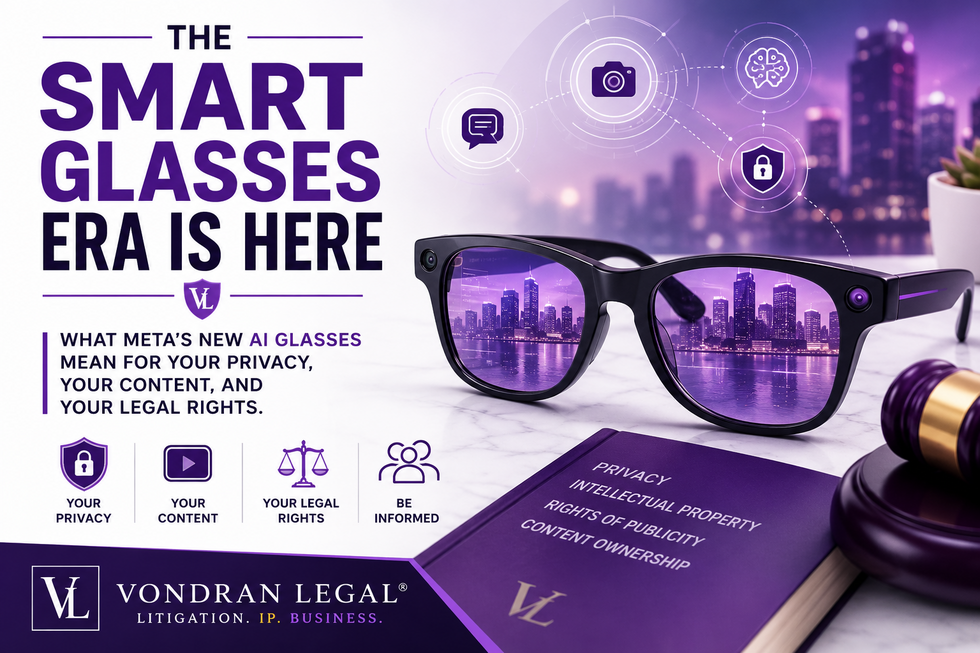
The latest generation of Meta AI smart glasses—including the highly publicized limited-edition Kylie Jenner collaboration—are bringing wearable AI cameras into everyday life. They look remarkably similar to fashion sunglasses, but they can capture photos, record video, livestream, answer questions using artificial intelligence, and increasingly understand the world around the wearer in real time.
The legal questions are just beginning.
As wearable AI becomes more socially acceptable, businesses, influencers, creators, employers, and ordinary people should understand that the law has not yet fully kept pace with the technology.
WHY THE KYLIE JENNER RELEASE MATTERS
The launch isn't just about another celebrity product—it represents something much bigger.
For the first time, AI-powered wearable cameras are becoming fashion accessories, making the technology more accessible and socially acceptable to everyday consumers. That shift has the potential to dramatically increase adoption.
Instead of early tech enthusiasts wearing obviously futuristic glasses, millions of people may soon wear devices that blend seamlessly into everyday clothing. As recording technology becomes increasingly invisible, expectations about privacy are likely to change.
The law, however, may not.
WHAT CAN META AI GLASSES ACTUALLY DO?
Today's Meta AI glasses can:
- Record video hands-free
- Take photographs
- Livestream directly to social media
- Listen to voice commands
- Use AI to answer questions about what the wearer is seeing
- Translate languages
- Identify landmarks and objects
- Read text aloud
- Integrate with Meta's AI assistant
While today's models still include an LED recording indicator, critics have questioned whether the small light is sufficient notice in crowded public environments.
Future versions will almost certainly become even smaller, smarter, and more difficult to distinguish from ordinary eyewear.
That raises significant legal and ethical questions.
CAN SOMEONE LEGALLY RECORD YOU WITHOUT YOUR PERMISSION?
The short answer is:
Sometimes.
Whether someone can legally record you depends on where you are, what is being recorded, and how that recording is ultimately used.
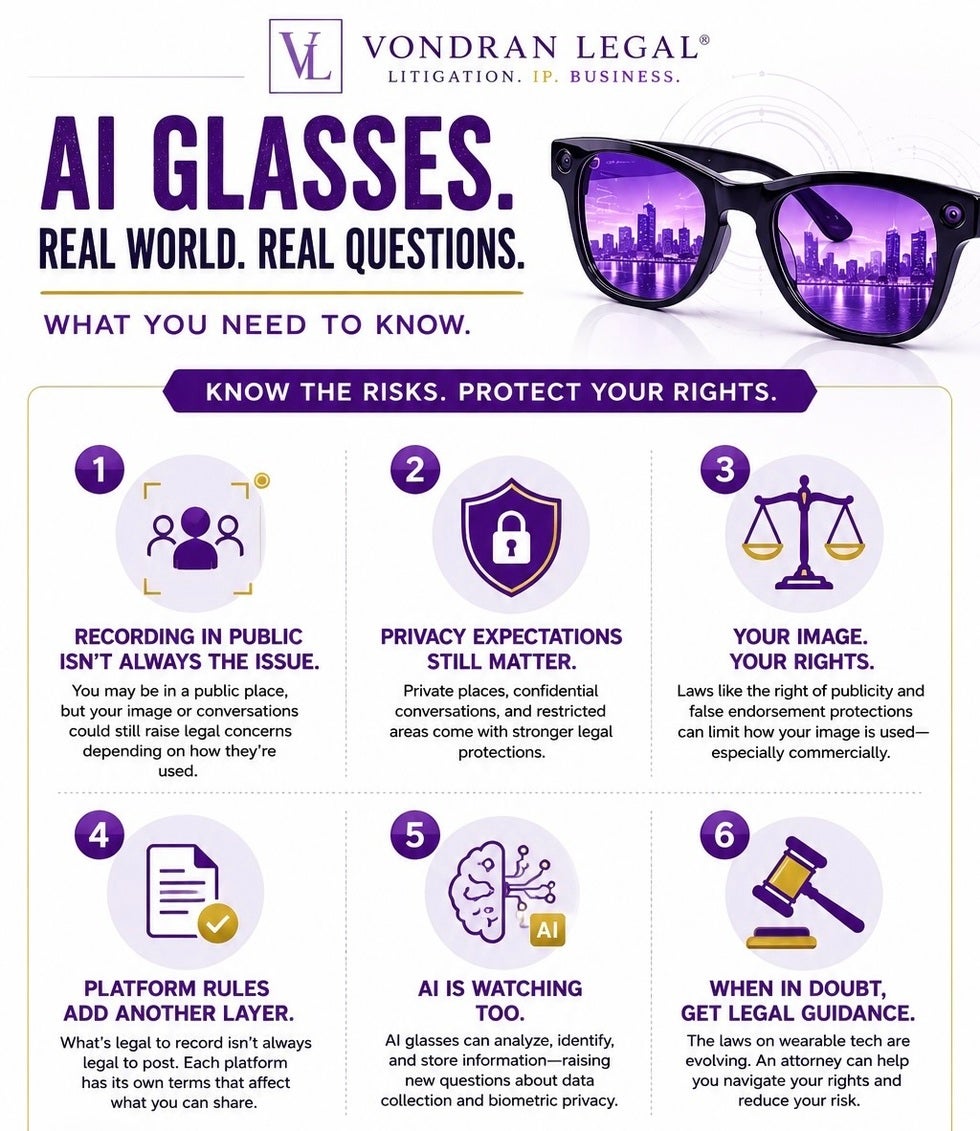
Many people mistakenly believe they always have the legal right to stop someone from filming them. In reality, U.S. law generally does not prohibit recording people who are in places where there is no reasonable expectation of privacy.
In Public Places
If you're walking down a public sidewalk, shopping at an outdoor market, attending a parade, or standing in a city park, someone may generally be permitted to photograph or record what is plainly visible in public.
However, that does not mean you have no rights.
The legal analysis can change if your image is later used to advertise a product, falsely suggest your endorsement of a business, reveal private information, or violate other privacy or publicity laws. Likewise, social media platforms often have their own policies that may allow you to report or request the removal of certain content—even when the recording itself was not unlawful.
If a photo or video of you has been posted online and you're wondering what options may be available, read our blog: How to Remove a Picture or Video of Yourself from the Internet: A Complete Guide.
When Recording Can Become a Legal Problem
Simply capturing someone's image is often only the beginning of the legal analysis.
Problems may arise when recordings are used in ways that have given rise to additional legal claims.
Examples include:
1. Commercial Use of Your Likeness
If someone uses your image to advertise a product or imply that you endorse a business, they may face claims involving the right of publicity or false endorsement under the federal Lanham Act and applicable state laws.
This issue becomes especially important for influencers, athletes, entertainers, and individuals whose identities have commercial value—but ordinary individuals may also have rights depending on the circumstances.
2. Recording Private Conversations
Video is one issue.
Audio is another.
Many states—including California—have laws restricting the recording of confidential communications without consent.
Someone secretly recording audio with wearable technology could create significant legal exposure, depending on where the recording occurred and the applicable state law.
3. Harassment or Stalking
Repeatedly recording someone, following them, or using AI-powered glasses to document their movements could support harassment, stalking, or invasion-of-privacy claims in appropriate circumstances.
Technology does not eliminate existing legal protections.
4. Recording Inside Businesses
Many businesses prohibit recording on their premises. Private businesses generally have the right to establish rules governing recording on their property.
Ignoring those policies can result in removal from the premises and, in some situations, additional legal consequences.
WHO OWNS THE VIDEOS YOU RECORD?
Many users assume:
"I recorded it, so I own everything."
Not necessarily.
While you may own the copyright in your original recording (subject to important exceptions), ownership of the recording does not automatically give you every legal right to publish or commercially exploit it.
The content may still imply:
- Rights of publicity
- Trademark law
- Copyright issues involving artwork, music, or performances
- Privacy rights
- Contractual restrictions
- Platform terms of service
Owning the file and having the legal right to use it are two different questions.
That distinction is becoming increasingly important as wearable AI devices become more common.
WHAT ABOUT CONTENT YOU CREATE USING META GLASSES?
Another overlooked issue involves what happens after you capture the footage.
Many users immediately upload recordings to:
- Threads
- YouTube
- TikTok
Once uploaded, additional platform terms may govern how your content is hosted, displayed, shared, and processed. Uploading content can involve licenses that allow the platform to operate and distribute your posts under its terms of service, even though you generally retain ownership of your original content.
Understanding the difference between copyright ownership and platform licenses is becoming one of the most important legal concepts for digital creators.
CAN AI ANALYZE THE PEOPLE YOU RECORD?
This may be one of the biggest legal frontiers.
Today's AI is increasingly capable of:
- Identifying objects
- Reading signs
- Recognizing products
- Translating conversations
- Describing surroundings
As these systems improve, questions arise about whether wearable AI could eventually infer identities, behaviors, routines, or other personal information from what it observes.
That raises broader concerns involving biometric privacy, data collection, consumer protection, and AI governance. Laws in these areas are evolving, and different jurisdictions are taking different approaches.
WHAT SHOULD BUSINESSES BE THINKING ABOUT?
Employers may soon face questions they have never had to answer before:
- Can employees wear AI glasses at work?
- Can confidential meetings be recorded?
- What happens if customer information is captured?
- Are trade secrets being documented?
- Should AI wearables be addressed in employee handbooks?
Businesses that already regulate smartphone use may want to consider whether those policies adequately address wearable AI devices.
PRACTICAL TIPS FOR EVERYDAY USERS
Before wearing AI smart glasses in public, consider asking yourself:
- Am I recording in a place where people reasonably expect privacy?
- Does this location prohibit recording?
- Am I capturing confidential conversations?
- Could someone believe I am using their image commercially?
- Am I uploading content that includes other identifiable people?
- Have I reviewed the platform's terms before posting?
These questions can help reduce legal risk while promoting respectful use of emerging technology.
THE BIGGER PICTURE
The legal debate surrounding Meta's AI glasses is not really about glasses—it is about something much larger. For decades, using a camera required a deliberate action. Someone had to pull out a phone, raise a camera, or make it obvious that they were recording. Today, cameras are becoming part of everyday clothing, making it easier than ever to capture moments without drawing attention.
As artificial intelligence continues to evolve, these devices may do far more than simply record the world around them. They may interpret what they see, summarize events, search for information, recognize objects, and potentially learn from what they observe. As these capabilities expand, lawmakers and courts will continue grappling with where privacy ends, where consent begins, and how existing laws apply to technology that barely existed when many of those laws were written.
Consumers, businesses, content creators, influencers, and employers should all pay close attention. The next major privacy lawsuit may not involve a hidden camera or sophisticated surveillance device—it may involve a pair of glasses that looked completely ordinary.
Final Thoughts
Wearable AI is advancing faster than the legal rules governing it. While recording in public is often lawful, using that footage—especially for commercial purposes, in private settings, or when confidential communications are involved—can create significant legal issues. Businesses, content creators, and everyday consumers should not assume that new technology changes long-standing privacy, publicity, copyright, or consent laws. As AI-powered wearables become more common, understanding these legal boundaries will become increasingly important.
